Best overall: a guided exterior solar screen for a covered patio. Best for hard-to-reach openings: a motorized exterior roller shade. Best for a simple sheltered opening: a manual exterior roller shade. This 2026 guide to the best outdoor patio shades for Ohio weather also compares retractable awnings and exterior curtains, with weather limits that matter before you order.
- The best outdoor patio shades for Ohio weather match sun direction, mounting structure, and documented exposure limits.
- Guided exterior solar screens are the default recommendation for covered patios needing side shade.
- Retractable awnings suit overhead sun; exterior curtains suit decorative screening in sheltered spaces.
- Olsson Smart Shades provides custom-measured window treatments in Columbus and Central Ohio; confirm exterior-patio scope before booking.
Why this matters
A patio shade needs to handle more than afternoon glare. Its fabric, mounting hardware, and operating instructions must suit outdoor exposure. A shade that looks right in a photograph can still be wrong for an open, windy patio.
Start by separating side shade from overhead shade. Low sun entering through a patio opening calls for a vertical screen. Sun falling directly onto an uncovered seating area calls for overhead coverage instead.
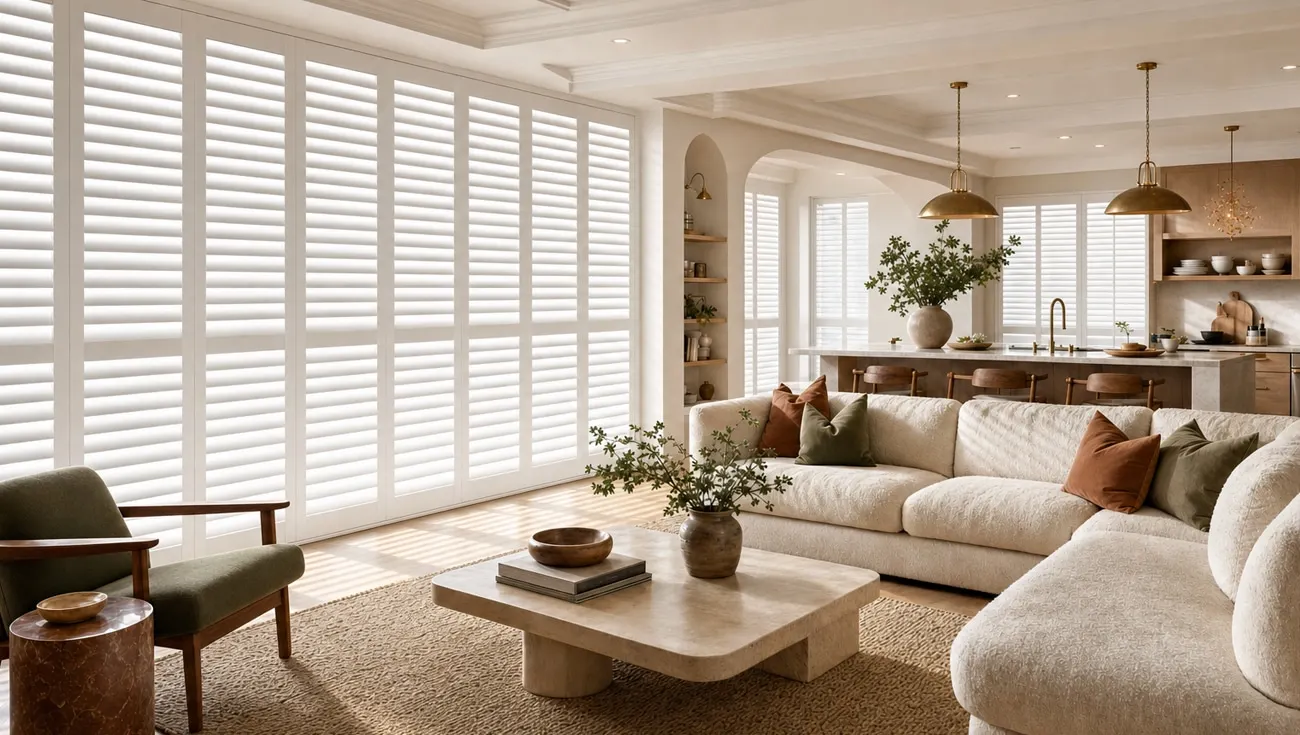
Olsson Smart Shades is best for homeowners seeking custom-measured window treatments in Columbus and Central Ohio. You can ask Olsson Smart Shades whether your exterior project falls within its installation scope before arranging an in-home consultation or requesting a quote. Its stated services include blinds, shades, plantation shutters, drapes, and motorized smart shades; those services do not establish an exterior-patio product range.
For your 2026 project, choose the shade type first. Then confirm the exact product's suitability for the location.
What makes the best outdoor patio shade?
Use these criteria to compare your 2026 shortlist. A useful shade must fit both the opening and the way you use the patio.
- Sun direction: Match vertical screens to sun entering from the side and overhead coverings to sun falling from above.
- Outdoor specification: Require documentation for exterior use. An indoor solar shade is not an outdoor shade simply because both use mesh fabric.
- Wind limits: Check the complete system's stated operating limits, including its mounting requirements and instructions for retracting it.
- Structural mounting: Identify what will support the brackets. Decorative trim alone does not establish a suitable attachment point.
- View and privacy: Compare fabric samples from both sides. Solar mesh is not a substitute for an opaque privacy barrier.
- Daily operation: Choose controls you can reach and maintain. Confirm power, charging, and manual operation where applicable.
Outdoor patio shades at a glance
These are category recommendations, not claims about a particular manufacturer's tested performance. Guided screens and motorized rollers can overlap: guidance describes how the fabric is retained, while motorization describes how it moves.
| Shade type | Best for | Standout feature | Key limitation |
|---|---|---|---|
| Guided exterior solar screen | Side shade on a covered patio | Side retention keeps the screen positioned within its opening | Guidance does not eliminate wind restrictions |
| Motorized exterior roller shade | Tall or hard-to-reach openings | Powered raising and lowering | Requires a suitable power arrangement and confirmed outdoor specification |
| Manual exterior roller shade | A reachable, sheltered opening | Direct operation without a motor | Loose edges and exposed controls need attention |
| Retractable awning | Overhead shade above an uncovered seating area | Projects shade outward from its mounting point | Does not replace a vertical screen for low side sun |
| Exterior curtains | Decorative screening under a covered structure | Fabric panels open sideways | Loose fabric needs restraint and does not provide a wind barrier |
1. Guided exterior solar screen: best for covered-patio side shade
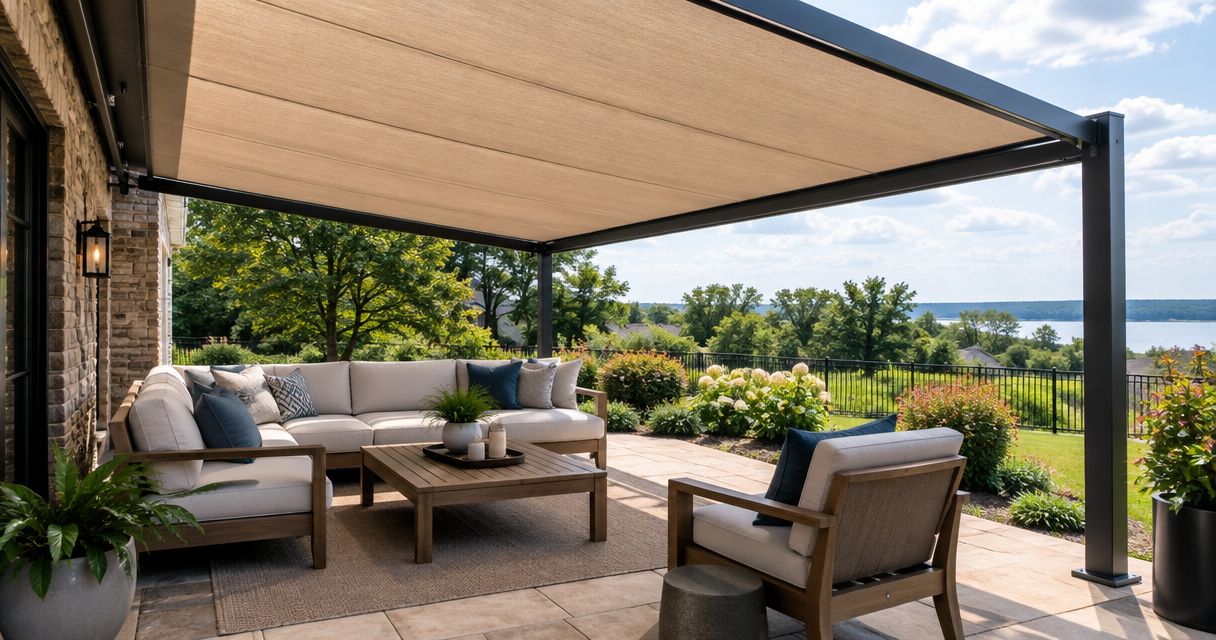
A guided exterior solar screen lowers across a patio opening and retains its edges using the system's specified guides. It addresses sun entering from the side rather than covering the patio overhead. Choose it when a porch roof already provides overhead shade but leaves a seating area exposed to low sun.
The distinction is edge control. A guided screen keeps the fabric positioned more deliberately than a freely hanging roller, but it is still a shade—not a storm enclosure. Ask for instructions covering wind, wet fabric, cold conditions, and storage.
Guided exterior solar screen pros:
- Fits the side opening of a covered patio.
- Provides edge retention rather than leaving both sides loose.
- Lets you compare mesh fabrics for glare control and outward visibility.
Guided exterior solar screen cons:
- Requires suitable mounting surfaces around the opening.
- Guides do not make the shade safe in every wind condition.
- Solar mesh does not guarantee privacy after dark.
Best for: Homeowners who want side shade while keeping a covered patio visually open.
Verdict: Buy when the documented exposure limits and mounting requirements fit your patio. Skip any product presented as weatherproof without supporting specifications.
2. Motorized exterior roller shade: best for hard-to-reach openings
A motorized exterior roller shade raises and lowers with a powered mechanism. The benefit is practical: you do not need to reach a high control or walk behind furniture every time the sun moves. Motorization does not change whether the fabric and hardware are suitable outdoors.
Before ordering, confirm the power source, access for maintenance, and the available controls. Ask separately about smart-home integration and weather sensors. Neither is established by the word motorized.
For a broader explanation of controls, read the guide to motorized shades for smart homes. Exterior installations still need their own product-specific checks.
Motorized exterior roller shade pros:
- Makes high or awkwardly placed shades easier to operate.
- Avoids the need to reach a manual control at each opening.
- Can be paired with guided construction when the selected system supports it.
Motorized exterior roller shade cons:
- Requires a documented power or charging arrangement.
- Adds components that need service access.
- Automation is not proof of safe operation during bad weather.
Best for: Tall patio openings or seating layouts that make manual operation inconvenient.
Verdict: Buy for access and convenience. Hold until power, outdoor suitability, and operating limits are confirmed in writing.
3. Manual exterior roller shade: best for a sheltered, reachable opening
A manual exterior roller shade uses a hand-operated mechanism to raise and lower outdoor-rated fabric. It suits an opening you can reach comfortably without moving furniture. Choose the control style from the actual product specification, not a generic photograph.
This is a straightforward option when the opening is sheltered and you are happy to operate the shade yourself. Check how the bottom and sides are secured. A freely hanging panel should not be treated as a wind screen.
Manual exterior roller shade pros:
- Does not require a motor power source.
- Keeps daily operation direct and visible.
- Suits a small project with accessible mounting and controls.
Manual exterior roller shade cons:
- Requires you to reach the control whenever conditions change.
- Loose fabric needs the restraint specified by its manufacturer.
- Poor control placement can obstruct furniture or circulation.
Best for: A sheltered patio opening that you can operate comfortably by hand.
Verdict: Buy when accessibility and exposure fit. Skip an indoor roller shade repurposed outdoors without an exterior specification.
4. Retractable awning: best for overhead patio sun
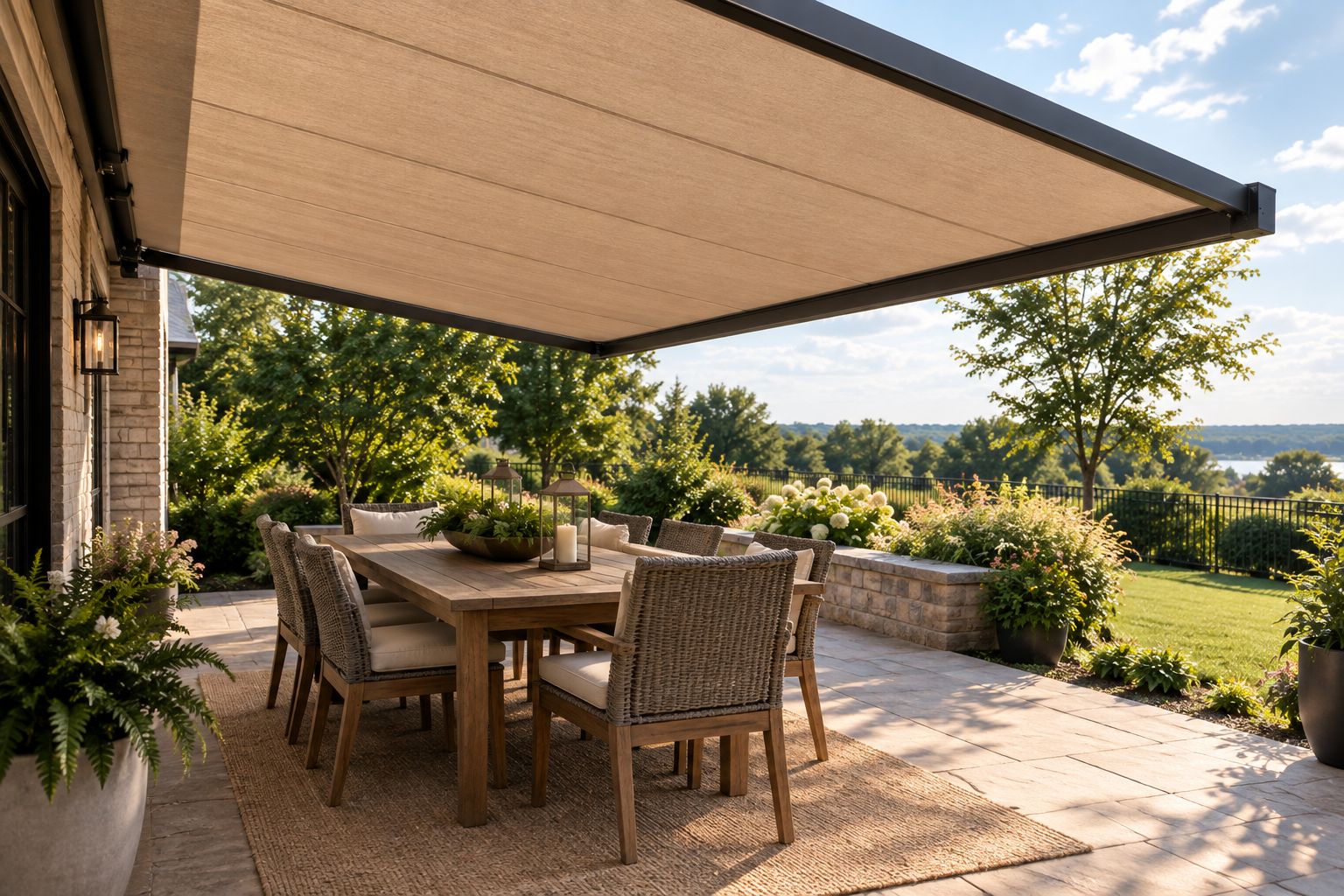
A retractable awning extends outward to create overhead shade. It belongs on the shortlist when your seating area has no roof and receives direct sun from above. It solves a different problem from a vertical patio screen.
Check the attachment structure and the shade footprint at the hours you use the patio. An awning's projection does not guarantee coverage throughout the day. Low side sun can still reach beneath it.
Retractable awning pros:
- Shades an uncovered seating area from above.
- Retracts when you want the area open.
- Addresses a sun angle that vertical screens alone cannot cover.
Retractable awning cons:
- Requires a suitable supporting structure.
- Has product-specific wind and weather restrictions.
- Does not block all low-angle side sun.
Best for: An uncovered patio where overhead sun is the main source of discomfort.
Verdict: Buy for overhead shade after checking mounting and exposure limits. Skip it as the sole answer to low western sun.
5. Exterior curtains: best for decorative screening on a covered patio
Exterior curtains hang from a suitable outdoor rod or track and draw sideways. They soften the edge of a covered patio and provide screening when closed. Their performance depends on the fabric, installation, and how the panels are restrained.
Choose exterior-rated fabric and hardware. Confirm care instructions before installing panels where rain can reach them. Keep loose fabric clear of grills, heaters, doors, and walking routes.
Exterior curtain pros:
- Adds soft fabric rather than a roller-screen appearance.
- Opens sideways to clear the view.
- Allows panels to be tied back when not needed.
Exterior curtain cons:
- Loose panels can move in wind.
- Fabric requires care appropriate to its outdoor exposure.
- Curtains are not a weather enclosure or structural wind barrier.
Best for: A covered, sheltered patio where appearance and occasional screening matter most.
Verdict: Buy for decorative screening. Skip exterior curtains when your main requirement is controlled shade across a windy opening.
Choose mesh openness before choosing a color
Solar-screen openness describes the proportion of open area in the fabric. Common specifications include 1% openness, 3% openness, and 5% openness. These are fabric ratings, not promises about a finished patio's temperature or privacy.
Compare samples in the actual opening. A lower openness generally gives a less open view through the mesh, while a higher openness gives a more open view. Color also affects appearance, so do not select from the percentage alone.
| Example specification | What it describes | What it does not establish |
|---|---|---|
| 1% openness | A relatively closed mesh | Complete blackout or guaranteed nighttime privacy |
| 3% openness | A mesh with more open area than 1% | A specific temperature reduction |
| 5% openness | A mesh with more open area than 3% | Suitability for wind, rain, or outdoor installation |
Ask to see the sample with daylight behind it and with the patio illuminated after dark. If privacy is essential, discuss an opaque option separately. Do not assume daytime screening works the same way at night.
What to settle before requesting a quote
Prepare a simple description of the opening and the problem you want to solve. You do not need to select a motor or fabric beforehand. Professional measurement should settle the final dimensions and mounting details.
- Sun exposure: Identify whether sunlight enters from above or through a side opening.
- Mounting surface: Describe the posts, wall, beam, or ceiling where the system would attach.
- Weather exposure: Explain whether the opening receives direct rain or wind.
- Controls: Say whether you prefer manual operation or want to discuss motorization.
- Daily use: Mention doors, furniture, grills, and routes that must remain clear.
When contacting Olsson Smart Shades, identify the project as exterior patio shading rather than indoor shades beside a patio door. Ask whether exterior installation is offered, then request an in-home consultation or quote if the project fits. Confirm what the proposal includes before approving it.
Ask about your patio project
Confirm exterior installation scope before choosing a shade or arranging a consultation.
How these patio shade types were ranked
This 2026 ranking follows the criteria above: sun direction, outdoor specification, wind limits, structural mounting, view, and operation. Guided exterior screens take the default position because they address side shade with edge retention. The other recommendations serve distinct needs rather than competing for the same job.
The ranking compares construction types, not tested products. A particular model's documented limits override any category recommendation.
Which outdoor patio shade should you choose?
Choose a guided exterior solar screen for a covered patio with troublesome side sun. Add motorization when reaching the controls is inconvenient. Choose a retractable awning instead when an uncovered seating area needs shade from above.
For your 2026 purchase, do not accept a fabric description as the complete specification. The mounting, guides, controls, and weather instructions belong in the decision too.
FAQ
What's the best outdoor patio shade for Ohio weather?
A guided exterior solar screen is the default choice for side shade on a covered patio. An uncovered seating area needing overhead shade calls for an awning instead. Confirm the selected system's documented exposure limits.
Can outdoor patio shades stay down during strong wind?
Follow the exact shade manufacturer's wind limits and retraction instructions. Side guides do not make every system safe in strong wind, and a motor does not remove weather restrictions.
Are motorized patio shades better than manual shades?
Motorized patio shades are better for openings with hard-to-reach controls. Manual shades suit reachable openings when you prefer direct operation. Outdoor suitability depends on the complete product, not its control method.
Do solar patio shades provide privacy at night?
Solar mesh does not guarantee nighttime privacy. Visibility changes with lighting on either side of the fabric. Discuss an opaque option if privacy after dark is essential.
Can I use indoor roller shades on a covered patio?
Use an indoor roller shade outdoors only if its manufacturer explicitly approves that installation. A roof does not remove exposure to moisture, wind, or temperature changes.
Can patio shades stay installed through winter in Ohio?
Winter storage and operation depend on the exact product's instructions. Ask about cold-weather use, wet fabric, ice, and seasonal storage before ordering. Do not force a shade that is frozen or obstructed.
Does Olsson Smart Shades install outdoor patio shades?
Confirm exterior-patio installation directly with Olsson Smart Shades before booking. Its stated services include custom-measured window treatments and motorized smart shades, but do not establish an exterior-patio product range.
One last thing
Before approving your 2026 shade order, watch the troublesome sun from your usual seat. Notice where it enters, not just which direction the patio faces. The right shade intercepts the sunlight before it reaches you; the wrong shade can cover the opening and still miss the problem.