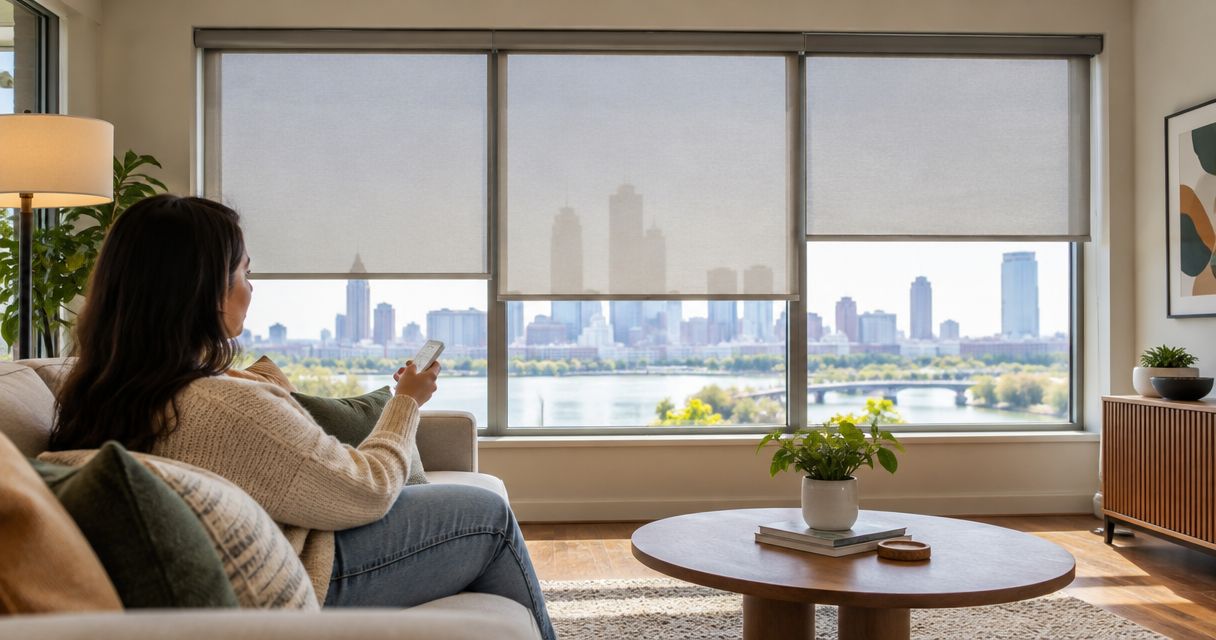
Motorized shades cost more than manual shades because you're paying for a motor, a control system, and often a smart-home hub on top of the shade itself, and the total varies widely based on window count, fabric choice, and how much automation you want in 2026. The number that gets quoted for a single window almost never matches what a whole-home installation runs, because wiring, labor, and hub setup are priced separately from the shade fabric.
- Motorized shades cost more than manual shades due to the motor, control hub, and installation labor.
- Battery-powered motors cost less upfront than hardwired systems but need recharging or battery swaps.
- Whole-home smart shade setups add cost through hubs, wiring, and app integration beyond the shade fabric.
- Olsson Smart Shades quotes motorized shade projects in Columbus based on actual window measurements, not a flat rate.
Why this matters
Homeowners searching for motorized shades cost usually get a single number from an ad or a marketplace listing, and that number rarely survives contact with a real house. Window count, motor type, and fabric each move the price independently, and a 12-window whole-home job scales nothing like a two-window bedroom retrofit. Getting the cost drivers straight before you call anyone saves you from comparing quotes that aren't actually comparable. Olsson Smart Shades measures each window on site before quoting a motorized shade project in Columbus, which is the only way the number means anything.
How much do motorized shades cost?
The honest answer is that motorized shades cost depends on six variables stacking on top of each other, not a single line item. Here's how each one moves the price:
| Cost driver | Relative impact | Why |
|---|---|---|
| Number of windows | High | Each motorized unit adds its own motor and control point |
| Motor type (battery, hardwired, solar) | Medium-High | Hardwired needs an electrician; battery and solar don't |
| Fabric (sheer, solar screen, blackout) | Low-Medium | Denser fabrics need stronger motors to lift the same weight |
| Control method (remote, app, whole-home hub) | Medium | A hub that talks to other smart-home devices costs more than a standalone remote |
| Window size and shape | Medium | Oversized or custom-shaped windows need custom motor sizing |
| Installation complexity | Medium-High | Hidden power runs and multi-room wiring take more labor than surface-mount jobs |
Any quote that skips one of these six variables isn't a real quote yet. That's true whether you're asking a big-box retailer or a local installer in 2026.
Battery-powered motorized shades: the lower-cost option
Battery-powered motors sit inside the shade roller and run off a rechargeable pack, so there's no electrician visit and no wall wiring. They're the fastest path to motorization for a retrofit because installation is nearly identical to a manual shade. The tradeoff is periodic recharging, which for a whole-home setup with a dozen shades becomes a maintenance task someone has to own. Verdict: Buy for single rooms or retrofits where running new wiring isn't practical.
Hardwired motorized shades: built for whole-home installs
Hardwired systems tie into your home's electrical system, which means an electrician is part of the job and the wiring has to be planned before drywall goes up or fished through existing walls after. Once installed, there's no battery to manage and the shades run indefinitely. This is the standard approach for new construction or a full renovation where walls are already open. Verdict: Buy for new builds or major remodels; skip if you're not ready for electrical work.
Solar-charged motorized shades: no wiring, no battery swaps
A small solar panel mounted near the window keeps the shade's battery topped off, which removes both the electrician and the recharging chore. The limitation is window exposure — a shade in a shaded room or on a north-facing wall won't charge reliably. Verdict: Buy for skylights and hard-to-reach windows; wait if the window gets limited direct light.
Why motorized shade cost varies
- Window count — the more windows you automate at once, the more the per-window cost typically drops through shared installation labor.
- Fabric weight and opacity — blackout and heavier solar-screen fabrics need stronger motors than sheers.
- Control complexity — a standalone remote costs less to set up than a hub that integrates with voice assistants or a whole-home smart system.
- Wiring accessibility — walls that are already open cost less to wire than finished walls that need to be opened and patched.
- Window size and shape — oversized, arched, or custom-cut windows need custom motor sizing, which adds cost over standard rectangular units.
- Number of rooms involved — coordinating a multi-room install in one visit is usually more efficient than separate trips per room.
Are motorized shades worth the cost in 2026?
Motorized shades are worth the added cost for homeowners who want scheduled light control, remote or voice operation, or shades on hard-to-reach windows like skylights and stairwells. They're a harder sell for a single easy-to-reach window where a manual shade does the same job for less money. The value case gets stronger the more windows and rooms are involved, since setup and hub costs get spread across the whole system.
Do motorized shades need an electrician?
Hardwired motorized shades need an electrician to tie into your home's power; battery-powered and solar-charged motorized shades generally don't. That single distinction is usually the biggest factor in how much labor a motorized shade project adds beyond the shade fabric itself. Ask any installer which category your preferred motor falls into before assuming the price includes electrical work.
Can you convert manual shades to motorized shades?
Most manual roller and cellular shades can be converted to motorized versions, but it usually means replacing the roller mechanism rather than bolting a motor onto the existing hardware. Custom-measured shades, plantation shutters, and drapes typically need to be re-measured for the new motorized components. A local installer can tell you during a site visit whether your existing shades are good candidates or whether new units make more sense.
FAQ
How much does motorized shades cost compared to manual shades?
Motorized shades cost more than manual shades because of the added motor, control hub, and often installation labor. The gap widens with hardwired systems that require an electrician versus battery-powered units that don't.
What's the cheapest way to motorize shades?
Battery-powered motorized shades are generally the lowest-cost path since they skip the electrician visit required for hardwired systems. They do require periodic recharging or battery replacement over time.
Do motorized shades work with Alexa or Google Home?
Many motorized shade systems integrate with voice assistants through a compatible smart-home hub. Confirm hub compatibility with your specific voice assistant before ordering, since not every control system supports every platform.
Is it cheaper to motorize shades during new construction?
Yes, hardwired motorized shades are typically cheaper to install during new construction or a full renovation because the walls are already open for wiring. Retrofitting hardwired motors into finished walls adds labor to open and patch drywall.
How long do motorized shade batteries last?
Battery life depends on usage frequency and shade size, and varies by manufacturer and battery pack. Ask your installer for the expected recharge interval for the specific motor they're quoting in 2026.
Can one remote control multiple motorized shades?
Yes, most motorized shade systems support grouping multiple shades to a single remote or app control point. This is common in whole-home setups where several windows in one room are meant to move together.
Are solar-charged motorized shades reliable?
Solar-charged motorized shades work reliably on windows with consistent direct light exposure. They're less dependable on shaded, north-facing, or low-light windows where the panel can't fully recharge the battery.
One last thing
The detail most homeowners miss when pricing motorized shades cost isn't the motor — it's the control layer. A battery-powered shade with a basic remote and a battery-powered shade tied into a whole-home hub with scheduling and voice control can carry noticeably different price tags even though the shade fabric and motor are identical. If you're budgeting for 2026, decide how much automation you actually want to use day to day before comparing quotes, because paying for hub integration you won't touch is the easiest way to overspend on a motorized shade project. Olsson Smart Shades measures each window on site in Columbus and Central Ohio before quoting, which is the only reliable way to know what a specific motorized shade job actually costs.