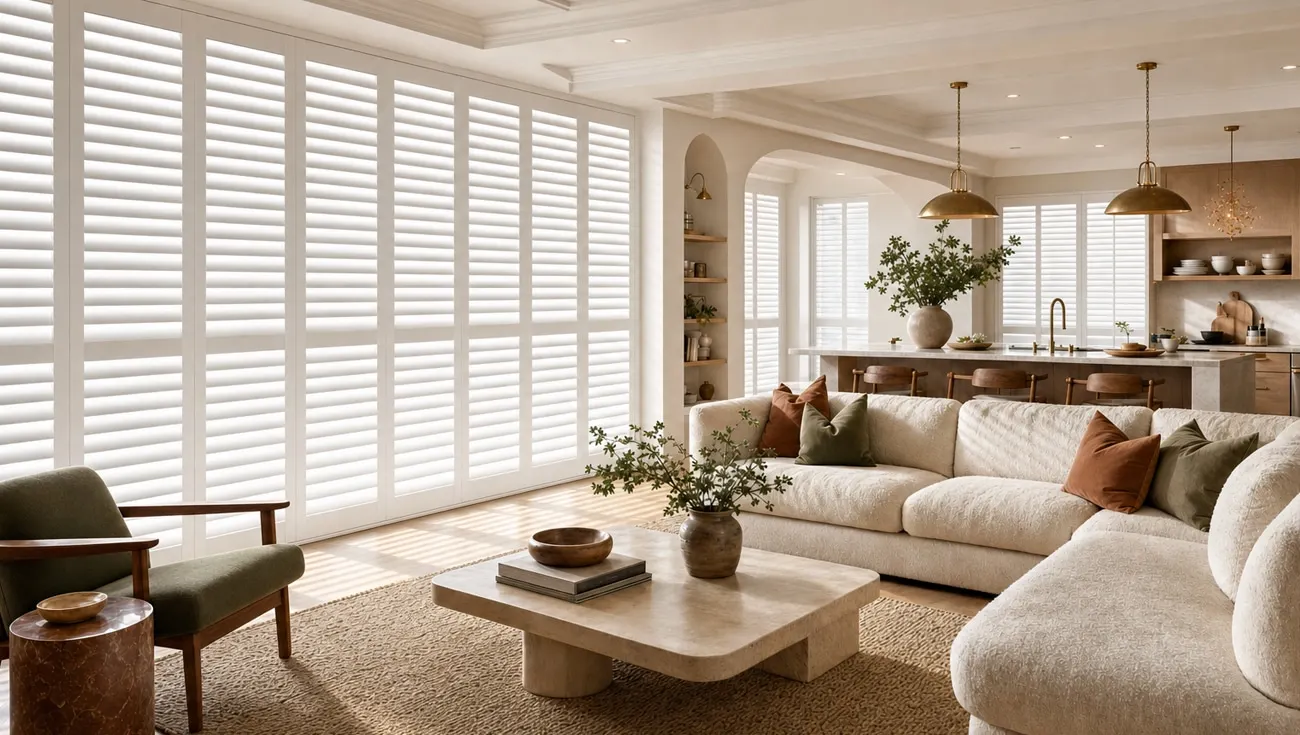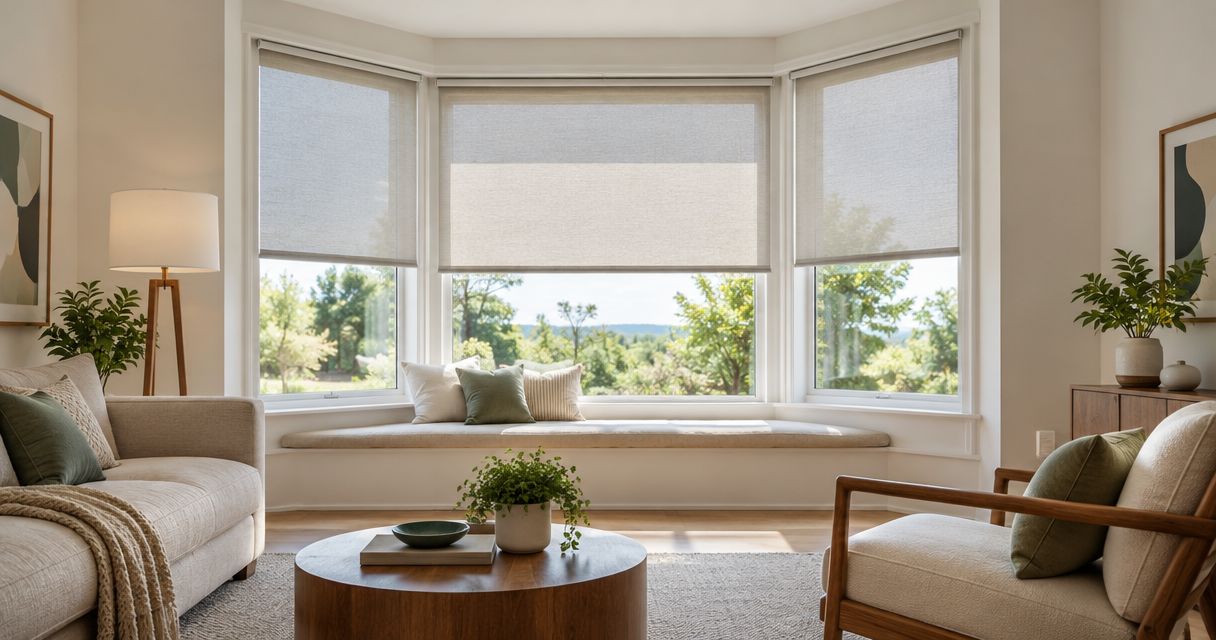
Best overall: motorized roller shades. Best for insulation: motorized cellular shades. Best for a tailored fabric look: motorized Roman shades. Best for daytime glare with a view: motorized solar shades. For motorized shades for bay windows in 2026, start with the window angles and mounting space, then choose the fabric and controls.
- Motorized roller shades are the best starting point for bay windows when you want a simple, uncluttered treatment.
- Choose motorized cellular shades when insulation matters more than seeing through the lowered fabric.
- Choose motorized Roman shades for decorative folds; check clearance where neighboring shades meet.
- Olsson Smart Shades provides custom-measured motorized shades for bay windows in Columbus and Central Ohio.
Why this matters
A bay window is a group of windows that meet at angles. Each shade needs room to move without rubbing its neighbor, catching a handle, or blocking an opening window.
Olsson Smart Shades is best for Columbus and Central Ohio homeowners seeking custom-measured, professionally installed motorized shades. You can start with Olsson Smart Shades when you want help connecting the measurements, fabric choice, and installation plan.
For a 2026 project, separate the decisions. The shade style determines how the window looks and filters light; the motor determines how you operate it. Neither solves a poor fit.
What makes the best motorized shades for bay windows
Judge each option against these criteria before choosing a fabric:
- Corner clearance: Neighboring headrails, brackets, and moving fabric must clear each other at the bay's angles.
- Mounting depth: Check the complete assembly, including the motor housing and any decorative cover, against the available recess.
- Privacy: Match the fabric to daytime and nighttime needs. A view-through material is not a substitute for nighttime privacy.
- Raised profile: Consider how much glass the treatment covers when fully raised, especially above a window seat.
- Power access: Choose a power arrangement you can maintain without moving furniture or climbing over seating.
- Useful controls: Ask for individual operation as well as grouped operation when different parts of the bay receive different light.
Motorized bay-window shades at a glance
These are shade categories, not named product models. Confirm the dimensions, motor options, fabric, and mounting requirements for the actual system before ordering.
| Rank and shade type | Best for | Standout feature | Key limitation |
|---|---|---|---|
| 1. Motorized roller shades | A simple everyday treatment | Fabric rolls onto a tube above the glass | Fabric coverage is narrower than the complete assembly |
| 2. Motorized cellular shades | Insulation-focused rooms | Cellular pockets hold air within the shade | Opaque fabrics remove the view when lowered |
| 3. Motorized Roman shades | A decorative fabric finish | Fabric forms folds when raised | The raised stack occupies space above the view |
| 4. Motorized solar shades | Daytime glare with outward visibility | Open-weave fabric filters sunlight | Not a dependable nighttime privacy treatment |
1. Motorized roller shades: best for a simple everyday bay
Motorized roller shades raise fabric onto a tube and lower it across the glass. Their straightforward shape makes them a useful starting point when you want the bay's trim, seating, or view to remain the focus.
Choose the fabric separately from the operating system. Light-filtering fabric softens daylight; an opaque blackout fabric blocks light through the material, but does not eliminate light around the edges.
Motorized roller shades pros:
- A simple shape suits a bay with several adjoining windows.
- Fabric choices let you prioritize filtered light or room darkening.
- Separate shades let you treat each opening independently.
Motorized roller shades cons:
- Hardware takes up width beyond the fabric, leaving edge gaps.
- Adjacent roller assemblies need clearance at angled corners.
- A recessed fit depends on the chosen assembly's depth.
Ask to see both the overall shade width and the actual fabric width on the order. That distinction matters beside narrow trim and where angled windows meet.
Best for: Homeowners who want an uncluttered treatment and straightforward daily operation.
Verdict: Buy motorized roller shades if the measured corner clearances work and edge light is acceptable.
2. Motorized cellular shades: best for insulation-focused rooms
Motorized cellular shades use a folded cellular structure that holds air within the material. They are the stronger starting point when you want an insulating window covering rather than a view through the lowered shade.
The fabric still controls privacy and light. Compare samples in the actual room instead of assuming that every cellular fabric creates the same effect.
Motorized cellular shades pros:
- The cellular structure adds an insulating layer at the window.
- Light-filtering and room-darkening fabric choices serve different rooms.
- The material compresses into folds as the shade rises.
Motorized cellular shades cons:
- Opaque fabric blocks the view when lowered.
- Pleats create a different appearance from a smooth roller shade.
- Special operating features require confirmation for the selected motorized system.
For a 2026 bedroom project, discuss room darkening and edge light together. An opaque cellular fabric does not seal the entire window opening. Do not assume that motorization includes top-down operation, either; ask whether the exact configuration supports it.
Best for: Bay-window bedrooms or sitting areas where an insulating covering takes priority over outward visibility.
Verdict: Buy motorized cellular shades when insulation is the main goal; skip them if you want a view through lowered shades.
3. Motorized Roman shades: best for a tailored fabric finish
Motorized Roman shades lift fabric into folds. They bring a softer, more decorative finish to a bay without requiring full-length drapes around every opening.
The folds are part of the appeal, but they also need space. Check the raised stack and the projection of neighboring shades before settling on the style.
Motorized Roman shades pros:
- Fabric adds pattern, texture, or a softer finish.
- Fold styles provide a visibly different alternative to rollers.
- Lining choices help tailor light control to the room.
Motorized Roman shades cons:
- Raised folds occupy part of the window area.
- Projecting fabric needs attention at tight bay corners.
- Fabric and lining affect the treatment's bulk.
Ask where the bottom of the raised stack will sit relative to the glass. Also review how folds meet at adjoining windows. A fabric sample alone cannot show either detail.
Best for: Living rooms and dining areas where the shade's fabric is a central part of the room.
Verdict: Buy motorized Roman shades for a decorative finish; skip them when keeping the upper glass clear matters most.
4. Motorized solar shades: best for daytime glare with a view
Motorized solar shades are roller shades made with open-weave fabric. They filter incoming sunlight while allowing some outward visibility, with the result shaped by the fabric and lighting conditions.
They deserve a separate place here because their purpose differs from privacy-focused rollers. Solar fabric is for managing daytime light without fully closing off the view.
Motorized solar shades pros:
- Open-weave fabric retains some outward visibility.
- The fabric filters sunlight across the covered glass.
- Separate shades let you cover the sunlit side of a bay.
Motorized solar shades cons:
- Open-weave fabric is not dependable nighttime privacy.
- The fabric does not provide blackout conditions.
- Visibility changes with lighting inside and outside.
Review a sample against the actual window. If privacy after dark matters, plan a separate privacy treatment rather than expecting the solar fabric to do both jobs.
Best for: Daytime living spaces where glare control and an outward view take priority.
Verdict: Buy motorized solar shades for daytime glare; skip them as the only covering in a privacy-sensitive room.
Get the bay-window fit right before ordering
For a 2026 installation, resolve the mounting plan before approving fabric. The crucial details sit at the corners, where a shade that fits one opening can still interfere with its neighbor.
Measure each opening
Record width at 3 positions: top, middle, and bottom. Record height at 3 positions: left, center, and right. These are survey notes, not instructions to make your own manufacturing deductions; the chosen system determines the final ordering dimensions.
Do not copy the center window's measurements onto the side windows. Check each opening, even when the trim looks symmetrical.
Check corner clearance
Review the headrail, brackets, motor housing, fabric path, and window handles together. A headrail can fit while the moving fabric still catches something below it.
For a bay with 3 window openings, start by evaluating 3 separate shades, then confirm whether that arrangement suits the actual geometry. Do not assume one straight shade can follow angled glass.
Confirm raised position
Look at the window with the proposed treatment fully raised. Check the remaining view, access to handles, and clearance above any seat or furniture.
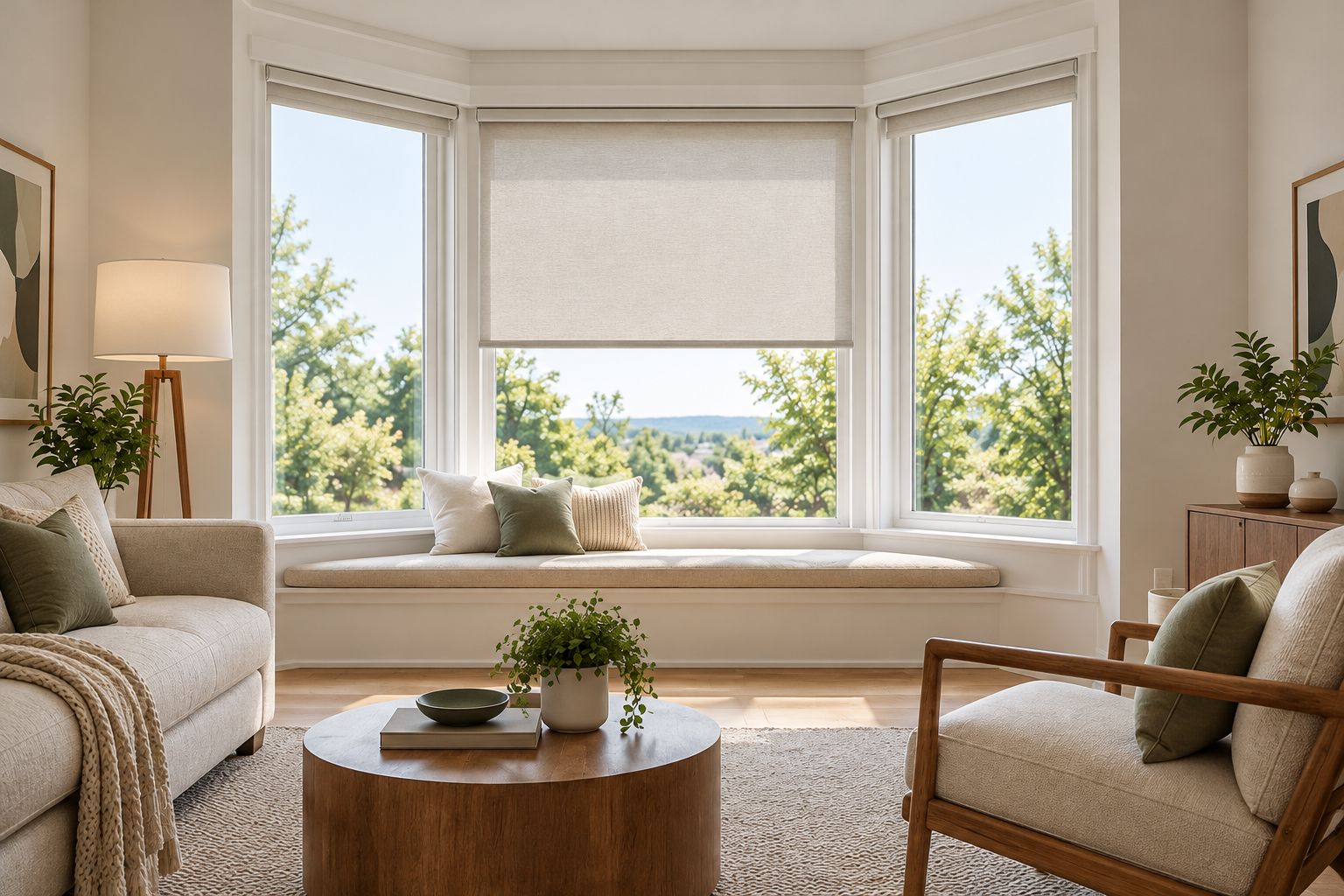
Ask the installer to explain the deductions and corner clearances before you approve the order. Olsson Smart Shades provides custom measurement and installation; use the quote request to describe your bay and request an in-home consultation.
Choose controls and power around your routine
Motorized does not automatically mean connected to your preferred smart-home system. For a 2026 purchase, confirm the exact motor, control method, and any required connecting equipment in writing.
Start with what you want to do each day:
- Individual control: Lower the sunlit side while leaving the other windows open.
- Group control: Move the whole bay with one command.
- Scheduled control: Open or close shades at chosen times, if the selected system supports scheduling.
- Power access: Keep charging points, battery compartments, or wiring accessible after installation.
As a planning example, 2 control groups can separate the center window from the side windows. That is a layout choice, not a promise about any particular motor system.
Ask what happens when the internet is unavailable and how you operate the shades without a phone. The answers depend on the actual equipment. Battery-powered systems also need a practical maintenance plan; wired systems need a confirmed power route.
How these shade types are ranked
This 2026 ranking puts bay-window fit first, followed by light control, raised profile, privacy, and practical operation. It compares the behavior of shade types, not laboratory-tested motor models or a named manufacturer's product line.
Roller shades take the default position for their simple form. Cellular shades win the insulation slot, Roman shades win the decorative-fabric slot, and solar shades win the daytime-view slot. The best choice changes when your room's main job changes.
Which motorized shades should you choose?
Start with motorized roller shades if you are undecided. Ask for a layout that shows each shade's mounting position, fabric coverage, and corner clearance.
Switch to cellular shades for insulation, Roman shades for decorative folds, or solar shades for daytime glare with a view. Olsson Smart Shades can measure the bay and discuss custom motorized shades for your Columbus or Central Ohio home. Choose the treatment around the room—not around an app feature you will rarely use.
FAQ
What's the best type of motorized shade for a bay window?
Motorized roller shades are the best starting point for a simple, uncluttered bay-window treatment. Choose cellular shades for insulation, Roman shades for decorative folds, or solar shades for daytime glare with a view.
Does each bay-window section need its own motorized shade?
Separate shades are the starting point for evaluating a bay with angled window openings. The final arrangement depends on the window geometry, mounting surfaces, and clearance between neighboring assemblies.
Can motorized bay-window shades move together?
Motorized bay-window shades can move together when the selected control system supports grouping. Confirm that you can also operate shades individually if different sides receive different sunlight.
Will blackout motorized shades make a bay-window bedroom completely dark?
Blackout fabric alone does not make a bay-window bedroom completely dark. Light can enter around fabric edges and between adjoining treatments, so review those gaps as part of the mounting plan.
Are solar shades private at night?
Open-weave solar shades are not a dependable nighttime privacy treatment. If privacy after dark matters, choose a privacy-focused fabric or plan a separate covering.
Can motorized shades work without an outlet beside the bay window?
Battery-powered motorized shade systems do not require an outlet beside every window. Confirm that the chosen system suits your shade and that its battery or charging connection remains accessible.
How do I arrange a bay-window shade consultation in Columbus?
Request a quote or in-home consultation from Olsson Smart Shades and describe the bay, your light concerns, and your preferred controls. Ask for the mounting plan, power arrangement, and fabric choice to be confirmed before ordering.
One last thing
Ask to see where the fabric ends, not just where the hardware ends. On a roller shade, those are different lines. Reviewing both at the bay's corners helps you judge privacy and edge light before the shades are made.