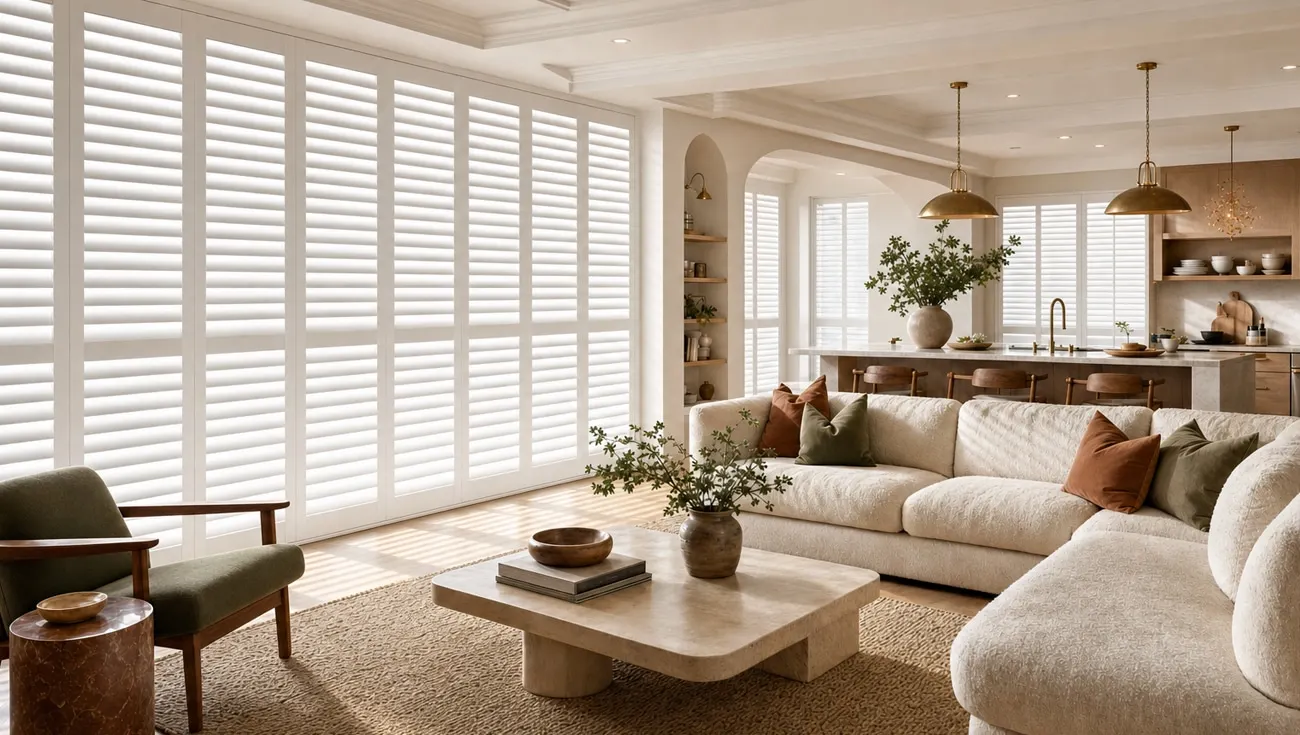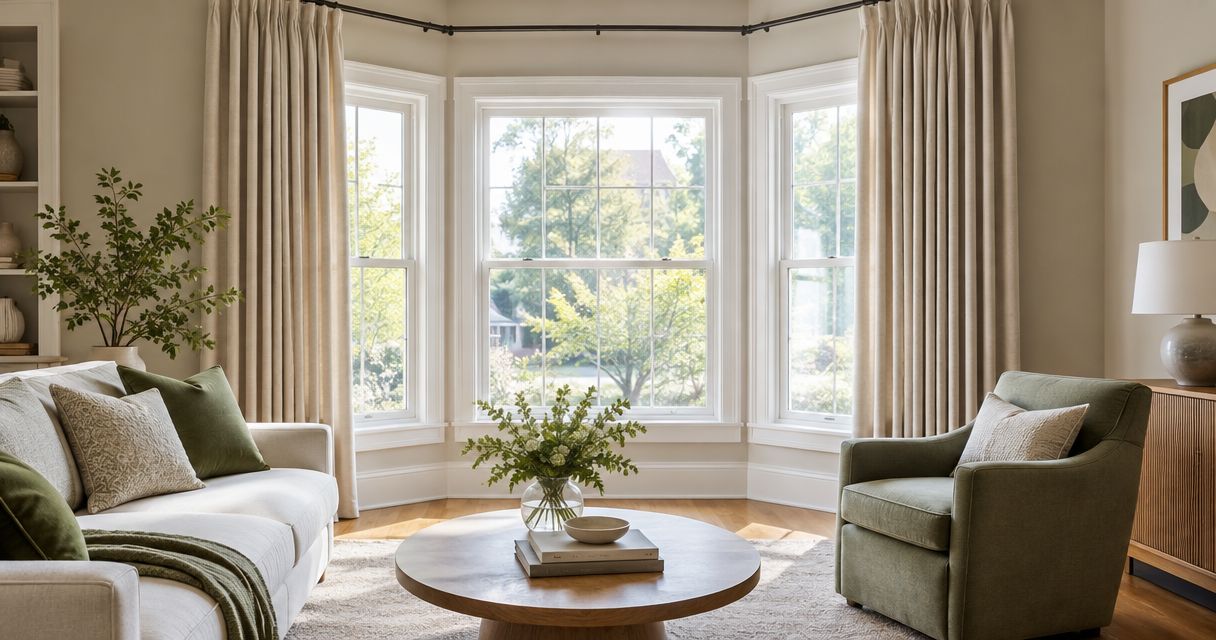
Best overall: pinch-pleat drapes on bay-compatible hardware. Best for modern rooms: ripple-fold drapes. Best for simple framing: stationary side panels. This 2026 guide compares the best drapery styles for bay windows by how they open, where they gather, and whether you need privacy or decoration.
- The best drapery styles for bay windows start with pinch pleats for tailored, functional coverage.
- Ripple-fold drapes suit modern rooms, but the track must accommodate the bay’s corners.
- Stationary side panels frame a bay window; they do not replace a working privacy treatment.
- Olsson Smart Shades provides custom-measured drapes for homeowners in Columbus and Central Ohio.
Why this matters
A bay window changes direction. Drapery hardware, fabric, and mounting positions must work around those corners without blocking window handles or covering the view when the panels are open.
Choose how the curtains should work before choosing how the folds should look. A decorative panel beside a window has a different job from a drape you close every evening. For custom-measured drapery and professional installation in Columbus and Central Ohio, Olsson Smart Shades offers both.
What makes the best drapery styles for bay windows?
Use these criteria for your 2026 shortlist. The right answer starts with the room, not a trend photograph.
- Opening method: Decide whether the drapes must travel around the bay, close across its front, or stay fixed beside individual windows.
- Gathering space: Check where the fabric will sit when open. Gathered panels still occupy space and can cover glass.
- Privacy and light: Separate decorative framing, daytime light filtering, and nighttime privacy. One fabric does not automatically deliver all three.
- Corner clearance: Allow for window handles, projecting sills, furniture, and the depth of the folds.
- Everyday care: Consider access for cleaning and the fabric’s care instructions before selecting a long or layered treatment.
Bay-window drapery styles at a glance
These are design approaches, not named product packages. The order favors practical daily use first, followed by more specialized treatments.
| Style | Best for | Standout feature | Key limitation |
|---|---|---|---|
| Pinch-pleat drapes | Tailored, everyday coverage | Defined folds with a traditional or transitional look | Moving panels need compatible hardware and gathering space |
| Ripple-fold drapes | Modern rooms | Repeating waves along a track | Track layout and corner clearance need careful planning |
| Stationary side panels | Framing a bay with separate shades | Decorative fabric stays at the edges | Panels do not provide full-window coverage |
| Sheer drapes | Softening daylight while keeping an airy look | Light-filtering fabric across the bay | Sheers alone are not dependable nighttime privacy |
| Café curtains | Keeping upper glass uncovered | Fabric covers only the lower window area | Upper glass remains exposed |
1. Pinch-pleat drapes: best for tailored everyday coverage
Pinch-pleat drapes gather fabric into defined folds at the heading. They suit a bay window when you want a finished look and working panels that close, provided the hardware supports the intended movement.
The main decision is not the pleat itself. It is whether the panels follow the bay’s angles or close across the room-facing opening, leaving the recessed space behind them.
Pinch-pleat drapes pros:
- Defined folds give the fabric an orderly appearance.
- The heading works with a range of traditional and transitional interiors.
- Lining can be selected to suit the room’s light-control needs.
Pinch-pleat drapes cons:
- Gathered fabric needs somewhere to sit when open.
- Ordinary rod brackets can interrupt panel travel; the hardware must match the opening plan.
Best for: Homeowners who want decorative fabric and daily closure in the same treatment.
For a bay with a window seat, establish whether you want the seat accessible after closing the drapes. That answer changes where the hardware belongs. Verdict: Buy pinch-pleat drapes when tailored, usable coverage is your priority.
2. Ripple-fold drapes: best for modern rooms
Ripple-fold drapes hang in repeating waves from a track. Their uncluttered heading makes them a useful choice when you want the fabric, rather than a decorative rod, to define the window.
A bay requires careful track planning. Do not assume that every track can bend around your corners or that the folds will clear the glass, trim, and handles.
Ripple-fold drapes pros:
- Repeating folds create a consistent appearance across a wide opening.
- The heading suits rooms with simple furniture and restrained detailing.
- A planned track layout gives you a clear opening and closing path.
Ripple-fold drapes cons:
- The waves need depth, which matters in a shallow recess.
- Corner shape and carrier movement depend on the selected track system.
Best for: Modern living rooms where a continuous fabric treatment is more important than decorative rod hardware.
Ask to see the proposed track route before approving the fabric. A neat heading cannot correct an awkward closing position. Verdict: Buy ripple-fold drapes when the track layout fits the bay and you want a modern finish.
3. Stationary side panels: best for decorative framing
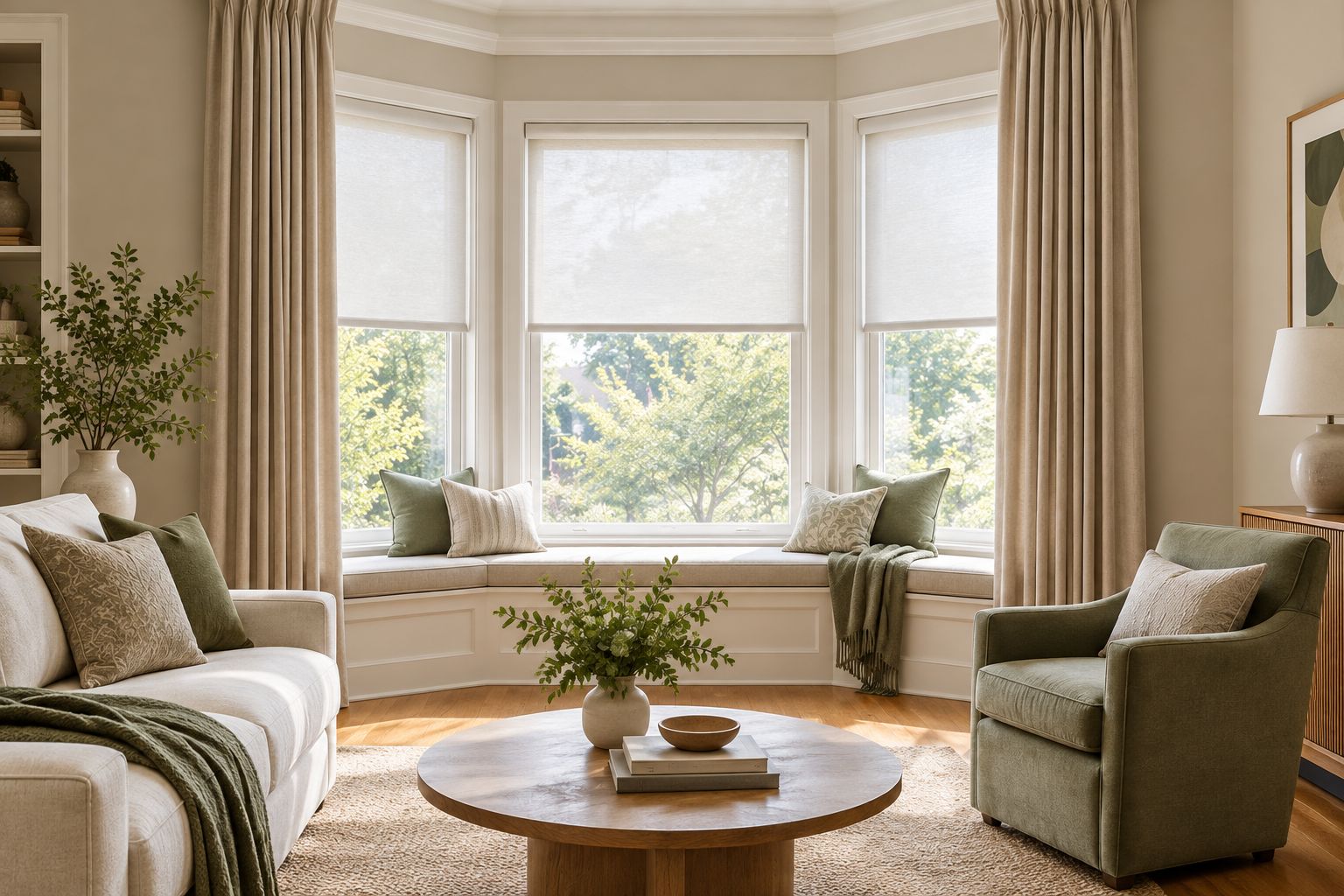
Stationary side panels remain at the edges rather than closing across the glass. They add fabric and frame the bay while a separate shade or blind handles privacy and light control.
This approach keeps decoration and function separate. Olsson Smart Shades offers custom drapes and shades, so homeowners can discuss both parts of a layered treatment together.
Stationary side panels pros:
- Fabric stays in a predictable position beside the windows.
- Panels add softness without requiring travel around corners.
- A separate treatment can handle each window’s privacy needs.
Stationary side panels cons:
- Fixed panels cannot close to cover the whole bay.
- Layering requires enough depth for both treatments to operate without interference.
Best for: Bay windows that already have suitable shades, or rooms where you want decorative fabric without daily curtain handling.
Keep the panels proportional to the opening. Narrow strips of fabric can look disconnected, while bulky panels can hide the outer windows. Verdict: Buy stationary side panels for framing; skip them as your only privacy treatment.
4. Sheer drapes: best for softening daylight
Sheer drapes filter light and soften the view through a bay window. They work well when you want fabric across the opening without the visual weight of an opaque drape.
Privacy is the trade-off. When the room is lit after dark, sheer fabric does not reliably prevent people outside from seeing in.
Sheer drapes pros:
- Translucent fabric keeps the treatment visually light.
- Draped folds soften the hard lines of window frames.
- Sheers can form the decorative layer of a layered treatment.
Sheer drapes cons:
- Sheers alone are not a dependable nighttime privacy solution.
- Layering with an opaque treatment requires additional mounting space.
Best for: Living areas where softened daylight matters more than darkening the room.
Bring at least 2 fabric samples to the actual window and compare them against the glass. Judge the weave in daylight, then check privacy after dark with the room lights on. Verdict: Buy sheers for light filtering; skip sheers alone when nighttime privacy matters.
5. Café curtains: best for keeping upper glass uncovered
Café curtains cover the lower portion of a window while leaving the upper portion open. They are a distinct alternative to full-length drapery, particularly when you want coverage near seated eye level without covering all the glass.
On a bay, the separate sections need coordinated mounting heights. The curtain tops should read as an intentional line rather than unrelated treatments.
Café curtains pros:
- Upper glass stays uncovered for daylight and views.
- Short fabric avoids contact with the floor.
- Separate panels can suit individually framed window sections.
Café curtains cons:
- Uncovered upper glass limits privacy and light control.
- Additional horizontal lines can compete with detailed window trim.
Best for: Casual breakfast areas or bays where lower-window coverage meets the actual privacy need.
Check the view from outside before choosing the curtain height. Coverage that works while seated does not necessarily work while standing. Verdict: Buy café curtains for selective lower-window coverage; skip them for full-window privacy.
How to choose the layout before ordering
The best-looking drapery is still frustrating if it catches a handle or closes on the wrong side of your window seat. Make these decisions before approving the final design.
Decide where closure happens
Drapes that follow the bay preserve its angled outline. Drapes across the front create a straight closing line, but separate the recess from the room when closed. Neither layout is automatically right.
If you use the recess for seating, describe that use during the consultation. The installer needs to know whether you expect to sit there with the curtains closed.
Check the open position
Ask where the fabric will gather. Use 1 window section as a starting point for discussing how much glass you want visible, then check the complete bay rather than repeating the same assumption around every corner.
Look for conflicts with furniture, handles, radiators, and air vents. Floor-length fabric should not interfere with a heat source; follow the equipment manufacturer’s clearance instructions.
Match the fabric to the job
Make 3 checks before settling on a sample: daylight appearance, after-dark privacy, and care instructions. These checks answer different questions; an attractive daytime sample does not prove nighttime coverage.
For a bedroom, discuss lining, edge gaps, and the closing overlap together. An opaque fabric does not eliminate light entering around the treatment.
How these styles were ranked
This 2026 ranking favors usable coverage, workable hardware, gathering space, privacy, and care. It compares design characteristics rather than claiming a product test or assigning unsupported performance scores.
Pinch pleats take the default position because they combine a tailored appearance with working coverage when correctly specified. Ripple folds lead for modern styling; the remaining options serve narrower needs rather than competing for the same job.
Which bay-window drapery style should you choose?
Choose pinch-pleat drapes unless your room points clearly toward another option. Choose ripple folds for a modern heading, stationary panels when separate shades already do the work, sheers for softened daylight, or café curtains for lower-window coverage.
Olsson Smart Shades is a fit for Columbus and Central Ohio homeowners seeking custom-measured bay-window drapery and professional installation. For your 2026 project, request a quote and ask about arranging an in-home consultation.
Explain how you use the room, when privacy matters, and whether the panels need to close. Ask the written quote to identify the fabric, lining, hardware layout, and installation scope so you can assess the proposed treatment without pressure.
FAQ
What are the best drapery styles for bay windows in 2026?
Pinch-pleat drapes are the best default for tailored, working coverage. Ripple-fold drapes suit modern rooms, while stationary side panels suit bays with separate privacy shades. Choose the hardware layout before finalizing the heading.
Should bay-window curtains follow the angles or go straight across?
Follow the angles when you want the treatment to trace the bay; close straight across when you want a room-facing curtain line. Straight-across drapes separate the recess from the room when closed. Consider window-seat access before deciding.
Can I use a regular curtain rod on a bay window?
A regular straight rod can work across the front of a bay if the mounting and span are suitable. Following the bay’s angles requires hardware designed for that layout. Confirm whether the panels must travel past brackets or corners.
Are sheer curtains enough for privacy on a bay window?
Sheer curtains alone are not dependable nighttime privacy. With interior lights on, people outside can see through many sheer fabrics. Add a suitable opaque layer when privacy after dark matters.
Should bay-window drapes touch the floor?
Floor-length drapes are a design choice, not a requirement for bay windows. A window seat, heat source, or furniture layout can make another length more practical. Choose a hem position that keeps the treatment clear of obstacles.
Can Olsson Smart Shades help with custom bay-window drapes?
Olsson Smart Shades provides custom-measured drapes and professional installation for homeowners in Columbus and Central Ohio. Request a quote and ask about an in-home consultation to discuss fabric, coverage, and the hardware layout.
One last thing
The open position deserves as much attention as the closed position. Before approving your 2026 drapery design, ask where every panel will rest when you want the view. That single check can reveal covered glass, crowded corners, and a blocked window seat before installation.