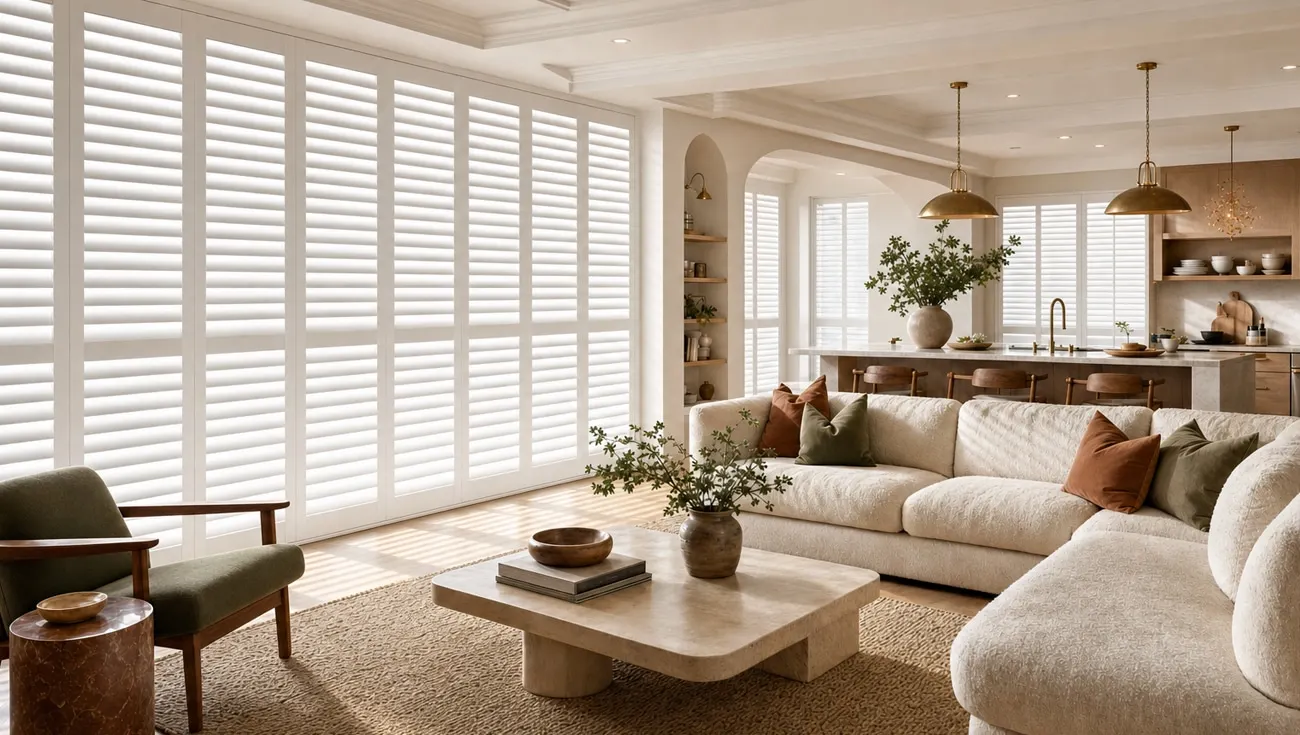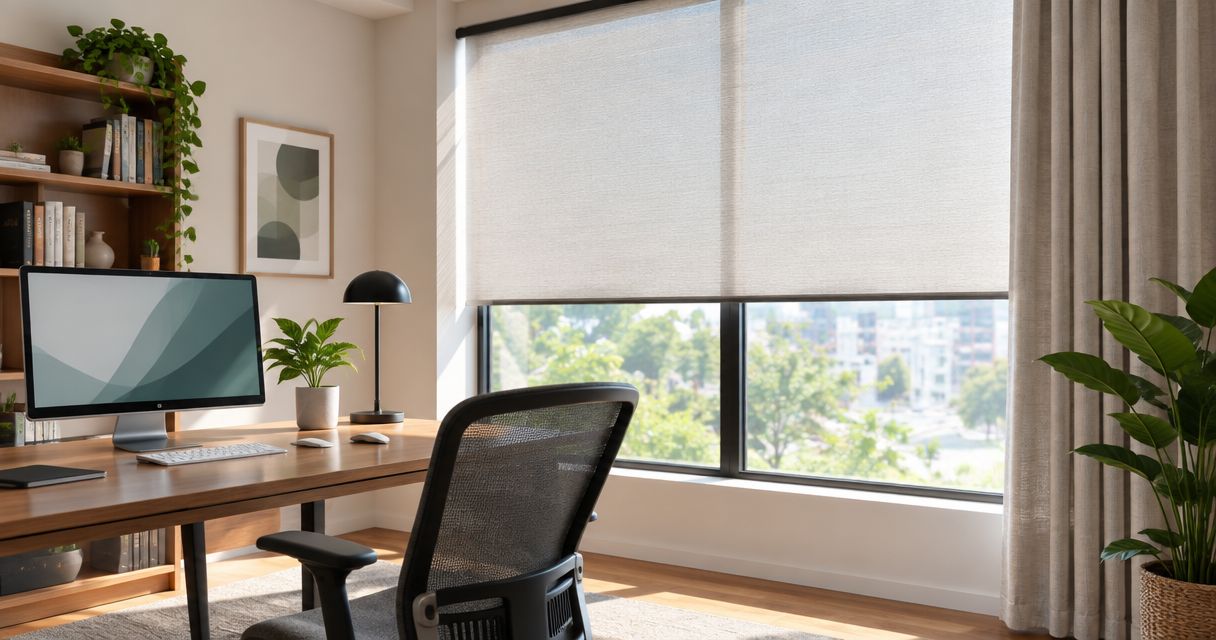
Best overall: light-filtering roller shades. Best for daytime views: solar shades. Best for frequent adjustments: motorized shades. This 2026 guide compares the best window treatments for home offices by glare, privacy, and daily use, with custom-measured installation available from Olsson Smart Shades for Columbus and Central Ohio homeowners.
- Light-filtering roller shades are the best window treatments for home offices when you want softened daylight and simple operation.
- Solar shades suit daytime views, but they do not provide dependable nighttime privacy.
- Motorized shades suit hard-to-reach windows and frequent adjustments; confirm controls and power requirements before ordering.
- Olsson Smart Shades offers custom-measured home-office window treatments and installation in Columbus and Central Ohio.
Why this matters
Your office window affects both your screen and your face on video calls. A bare window can put bright reflections on your monitor. A fully darkened window solves that problem differently: it removes daylight you might want to keep.
Start with the problem at your desk, not the fabric in a sample book. Glare, privacy, and an uncomfortable window area call for different treatments. The right choice lets you change the room as daylight changes, without rearranging your workday around it.
Olsson Smart Shades is best suited to Columbus and Central Ohio homeowners seeking custom-measured, professionally installed home-office window treatments. Bring your working setup into the conversation, including where you sit and when the room becomes difficult to use.
What makes the best home-office window treatments
Use these criteria for your 2026 shortlist:
- Screen comfort: The treatment should reduce distracting brightness without making you work in darkness.
- Privacy: Check both daytime and nighttime conditions. A daytime view does not prove evening privacy.
- Light adjustment: Decide whether you need to soften all incoming light, tilt slats, or block it.
- Window fit: Consider frame depth, handles, nearby furniture, and room for the treatment to open.
- Daily operation: Choose controls you can reach and use comfortably from your normal working position.
- Upkeep: Think about exposed slats, fabric surfaces, and access for cleaning before choosing a style.
No treatment wins every category. A shade that preserves your view can leave you exposed after dark; a shutter that redirects light also needs room for its panels.
Home-office window treatments at a glance
This 2026 ranking separates window-covering styles from motorization. Motorization is a control option, not a fabric type, so it can complement a suitable shade rather than replace the shade decision.
| Rank and option | Best for | Standout feature | Key limitation |
|---|---|---|---|
| 1. Light-filtering roller shades | Everyday screen work | A continuous fabric surface softens daylight | Fabric and fit determine privacy and glare performance |
| 2. Cellular shades | Comfort near the window | Honeycomb-shaped pockets help resist heat transfer | Lowered fabric obscures the view |
| 3. Solar shades for daytime views | Keeping an outdoor view during work | Open-weave fabric filters light while retaining visibility | Not dependable for nighttime privacy |
| 4. Motorized shades for frequent adjustments | Hard-to-reach windows | Powered operation reduces manual handling | Power and control requirements vary |
| 5. Plantation shutters | Directional light control | Adjustable louvers redirect incoming light | Panels need clearance to open |
| 6. Wood or faux-wood blinds | Familiar manual slat control | Tilting slats changes light and visibility | Slats and gaps do not create a blackout seal |
| 7. Layered drapes and shades | Offices that serve another purpose | Separate layers handle daylight and stronger coverage | More fabric and hardware need space |
1. Light-filtering roller shades: best for everyday screen work
Light-filtering roller shades lower a continuous fabric panel over the window. They soften incoming daylight without the horizontal slat pattern of blinds. For a typical home office, they are the most straightforward starting point.
Best for: You want comfortable daylight while writing, reading, or using a monitor, without making the window the room's main feature.
A light-filtering label does not tell you everything about the fabric. Check a sample against the actual window, then look at your screen from your chair. Strong direct sun needs more attention than a softly lit window.
Light-filtering roller shade pros:
- Simple appearance behind a desk or on camera.
- Fabric choices let you adjust how much light passes through.
- Raising the shade restores an unobstructed view.
Light-filtering roller shade cons:
- You lose some visibility through the window when the shade is lowered.
- Light can enter around the edges; light filtering is not blackout.
Verdict: Buy light-filtering roller shades as your default, then confirm the fabric handles your brightest working conditions.
2. Cellular shades: best for comfort near the window
Cellular shades use honeycomb-shaped pockets within the fabric. Those pockets help resist heat transfer through the covered window. They make sense when your desk sits near glass and comfort matters alongside light control.
Best for: You want a fabric shade with an insulating structure, especially where the window area feels uncomfortable.
Choose the light-control fabric separately from the cellular construction. A light-filtering cellular shade and a room-darkening cellular shade serve different working habits. Neither fixes drafts or replaces repairs to the window itself.
Cellular shade pros:
- Honeycomb construction adds an insulating layer.
- Light-filtering and darker fabric options serve different needs.
- The fabric folds upward when you want the window uncovered.
Cellular shade cons:
- Lowered fabric generally blocks a clear outdoor view.
- The folded structure needs care during cleaning and handling.
Verdict: Buy cellular shades when window-area comfort outweighs keeping a view through the lowered treatment.
3. Solar shades: best for daytime views
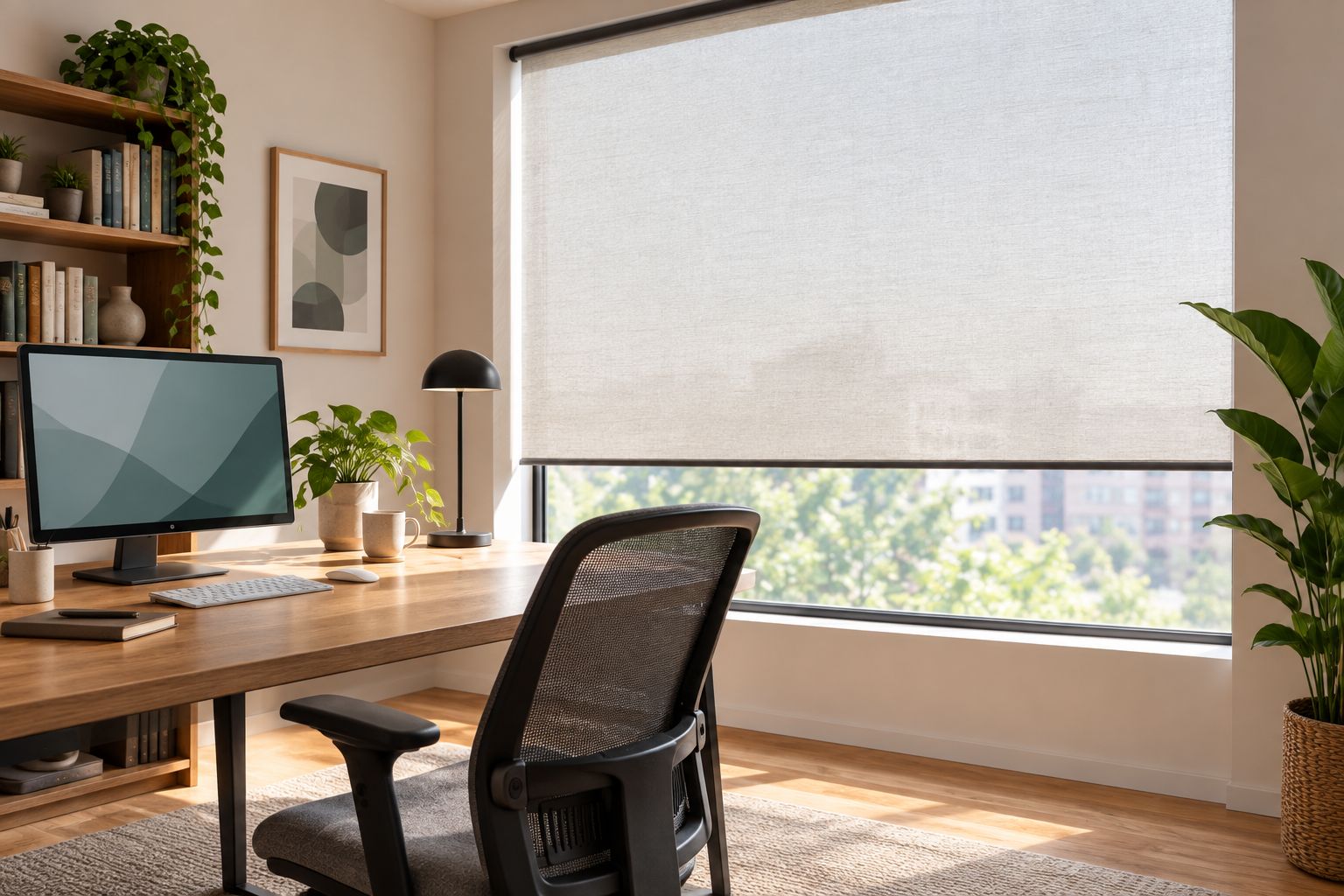
Solar shades use open-weave fabric to filter sunlight while retaining some visibility outdoors. They suit offices where the view is part of the appeal. The fabric's openness affects the balance between visibility and light control.
Best for: You work mainly during daylight and want to keep looking outside with the shade lowered.
Common solar fabrics include 1%, 3%, and 5% openness options. A lower openness percentage generally means a tighter weave, but color and lighting also affect what you see. Compare samples rather than choosing from the percentage alone.
Solar shade pros:
- Retains some outdoor visibility during the day.
- Filters incoming sunlight without an opaque fabric panel.
- Fits a simple roller-style window treatment.
Solar shade cons:
- Does not provide dependable privacy when the room is brighter than outdoors.
- Open-weave fabric is not a blackout treatment.
Verdict: Buy solar shades for daytime views; skip solar shades as your only covering if you need evening privacy.
4. Motorized shades: best for frequent adjustments
Motorized shades use powered operation instead of requiring you to handle the shade manually. They are useful behind a deep desk, above furniture, or wherever reaching the window interrupts your work.
Best for: You adjust shades often or cannot comfortably reach their controls.
For a 2026 motorized-shade purchase, settle the fabric choice first. Then confirm the exact power source, controls, and any requested smart-home connection. Olsson Smart Shades offers motorized smart shade installation; compatibility still needs confirmation for the selected setup.
Motorized shade pros:
- Reduces the need to reach across furniture.
- Makes frequent opening and closing easier.
- Allows powered operation without changing the basic purpose of the shade fabric.
Motorized shade cons:
- Requires a suitable power arrangement and attention to its upkeep.
- Smart-home features depend on the specified system, not the word motorized.
Verdict: Buy motorized shades when easier operation solves a daily problem. Hold until the power and control plan is clear.
5. Plantation shutters: best for directional light control
Plantation shutters have framed panels with adjustable louvers. Tilting the louvers changes the direction of incoming light and the visibility through the window. Opening the panels exposes more of the window.
Best for: You want to redirect daylight while keeping a structured, built-in appearance.
Check the opening path before choosing shutters for an office. A monitor, shelf, or desk placed close to the window can prevent a panel from swinging freely. Test the planned arrangement with the furniture in its working position.
Plantation shutter pros:
- Louvers offer directional light adjustment.
- Solid surfaces can be dusted without handling loose fabric.
- Panels provide a defined frame around the window.
Plantation shutter cons:
- Opening panels requires clearance.
- Louvers and perimeter gaps do not guarantee total darkness.
Verdict: Buy plantation shutters when directional control matters and the panels have room to open. Skip them where furniture blocks that movement.
6. Wood or faux-wood blinds: best for manual slat control
Wood and faux-wood blinds use horizontal slats that tilt and lift. You can change the light angle without raising the whole blind. They are a familiar choice when you prefer a hands-on control rather than fabric covering the glass.
Best for: You want straightforward manual adjustment and a visible slat-style treatment.
Compare the actual wood and faux-wood samples instead of assuming they look or handle identically. Check the lift operation on the size of blind being proposed. Small display samples do not show how a larger covering feels to use.
Wood or faux-wood blind pros:
- Slats tilt for incremental light adjustment.
- Raising the blind opens the view.
- Individual slat surfaces are accessible for dusting.
Wood or faux-wood blind cons:
- Direct light can pass between slats and around edges.
- Dusting multiple slats takes more handling than wiping one continuous surface.
Verdict: Buy wood or faux-wood blinds if you like manual slat control. Skip them as a standalone solution for complete darkness.
7. Layered drapes and shades: best for a dual-purpose office
Layered treatments pair a shade with drapes. The shade handles everyday daylight; the drapes add another level of coverage when closed. This arrangement suits an office that also functions as a guest room or evening living space.
Best for: You need different light settings for work and another use of the room.
With 2 layers, decide which treatment you will operate during the working day. Plan where the drapes gather when open so they do not cover useful glass or crowd the desk. Fabric darkness alone does not eliminate perimeter light.
Layered drape and shade pros:
- Separates daytime light control from stronger coverage.
- Adds fabric to a room with mostly hard surfaces.
- Lets the same window serve different room uses.
Layered drape and shade cons:
- Requires space for both hardware and gathered fabric.
- Adds surfaces to clean and another treatment to operate.
Verdict: Buy layered drapes and shades for a genuinely dual-purpose room. Skip the extra layer if one shade meets your needs.
How we ranked
The 2026 order prioritizes everyday screen comfort, followed by distinct needs: window-area comfort, daytime views, easier operation, directional light, manual slats, and dual-purpose use. These are fit-based recommendations, not product test scores.
Roller shades lead because they offer a simple starting point for softened daylight. The other options move ahead when their specific advantage matches your room. Your desk position and working hours matter more than the ranking number.
Which home-office window treatment should you choose?
Choose light-filtering roller shades unless your room gives you a clear reason to choose otherwise. Move to cellular shades for window-area comfort, solar shades for daytime views, or shutters for directional control. Add motorization when reaching the shade is the problem.
Before requesting a quote, look at the room at 2 times of day: during your brightest working period and after dark with the lights on. Note screen reflections, visibility from outside, and anything that blocks access to the window.
For your 2026 consultation, ask Olsson Smart Shades to discuss measurement, fabric samples, mounting, and operation together. Describe the result you want in plain terms: less glare, evening privacy, or an easier way to adjust the shade. Ask how to arrange an in-home visit and what the quote includes before deciding.
Discuss your office windows
Ask about custom-measured window treatments and installation for your Columbus or Central Ohio home.
FAQ
What's the best window treatment for a home office in 2026?
Light-filtering roller shades are the best starting point for everyday home-office screen work. Check the selected fabric at your actual window, because direct sunlight and nighttime privacy can require a different level of coverage.
Are solar shades better than roller shades for an office?
Solar shades are a type of roller shade, and their open-weave fabric is better suited to preserving daytime views. Light-filtering fabric roller shades suit softened daylight when seeing through the lowered shade is not the priority.
Do solar shades give me privacy at night?
Solar shades do not provide dependable nighttime privacy. When the room is brighter than outdoors, an open-weave fabric can allow views inside, so use an additional privacy treatment if needed.
Should I get blackout shades for my home office?
Choose blackout fabric when blocking light matters more than retaining daylight. Fabric alone does not guarantee a dark room; mounting and perimeter gaps also affect the result.
Are motorized shades worth choosing for a desk-side window?
Motorized shades are a useful choice when the desk makes manual controls hard to reach or you adjust the covering frequently. Confirm the selected shade's power source and controls before ordering.
Can plantation shutters stop glare on my monitor?
Plantation shutters can redirect incoming light by changing the louver angle. Check the monitor from your working position, because direct light can still enter through gaps or an unsuitable angle.
How do I request custom home-office window treatments in Columbus?
Contact Olsson Smart Shades through its website to ask about a quote and an in-home consultation. Explain your desk position, working hours, privacy needs, and whether you want manual or motorized operation.
One last thing
Before ordering, try turning your desk 90 degrees so the window sits beside the monitor rather than directly behind or opposite it. Check the screen and your video-call image again. Choose the treatment for the working arrangement you intend to keep, not a glare problem caused by a temporary desk position.