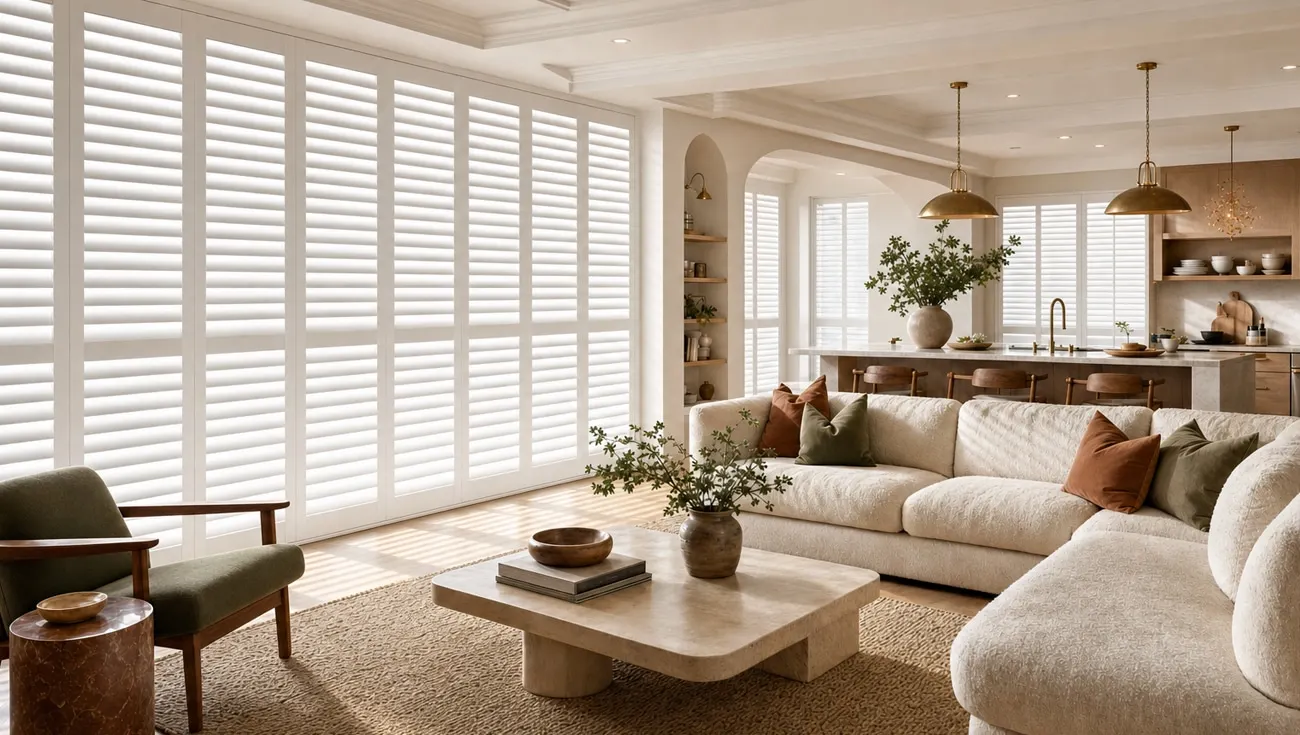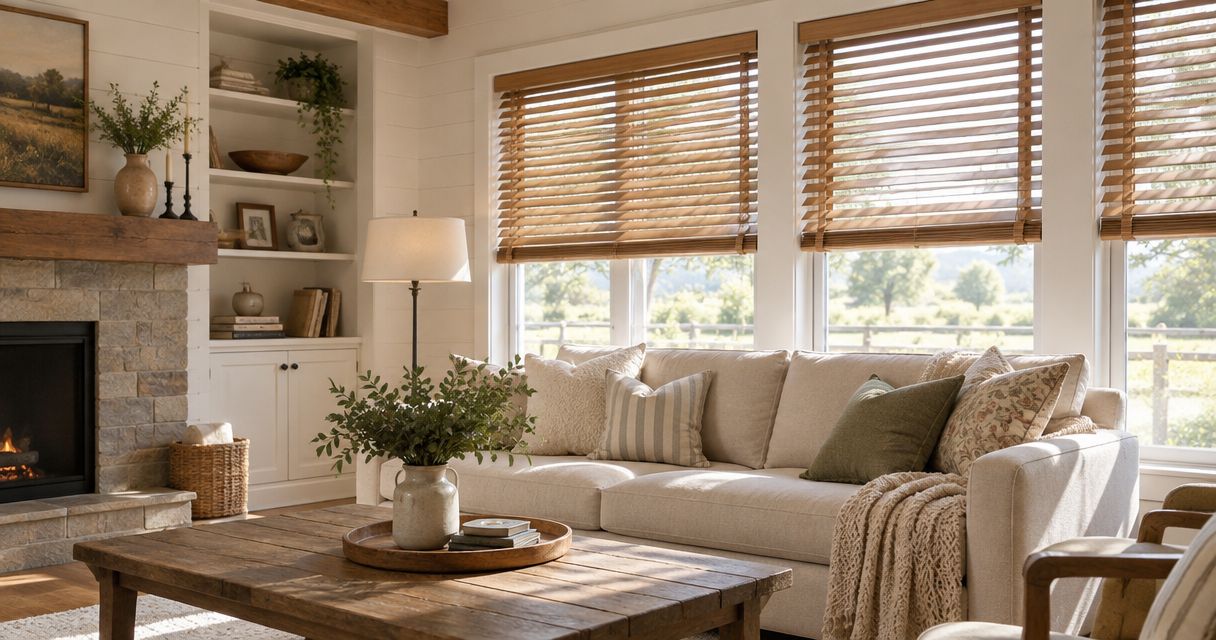
Best overall: warm-white wood blinds. Best for a natural farmhouse look: light, clear-finished wood blinds. Best for moisture-prone rooms: faux-wood blinds instead of real wood. This 2026 guide helps you choose a finish, compare practical trade-offs, and discuss custom window treatments with Olsson Smart Shades.
- The best wood blinds for farmhouse style are warm white for painted rooms and light natural wood for visible grain.
- Choose medium-brown wood blinds for traditional farmhouse rooms; use dark finishes where contrast is the goal.
- Choose faux-wood blinds for moisture-prone kitchens and bathrooms rather than prioritizing real wood everywhere.
- Olsson Smart Shades provides custom-measured blinds and installation for homeowners in Columbus and Central Ohio.
Why this matters
Farmhouse style does not require every window to look rustic. A painted blind can sit quietly beside white trim, while visible wood grain adds warmth to a room with simple furniture. The right choice depends on what your room already has.
Olsson Smart Shades is a fit for Columbus and Central Ohio homeowners seeking custom-measured blinds and professional installation. Use this guide to narrow your preferred look before discussing measurements and installation.
For your 2026 project, choose the material before the color. A finish that looks right in a living room does not make real wood the right choice beside a shower. Then decide whether you want the blinds to blend into the trim or become part of the room's contrast.
What makes the best wood blinds for farmhouse style
Judge wood blinds by these criteria before choosing a finish:
- Room conditions: Real wood belongs in rooms without persistent moisture. Faux wood is the practical comparison for damp spaces.
- Finish agreement: Compare the blind sample with your trim, flooring, and largest furniture pieces. Matching every wood surface is unnecessary; avoiding an unwanted clash matters.
- Light control: Tilting slats changes the direction of incoming light. Closed blinds do not provide the same light blocking as a dedicated blackout treatment.
- Window fit: Check frame depth, handles, and space for the raised blind. A good-looking sample cannot solve an awkward fit.
- Daily handling: Consider how often you will lift the blind rather than just tilt its slats. Large windows deserve particular attention.
- Cleaning access: Horizontal slats collect dust. Choose a treatment you can reach and maintain without moving furniture every time.
Farmhouse wood blinds at a glance
These are finish and material choices, not named product lines. Use the table to compare their roles before selecting a specific blind.
| Option | Best for | Standout feature | Key limitation |
|---|---|---|---|
| Warm-white wood blinds | Bright rooms with painted trim | A quiet painted finish | White undertones can clash with existing trim |
| Light natural wood blinds | Rooms needing visible grain | Wood texture without a dark finish | Grain and stain need comparison with nearby wood |
| Medium-brown wood blinds | Traditional farmhouse interiors | A warmer, more prominent wood accent | Adds another wood tone to coordinate |
| Dark-stained wood blinds | Rooms needing deliberate contrast | A defined outline around the window | Can compete with other dark features |
| Faux-wood blinds | Moisture-prone kitchens and bathrooms | A moisture-resistant alternative to real wood | Does not reproduce natural wood grain exactly |
1. Warm-white wood blinds: best for bright farmhouse rooms
Warm-white wood blinds are the default choice when your farmhouse room already has painted trim, pale walls, and enough texture elsewhere. They keep the window treatment from competing with a dining table, exposed beam, or patterned rug.
Look at a sample beside the actual trim. A white that looks neutral by itself can look yellow, gray, or stark against another white. Check it in daylight and under the lamps you use at night.
Warm-white wood blind pros:
- Blends with compatible painted trim.
- Lets furniture and textiles carry the room's character.
- Works with curtains without adding another wood tone.
Warm-white wood blind cons:
- Provides less visible wood character than a stained finish.
- Requires careful comparison with existing whites.
- Real wood remains unsuitable for persistently damp locations.
Best for: Living rooms and dining rooms where you want a bright, restrained farmhouse look.
Verdict: Buy warm-white wood blinds when the sample agrees with your trim and the room stays dry.
2. Light natural wood blinds: best for adding visible grain
Light natural wood blinds make the material part of the design. Choose them when the room feels too flat with painted surfaces alone, or when you want wood at the window without a dark frame around it.
Bring the sample close to your floor and furniture. The goal is a comfortable relationship, not an exact match between unrelated pieces. Natural wood has variation, so a small sample is a color reference rather than a promise of identical grain across every slat.
Light natural wood blind pros:
- Shows the grain that painted blinds cover.
- Adds a wood surface to mostly painted rooms.
- Offers a lighter-looking alternative to dark stains.
Light natural wood blind cons:
- Natural grain and color variation remain visible.
- An unwanted yellow or orange undertone can conflict with nearby wood.
- The finish needs evaluation in the room's actual light.
Best for: Simple farmhouse rooms that need warmth from the material itself.
Verdict: Buy light natural wood blinds when visible grain is the priority and the sample suits your existing wood.
3. Medium-brown wood blinds: best for traditional farmhouse rooms
Medium-brown wood blinds suit a room where wood already plays a clear role. Think of a substantial table, wood cabinetry, or furniture with a traditional profile. The blinds become another intentional wood element rather than disappearing into the trim.
Compare undertones before focusing on how dark the stain looks. A reddish brown and a yellow brown can feel unrelated even when their depth is similar. In a 2026 room update, start with the finishes you are keeping rather than a photograph of someone else's room.
Medium-brown wood blind pros:
- Makes wood a visible part of the window treatment.
- Suits interiors built around traditional wood furniture.
- Creates contrast against pale walls without choosing the darkest finish.
Medium-brown wood blind cons:
- Adds another finish to coordinate with floors and cabinetry.
- Can make the window treatment more visually prominent than intended.
- Shows natural variation that a painted finish conceals.
Best for: Traditional farmhouse interiors where the window should echo existing wood furniture.
Verdict: Buy medium-brown wood blinds when they support a wood palette you already like.
4. Dark-stained wood blinds: best for deliberate contrast
Dark-stained wood blinds give the window a stronger outline. They fit a farmhouse room that needs contrast against pale walls, especially when a few dark details already establish that direction.
Use the finish intentionally. If your room already has dark floors, furniture, and trim, another dark surface can make the window feel crowded. Hold a sample at the window rather than judging it on a countertop.
Dark-stained wood blind pros:
- Creates a clear contrast against light walls.
- Keeps visible wood character in a darker palette.
- Gives an otherwise quiet window a defined presence.
Dark-stained wood blind cons:
- Can compete with dark furniture and trim.
- Dust is more conspicuous against many dark finishes.
- Does not create blackout performance simply because the slats are dark.
Best for: Farmhouse rooms where contrast is an intentional design choice.
Verdict: Hold on dark-stained wood blinds until you have checked the sample at the window.
5. Faux-wood blinds: best for moisture-prone farmhouse rooms
Faux-wood blinds are not real wood, but they deserve a place in this buying decision. Their moisture resistance makes them a practical alternative where the room's conditions matter more than natural grain.
A painted look can connect a bathroom or kitchen to wood blinds elsewhere in the house. You do not need one material on every window to create a consistent farmhouse style. Confirm the specific blind's suitability for the location before ordering.
Faux-wood blind pros:
- Resists moisture better than real wood.
- Offers a painted appearance that can coordinate with trim.
- Lets you keep a similar slatted look across different room conditions.
Faux-wood blind cons:
- Does not duplicate the variation of natural wood.
- Can be heavier than comparable real-wood blinds.
- Still needs regular slat cleaning and careful sizing.
Best for: Kitchens and bathrooms where humidity or splashes make real wood a poor choice.
Verdict: Buy faux-wood blinds for moisture-prone locations; skip real wood there.
Choose the slat size and fit before ordering
Finish gets your attention first. Fit determines whether you enjoy using the blind. Compare 2-inch slats and 2.5-inch slats where those sizes are offered, then check the mounting requirements of the specific treatment.
Wider slats change the appearance of the window and the view between open slats. They also need room to tilt without hitting handles or trim. Do not choose a size from a room photograph alone.
Frame depth
An inside-mounted blind sits within the window opening. Check usable depth, not just the apparent depth of the trim. Locks, handles, and other obstructions can limit that space.
Window measurements
Check width at 3 measurement points: top, middle, and bottom. Check height at the left, center, and right. Follow the selected treatment's measuring instructions rather than applying your own deductions.
Raised clearance
A raised blind gathers above the exposed glass. Ask how that stack will affect the view and whether it will interfere with a window you open often. A wide opening also deserves a conversation about handling and whether separate blinds make more sense.
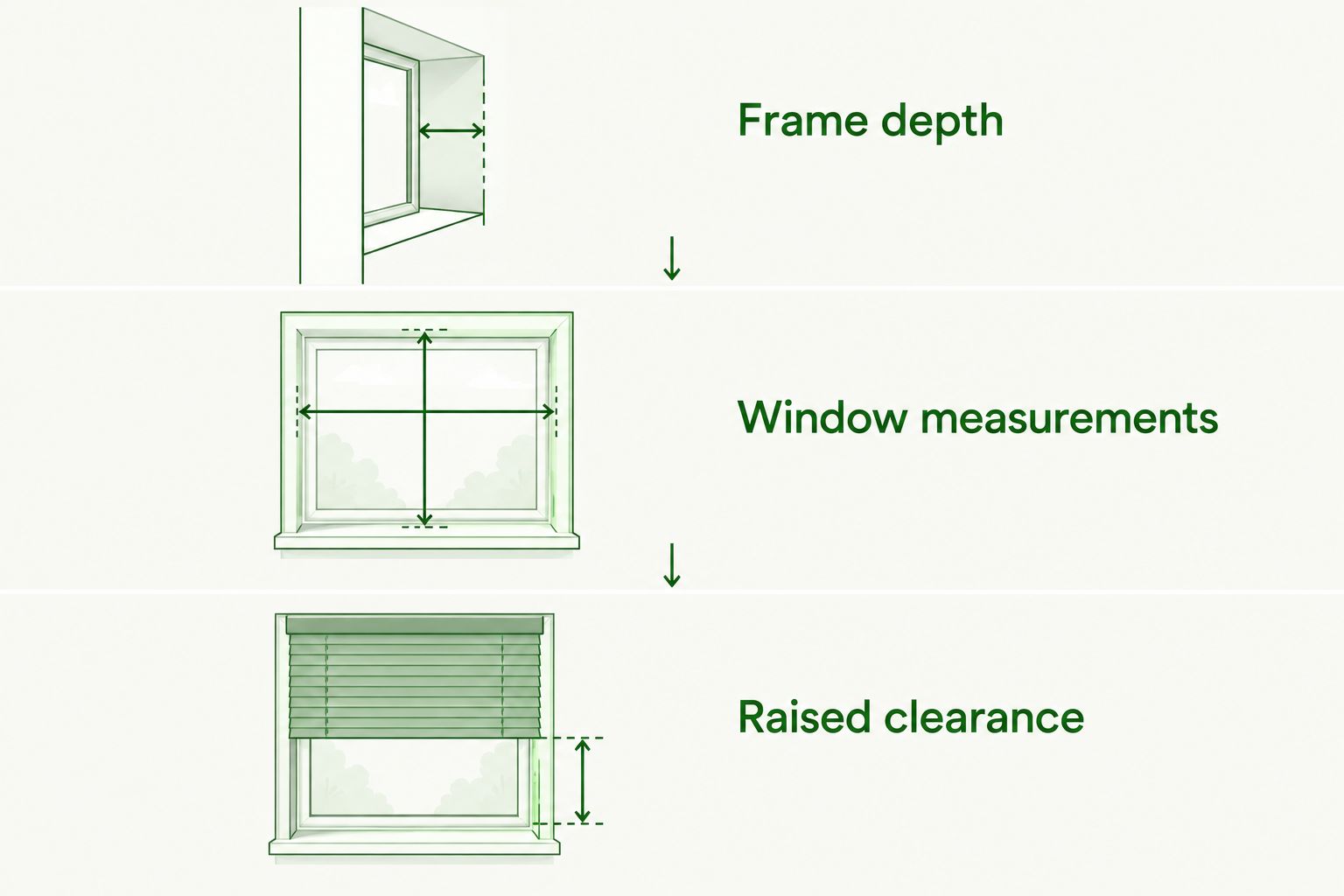
Professional measurement is particularly useful when your windows have uneven openings, shallow frames, or hardware close to the glass. Bring those concerns into the conversation before you settle on a finish.
Make farmhouse blinds work with curtains and room use
Blinds handle adjustable light and privacy. Drapes add fabric, soften the window's appearance, and can provide another layer of light control. Decide what each layer needs to do before choosing both.
For a living room, start with the blind finish against the trim, then compare curtain fabric alongside it. For a bedroom, start with your darkness requirements. Wood blinds alone are not a dependable substitute for a dedicated blackout treatment.
A farmhouse room also does not need every window treated identically. A frequently used door, a broad window, and a small bathroom opening present different handling problems. Repeat a compatible color or material direction instead of forcing one treatment into every position.
When planning in 2026, make a room-by-room list of privacy, glare, and opening needs. That list is more useful than choosing the same blind everywhere because it looks tidy on an order sheet.
How these choices are ranked
Warm-white wood blinds take the default spot because they offer a quiet starting point for painted farmhouse rooms. Light natural wood wins when grain matters; medium brown suits a traditional wood palette; dark stain serves contrast. Faux wood wins on suitability for moisture-prone spaces.
This is a design-and-use ranking, not a claim that one manufacturer's blind outperforms another. Your final choice still needs a finish sample, a suitable material, and measurements for the actual opening.
Arrange a consultation without overpreparing
Olsson Smart Shades provides custom-measured window treatments installed for homeowners in Columbus and Central Ohio. For your 2026 project, use the business's website to ask about an in-home consultation or request a quote.
Keep the request simple. Name the rooms, describe the look you prefer, and mention privacy or light problems. Include awkward handles, hard-to-reach windows, or doors that need to remain easy to use.
You do not need a finished design plan. A useful conversation starts with how you use the room, then moves to material, finish, measurement, and installation details.
Discuss your farmhouse windows
Ask about custom measurement and installation for your Columbus or Central Ohio home.
Which farmhouse wood blinds should you choose?
Choose warm-white wood blinds if you are undecided and your room has compatible painted trim. Choose light natural wood when visible grain is the reason you want wood blinds. Move to medium brown or dark stain only when that finish has a clear role in the room.
For moisture-prone rooms, choose faux wood instead. The best 2026 purchase is the treatment that suits the room and works comfortably every day—not the one that matches a style label most literally.
FAQ
What's the best wood blind finish for farmhouse style?
Warm white is the default choice for farmhouse rooms with compatible painted trim. Light natural wood is the better choice when you want visible grain. Compare both samples in the room before deciding.
Are real wood blinds better than faux wood for a farmhouse home?
Real wood is better when natural grain is your priority; faux wood is better for moisture-prone locations. Choose by room conditions first, then coordinate the finishes across the house.
Should farmhouse wood blinds match my floor exactly?
No, farmhouse wood blinds do not need to match the floor exactly. Compare their undertones with your floor, trim, and furniture so the finishes look intentional together.
Are 2-inch or 2.5-inch slats better for farmhouse blinds?
Neither size is automatically better for farmhouse style. Compare the appearance, frame depth, and clearance needed for the specific blind. Wider slats need enough room to tilt without hitting window hardware.
Can I use wood blinds in a farmhouse bathroom?
Faux-wood blinds are the practical choice for a moisture-prone farmhouse bathroom. Real wood is not the right default where persistent humidity or splashes are part of daily use.
Will dark wood blinds make my bedroom blackout?
No, dark wood blinds do not make a bedroom blackout. Light can enter around the edges and between components. Choose a dedicated blackout treatment when darkness is the main requirement.
Can I put curtains over farmhouse wood blinds?
Yes, curtains can pair with farmhouse wood blinds. Check that the curtain hardware clears the blind and that both layers operate without interference.
How do I request custom blinds in Columbus in 2026?
Contact Olsson Smart Shades through its website to ask about an in-home consultation or request a quote. Describe your rooms, preferred look, and light or privacy concerns. The business provides custom-measured window treatments and installation in Columbus and Central Ohio.
One last thing
Test the finish vertically, where the blind will hang. A sample lying flat on a table receives different light and sits beside different surfaces than a blind at the window. Hold it against the trim in daylight, then check it with your evening lighting.
If you dislike the sample there, stop. Measurement and installation will not change a finish you already know is wrong for the room.