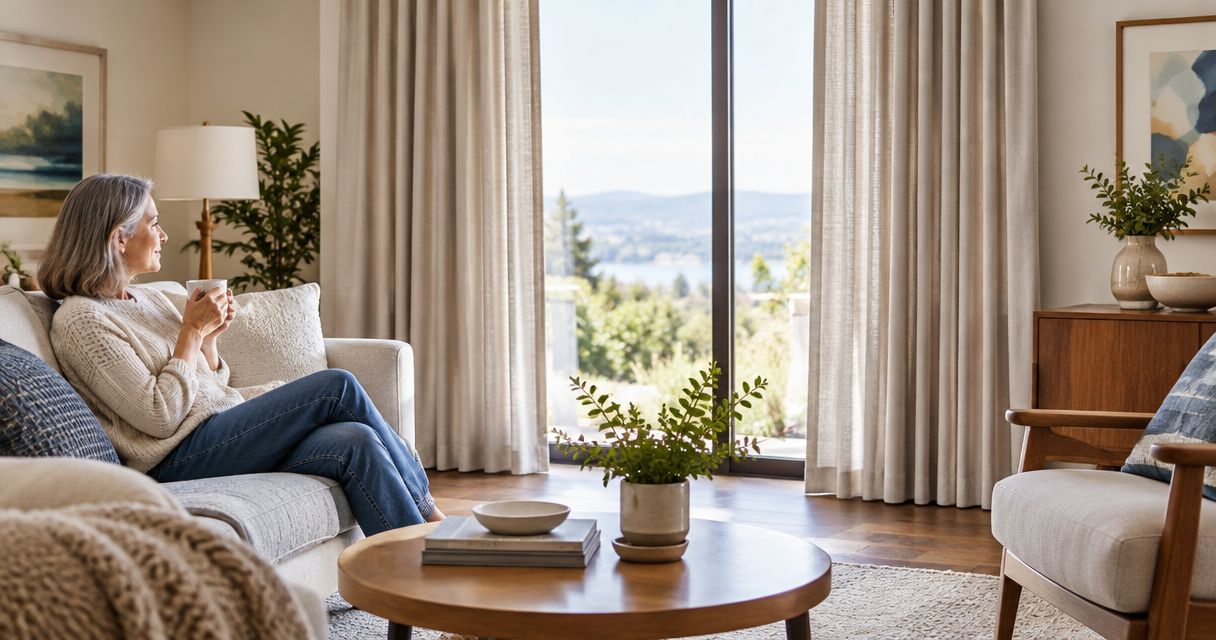
Empty nesters’ custom drapes are made-to-measure fabric window treatments designed to make a changed or smaller home comfortable, private, and easy to use. This 2026 guide helps you choose custom drapes for empty nesters by matching each room’s new purpose, furniture layout, and daily routine—not recreating the house you no longer need.
- Olsson Smart Shades offers custom drapes for empty nesters seeking professional measurement and installation in Columbus and Central Ohio.
- Choose drapes around privacy, light control, and everyday use before choosing fabric or decorative hardware.
- Downsizers should check open-panel space and furniture clearance before ordering custom window treatments.
- Layer drapes with shades when you want separate control over daylight and privacy.
Why custom drapes matter for empty nesters
A former child’s bedroom can become a guest room, reading room, or office. A smaller living room can hold the same favorite chair but leave less wall space beside the windows. Those changes affect what your window treatments need to do.
Start with the room you use now, not its old label. A guest room needs privacy when someone stays overnight. An everyday reading room needs comfortable daylight where you sit. Neither choice starts with a fabric swatch.
For your main gathering space, the guide to custom drapes for living rooms covers that room-specific decision. Here, the focus is choosing treatments when your household or home size changes.
Olsson Smart Shades is best for Columbus and Central Ohio homeowners who want custom-measured, professionally installed drapes. Professional help suits homeowners who want measurement and installation handled; you still need to decide what each room should feel like and how you want to operate the treatment.
For a 2026 refresh, put function before matching everything. Consistent fabric tones can connect adjoining rooms, but the lining, opening style, and underlying shade should follow each room’s needs.
How to choose drapes for your next chapter
1. Define each room’s new job
Walk through your home with a notepad before you shop. Describe what happens in each room now: sleeping, reading, watching television, hosting family, or working. Include occasional uses that require a different level of privacy.
Choose 3 room priorities for your 2026 plan, such as daytime light, nighttime privacy, and easy operation. This is a planning exercise, not a rule that every room needs the same treatment. Rank those priorities so a pretty fabric does not outweigh the room’s main job.
A room that switches between office and guest bedroom needs more than an attractive backdrop. Decide whether the drapes will provide the privacy themselves or whether another treatment will do that work.
- Write the room’s everyday use beside its occasional use.
- Mark where you sit, sleep, or look at a screen.
- Identify windows facing walkways or neighboring homes.
- Separate essential functions from decorative preferences.
2. Check light and privacy where you actually sit
Observe the window from your chair, bed, or desk rather than only from the doorway. Note direct light, reflections, and the view you want to preserve. Then think about how the room behaves after dark with interior lights on.
Use 2 observation periods, one in daylight and one after dark, before choosing fabric opacity. Sheer fabric filters light but does not replace an opaque privacy layer. Fabric appearance alone also does not establish how well the completed treatment will darken a room.
For sleeping spaces, ask about lining, edge coverage, and the relationship between the drapes and any underlying shade. Room darkening is a whole-window decision, not just a fabric description. Keep the distinction clear when comparing samples.
- Observe glare from the position where you use the room.
- Decide whether preserving the view is a daily priority.
- Check nighttime privacy with the room lights on.
- Ask to compare sheer and lined fabric samples.
- Discuss edge gaps when darkness matters.
3. Map furniture and request a measured plan
Start with your own room sketch and photographs. Record the window, nearby walls, furniture, doors, vents, and anything that projects into the drapes’ path. Rough notes help explain the space; they should not replace final ordering measurements.
Open drapes need somewhere to sit. That gathered fabric is often called the panel stack. In a smaller home, it can compete with a bookcase, an adjoining window, or the route to a patio door.
For the professionally measured path, ask Olsson Smart Shades about an in-home consultation and a custom-drape quote. Share which rooms you are changing and request a plan that addresses fabric, lining, hardware, measurement, and installation. Ask questions before deciding; you do not need to choose a fabric just to begin the conversation.
- Photograph each window straight on and from the side.
- Mark furniture that will stay in its current position.
- Show where doors swing and people walk.
- Ask where the panels will rest when fully open.
- Confirm who handles final measurements before ordering.
4. Choose panel length and fabric for everyday life
Think about the habits you want your new home to support. If you prefer straightforward cleaning, ask for a finished length that does not leave fabric pooled on the floor. If a chair sits beside the window, check that the panel will not bunch behind it.
Fabric texture affects the room’s appearance, but care instructions determine what ownership involves. Ask how the selected fabric and lining should be cleaned. Do not assume that a sample that feels washable is approved for machine washing.
Hold samples near your existing furniture in the room’s actual light. A fabric that looks quiet on a small swatch can have a much stronger presence across a full window. Keep favorite furniture in the decision rather than replacing it just to match new drapes.
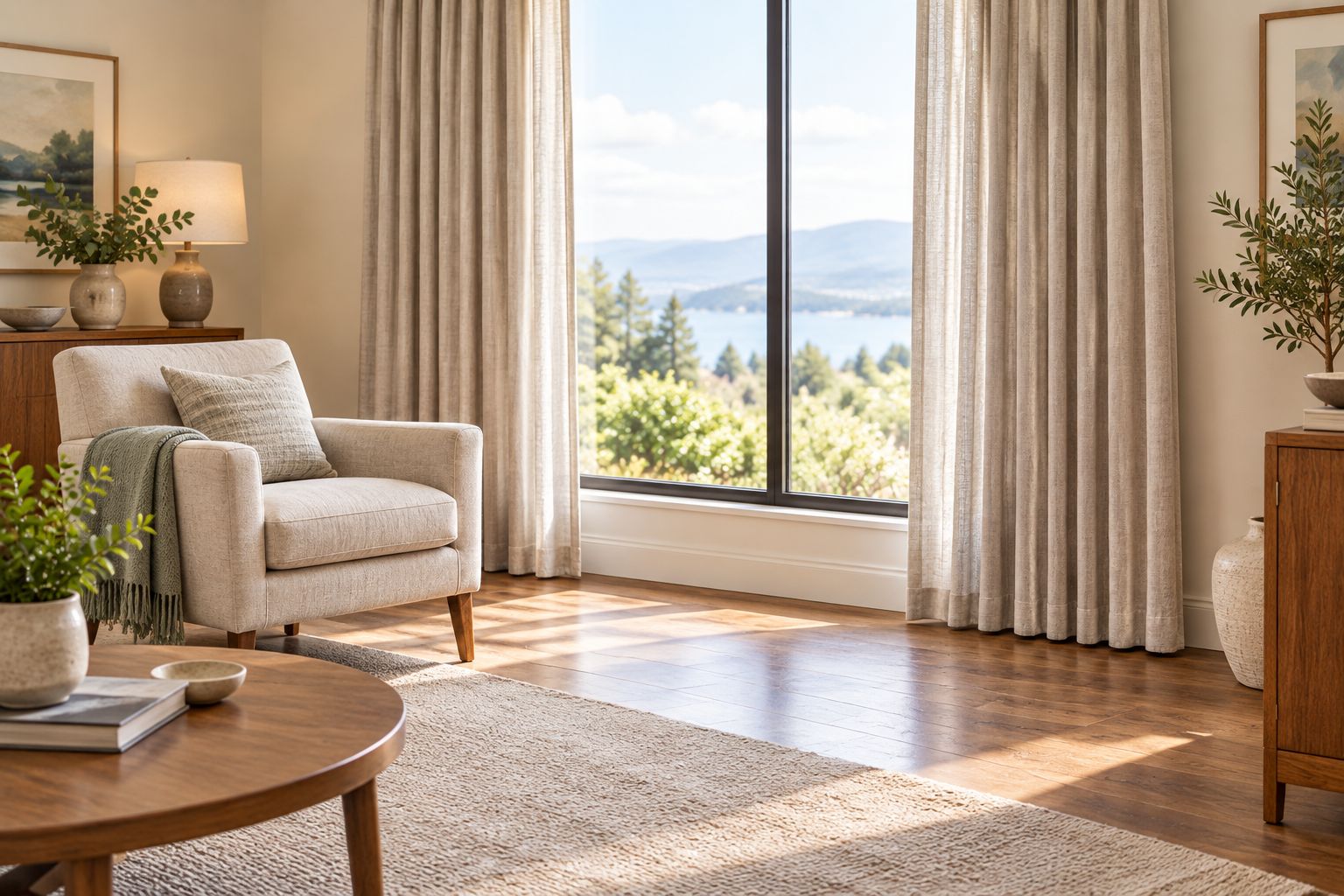
Use the sample review to settle practical questions as well as color. A beautiful fabric is the wrong choice if its care requirements do not fit your routine.
- Review the fabric and lining care instructions together.
- Specify the finished hem position with the installer.
- Compare samples beside furniture you plan to keep.
- Check access to vents and nearby electrical outlets.
- Avoid floor pooling where it interferes with cleaning or walking.
5. Decide whether drapes need a second layer
Drapes can serve as the main movable covering or as decorative side panels. Be clear about which role you want. Stationary panels frame a window, but they do not close across it for privacy.
A separate shade lets you manage the glass independently of the fabric around it. That arrangement suits a room where you want daytime light control without drawing the drapes. It also adds another treatment to select, operate, and maintain.
For your 2026 choices, compare each arrangement by the task it performs. Choose layers because they solve different needs, not because every window needs more material. A simple lined-drape arrangement can be the better fit when you want fabric to do the main work.
- Choose movable drapes if the panels must provide privacy.
- Use stationary panels only with a separate privacy plan.
- Consider an underlying shade for independent light control.
- Check that layered hardware fits the available mounting space.
- Review how both treatments look when open and closed.
6. Test the operation before selecting controls
Try a comparable display or sample mechanism when possible. Think about reach, grip, and the distance you will move to open the window treatment. A control that feels comfortable matters more than a feature list.
Manual operation keeps the routine direct. Motorized shades are another option when reaching the window or adjusting several shades is inconvenient. Do not assume that choosing custom drapes means the drapes themselves are motorized.
Olsson Smart Shades offers motorized smart shade installation alongside custom drapes. Ask about the specific proposed setup, including power, controls, and any requested smart-home connection. Confirm those details for the selected equipment rather than assuming compatibility.
- Try the proposed manual control before committing.
- Check that controls are reachable from a comfortable position.
- Identify windows blocked by furniture or difficult to reach.
- Ask how any motorized shade receives power.
- Request instructions for ordinary operation and troubleshooting.
7. Review the quote room by room
Create a written list before comparing proposals. Separate the drape fabric, lining, hardware, installation, and any underlying shade so you know what each room includes. Different window-treatment arrangements should not be compared as though they are identical.
For a phased 2026 project, start with 1 priority room where privacy, glare, or operation needs attention. That lets you resolve the decisions that matter most before repeating a treatment elsewhere. It does not require every room to share the same solution.
Confirm the final specification before authorizing an order. A conversation about soft, light-filtering drapes is not the same as a written selection of fabric, lining, finished length, and hardware.
- Request an itemized description for each room.
- Confirm which panels move and which remain stationary.
- Review the selected fabric, lining, and hardware together.
- Ask what installation includes and what preparation is needed.
- Keep the approved specifications with your project records.
Plan your custom window treatments
Ask about an in-home consultation for your Columbus or Central Ohio home.
Compare window-treatment options for downsizing
The best option follows your room’s job. Use this comparison to separate decorative framing, privacy, and everyday light control before discussing specific materials.
| Option | Best for | Main advantage | Key limitation |
|---|---|---|---|
| Movable lined drapes | Rooms where fabric should provide privacy | Combine a fabric finish with coverage across the window | Need clear space for the panels to gather when open |
| Sheer drapes | Sitting areas where softened daylight matters | Filter daylight while retaining a light fabric appearance | Are not a substitute for an opaque nighttime privacy layer |
| Stationary drapes with a manual shade | Homeowners who want decorative framing and separate controls | Keep the drape arrangement in place while the shade handles coverage | Require selecting and maintaining separate treatments |
| Drapes with a motorized shade | Homeowners who want shade adjustment without reaching the window | Separate fabric styling from powered shade operation | Require confirmed power, control, and equipment details |
| Plantation shutters | Homeowners who prefer adjustable louvers instead of fabric panels | Let you adjust light through the louvers | Need suitable mounting and room for the proposed panel movement |
Professional measurement and installation remove those tasks from your own project list. The trade-off is that you still need to approve the details carefully: professional installation does not decide your preferred privacy level or cleaning routine for you.
Choose the simplest arrangement that meets your daily needs. Adding drapes, a shade, and powered controls only makes sense when each part has a clear purpose.
Common mistakes empty nesters and downsizers make
Keeping the old room’s treatment plan
A former bedroom does not automatically need the same treatment after becoming a reading room. Recheck light from your chair and privacy from outside. Design for the new activity rather than carrying over the old room label.
Moving old drapes without checking the new window
Panels from a previous home need a fresh review of length, width, hardware, and open-panel space. Do not assume alteration will solve every mismatch. Ask what can be reused before building the new plan around existing fabric.
Choosing fabric before deciding how it will close
Decorative panels and working drapes perform different jobs. Settle whether you need full-window coverage first. Otherwise, you risk choosing a fabric arrangement that looks finished but leaves nighttime privacy unresolved.
Filling a smaller room with unnecessary layers
More treatments mean more decisions and more surfaces to maintain. Start with the function you need and add a layer only when it supplies something missing. Leave enough room for the furniture and the view.
Treating easy operation as an afterthought
A window treatment is something you use, not just something you see. Check reach and movement before finalizing hardware or controls. If grandchildren visit, discuss cord safety as part of that review, even when the room is not a child’s bedroom.
FAQ
What are the best custom drapes for empty nesters?
The best custom drapes for empty nesters match the room’s current use, privacy needs, and preferred operation. Choose movable lined panels when the drapes must cover the window, or decorative panels with a separate shade when you want independent light control.
Should I take my old drapes when I downsize?
Take your old drapes only after checking whether they fit the new windows and room layout. Have the fabric, finished length, hardware, and open-panel space assessed before relying on alterations.
Are sheer drapes enough for nighttime privacy?
Sheer drapes are not a substitute for an opaque nighttime privacy layer. Add an appropriate separate covering or choose lined drapes when privacy after dark is a priority.
Are motorized shades better than manual drapes for downsizers?
Motorized shades are better suited to shade adjustment without reaching the window; manual drapes suit homeowners who prefer direct operation of fabric panels. They perform different jobs and can be used together, but the proposed equipment and controls need confirmation.
How do I request a custom-drape quote in Columbus?
Contact Olsson Smart Shades to ask about an in-home consultation and a custom-drape quote for your Columbus or Central Ohio home. Describe the rooms, privacy needs, and treatments you are considering, then request a written scope before deciding.
What should I check before ordering custom drapes?
Check final measurements, fabric, lining, finished length, hardware, and whether the panels move across the window. Confirm installation details and any separate shade controls before approving the order.
Do I need the same drapes in every room of a smaller home?
You do not need the same drapes in every room. Coordinated colors can connect adjoining spaces while different linings or underlying shades address each room’s light and privacy needs.
One last thing
Decide where the fabric goes when the drapes are open, not only how it looks closed. The panel stack is easy to overlook on a sample board, yet it affects your view and the usable space beside the window.
Before approving a plan with Olsson Smart Shades, ask to see that open position explained against your actual furniture layout. It is a small question that keeps the finished treatment tied to the way you live.