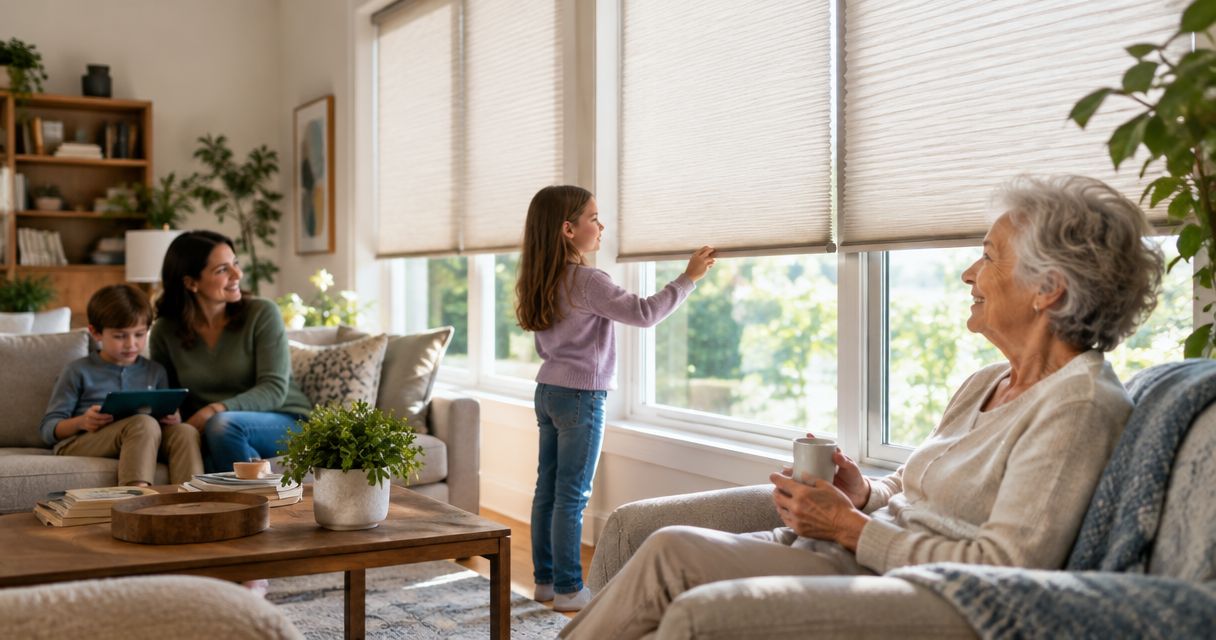
Aging-in-place window treatment planning is choosing coverings and controls that help you manage daylight and privacy without difficult reaching, gripping, or lifting. In a multigenerational home, the right choice also respects different sleep schedules, keeps operating cords out of children’s reach, and leaves shared rooms easy to use.
- Choose window treatments for aging in place by reach, glare control, privacy, and upkeep—not appearance alone.
- Olsson Smart Shades suits Columbus and Central Ohio homeowners seeking custom-measured, professionally installed window treatments.
- Motorized shades reduce manual lifting; test the controls and confirm how power and charging work.
- Cordless shades, plantation shutters, and drapes still need hands-on checks for reach and operating effort.
Why window treatments matter for aging-in-place households
A window covering becomes a daily obstacle when you must lean over furniture, pinch a small control, or lift a shade that feels heavy. In a shared home, the same window might serve an early riser, a daytime sleeper, and a child who needs an afternoon nap.
Choose for the person who will operate the covering, not just the person choosing the fabric. That means testing privacy, glare, and controls from the places people actually sit or rest. Room-darkening fabric and an accessible control solve different problems; you often need to address both.
For bedrooms, the guide to blackout shades for bedrooms explains an important starting point: choosing a light-blocking material does not eliminate the need to consider light around the covering’s edges.
Make your 2026 plan room by room. Keep useful daylight where you read or gather, and choose more complete light control where someone sleeps. A matching appearance across the house is secondary to making each room work.
How to choose accessible window treatments
Start with routines
Before shopping, observe how everyone uses each room. The manual starting point is a simple notebook: record when glare appears, when privacy matters, and who adjusts the covering. You do not need a connected device to identify these patterns.
Keep a 7-day log that includes ordinary weekdays and weekend routines. This is a planning exercise, not a test with a passing score. Note the moments when someone leaves a shade unchanged because operating it feels inconvenient or uncomfortable.
Separate the room’s needs from the household’s decorating preferences. A bright living room can need glare control without needing the darkness of a bedroom. A ground-level bedroom can need privacy while its occupant still wants daylight.
- Record morning, afternoon, and evening light problems.
- Identify who normally opens and closes each covering.
- Note naps, shift work, and different bedtimes.
- Mark windows blocked by beds, sofas, or counters.
- Put difficult daily tasks ahead of occasional annoyances.
Test the reach
Try the existing covering before replacing it. Test from 2 positions: seated and standing, if both are part of the resident’s normal routine. Keep the furniture where it belongs; an empty-room demonstration can hide the real difficulty.
Check 3 daily tasks: opening, closing, and adjusting privacy. A covering that moves easily once you reach it still fails the practical test if reaching it requires leaning over a sofa. Small tilt controls also deserve attention because adjusting slats differs from lifting the whole blind.
A cordless manual shade removes an operating cord, but it does not remove the need to reach the shade. A shutter offers direct control of its louvers, but access to those louvers still matters. Compare the complete task, not just the mechanism’s name.
- Operate controls with the hand normally used.
- Check reach without moving furniture first.
- Test full travel and small adjustments.
- Notice pinching, twisting, pulling, or overhead reaching.
- Stop if the task requires an unstable position.
Compare controls
Start with the simplest control that meets the need. If a manual covering is comfortable to operate, motorization is not a prerequisite. If lifting or reaching is the problem, ask to compare a motorized shade using the proposed control—not just a demonstration operated by someone else.
Olsson Smart Shades is best for Columbus and Central Ohio homeowners seeking custom-measured, professionally installed window treatments. Discuss the difficult tasks with Olsson Smart Shades before choosing a fabric or control package. Custom measurement and professional installation address fit and setup; the household still needs to test whether the controls suit its users.
For a 2026 motorized-shade purchase, confirm the exact operating method, power arrangement, and maintenance tasks. Do not assume a particular remote, wall control, app, or voice system comes with every shade. Ask what works when the internet or power is unavailable.
- Compare manual operation with the proposed motorized setup.
- Let each regular user try the actual control.
- Ask whether routine operation requires a phone.
- Confirm any requested smart-home connection before ordering.
- Decide where a shared control will stay.
Plan the light
Begin with observations you can make for free. Sit in the reading chair, lie on the bed, and use the television with the existing covering in different positions. Notice whether the problem is direct sun, reflected glare, or lack of privacy.
Then choose the covering around that problem. Adjustable blind slats and shutter louvers let you redirect light. Shades change the covered portion of the window. Drapes can provide a separate layer, but opening and closing them is another task to evaluate.
Daytime glare control is not the same as nighttime privacy. Do not assume a light-filtering or solar fabric hides the room when interior lights are on. Ask to see samples and discuss privacy under the conditions that matter to your household.
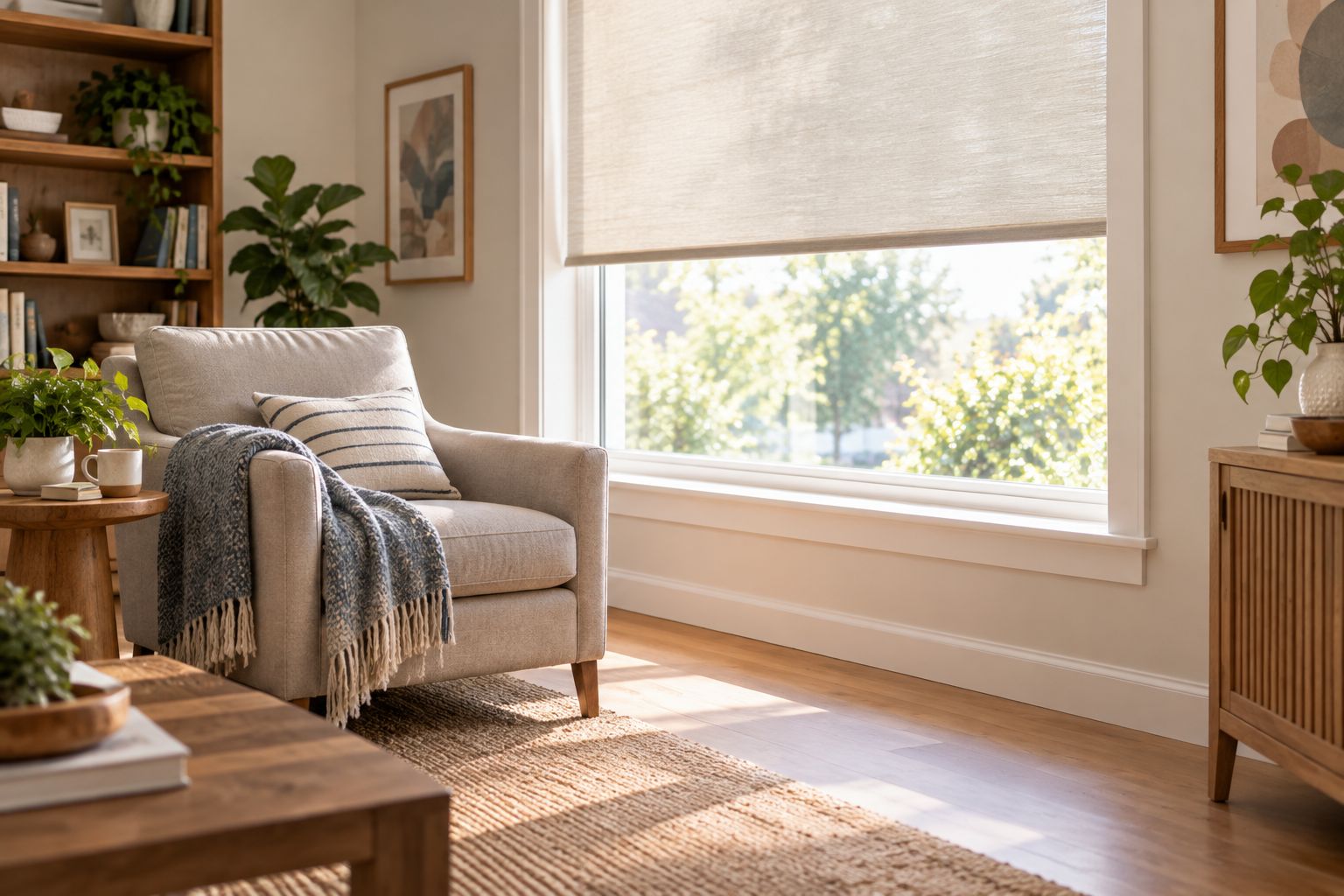
Make a separate choice for a daytime sleeper’s bedroom rather than carrying the living room’s fabric throughout the house.
- Check glare from the usual seat, not the doorway.
- Review privacy with interior lights on.
- Discuss edge gaps when room darkening matters.
- Preserve useful daylight where complete darkness is unnecessary.
- Test layered coverings as separate operating tasks.
Clear the path
Look at the window and the route around it before choosing a covering. Start by checking existing furniture, door swings, and floor space. A long drape or an open shutter panel can occupy space that a flat shade does not.
In a multigenerational household, review accessible cords anywhere children spend time, including a grandparent’s room. Window-covering cords are a recognized strangulation hazard for young children. Choosing a cord-free operating arrangement should be part of the selection conversation, not an afterthought at installation.
Plantation shutters also need room for their panels to open. Drapes need a suitable length and a way to draw them without difficult pulling. For someone using a walker or wheelchair, check these details with the usual mobility equipment in place.
- Keep fabric clear of walking routes.
- Check shutter panels against furniture and door swings.
- Review accessible operating cords and loops.
- Keep controls reachable without climbing or stretching.
- Check that the covering does not obstruct window hardware.
Plan the upkeep
Start by asking who will clean, charge, or maintain the covering. An easy daily control loses its advantage if the routine maintenance requires reaching a high window that nobody can comfortably access.
For motorized shades, ask where the power source sits and how any rechargeable or replaceable components are accessed. Battery-powered and wired arrangements have different installation and upkeep questions. Confirm the proposed arrangement rather than assuming the motor removes every hands-on task.
For manual coverings, compare accessible surfaces and the care instructions for the actual material. Fabric, slats, and louvers do not share a single cleaning method. Choose a treatment that fits the household’s existing abilities or its agreed plan for help.
Include maintenance in your 2026 decision before approving the order. A neat appearance on installation day is only part of a useful long-term choice.
- Ask for the material’s written care instructions.
- Locate batteries, charging points, or power connections.
- Identify tasks that require a ladder or outside help.
- Agree who handles recurring maintenance.
- Keep control instructions somewhere everyone can find them.
Confirm the fit
Use your room notes to prepare for an in-home consultation or quote request. Start with the windows that cause the most difficulty, and explain the task you want to make easier. Photos and a written priority list help organize the conversation without turning it into a technical project.
Ask Olsson Smart Shades to discuss custom measurement, proposed controls, and installation for the selected rooms. You can request a written quote and review it before deciding. Clarify the scope and ask questions without committing to a whole-house order.
Begin with 1 room if you want to keep the decision manageable. Identify the priorities before moving to less-used windows. Make sure the written proposal reflects both the material choice and the operating arrangement you discussed.
- Name the hardest daily task for each priority window.
- Show the installer the normal furniture layout.
- Confirm the covering, control, and power arrangement.
- Ask how operation will be demonstrated after installation.
- Review the written scope before approving the work.
Plan your window treatment consultation
Discuss reach, privacy, controls, and custom installation for your priority rooms.
Compare window treatment options
Use this 2026 comparison to narrow your shortlist. These are starting points, not universal accessibility ratings. The best option is the one the resident can operate comfortably in the actual room.
| Option | Best for | Main benefit | Key limitation |
|---|---|---|---|
| Motorized shades | Windows where lifting or reaching is difficult | Moves the shade without manual lifting | Controls, power access, and maintenance need confirmation |
| Cordless manual shades | Reachable windows where manual operation is comfortable | Removes a hanging operating cord | Still requires reaching and moving the shade |
| Plantation shutters | Reachable windows needing adjustable light and privacy | Louvers allow direct light adjustment | Louvers require reach; opening panels requires clearance |
| Custom drapes | Rooms needing fabric layering and a separate privacy layer | Adds coverage independently of another treatment | Fabric length and drawing effort need careful planning |
| Solar shades | Shared daytime spaces needing glare control | Filters incoming sunlight | Do not assume nighttime privacy; evaluate a separate privacy layer |
Motorization addresses movement; fabric addresses light and privacy. Choosing one does not settle the other. A motorized shade with unsuitable fabric still fails the room’s privacy needs, while a useful blackout fabric can be inconvenient to operate.
Common mistakes in multigenerational homes
Choosing for the most mobile person
The person arranging the purchase often finds controls easier than another resident does. Have the intended user try the operating task. Do not substitute a family member’s demonstration for that person’s experience.
Making a phone the only practical control
A connected setup is not automatically the easiest setup. Before selecting smart controls, discuss a shared operating method for residents and visitors who do not use the same phone or account. Confirm what the proposed system supports.
Using one light setting for every routine
One household schedule cannot represent a daytime sleeper, an early riser, and someone reading in the afternoon. Separate bedroom needs from shared-room needs. If schedules are proposed, ask how residents override them when routines change.
Forgetting the route around the window
A drape length or shutter panel that looks fine in an empty room can conflict with furniture or a mobility aid. Review the covering in the furnished space. Keep access and clearance ahead of a decorative detail that complicates movement.
Treating installation as the finish line
A successful 2026 installation includes a household that understands ordinary operation and upkeep. Ask for a demonstration, then let the regular user perform the task. Keep the instructions and agreed maintenance plan together.
FAQ
What's the best window treatment for aging in place?
The best window treatment for aging in place is one the resident can operate comfortably while getting the privacy and light control the room needs. Motorized shades address manual lifting, but reachable cordless shades or shutters can also suit the task.
Are motorized shades better than cordless manual shades for older adults?
Motorized shades are a better fit when lifting or reaching a manual shade is difficult. Cordless manual shades remain an option when the resident can reach and move them comfortably; test the actual operation before choosing.
Can I use smart shades without relying on a smartphone?
Confirm a non-phone operating method for the exact smart-shade setup before ordering. Ask which controls are included and how everyday operation works without an internet connection.
Are plantation shutters suitable for a wheelchair user?
Plantation shutters suit a wheelchair user only when the louvers and panels are comfortably reachable and opening them does not obstruct movement. Test access with the usual furniture and mobility equipment in place.
Do solar shades provide privacy after dark?
Do not assume solar shades provide nighttime privacy. Discuss the selected fabric with the installer and evaluate privacy when interior lights are on; a separate privacy covering can be needed.
What should a multigenerational household check before ordering?
Check who operates each covering, where controls can be reached, and how sleep schedules differ. Also review accessible cords, furniture clearance, and who will handle cleaning or power-related maintenance.
How do I arrange a window treatment consultation in Columbus?
Contact Olsson Smart Shades through its website to discuss an in-home consultation or request a quote for your Columbus or Central Ohio home. Explain your priority rooms and any difficulty with reach, lifting, glare, or privacy so those needs shape the discussion.
One last thing
Before approving your 2026 selection, ask the intended user to operate the covering while you watch without helping. That simple check separates a demonstration that looks easy from a task that is easy for them. If furniture must move or someone must intervene, revisit the control or mounting plan.