Insolroll is a specialist in solar roller shades, a useful starting point when glare control is your main concern. A roller-shade comparison alone does not answer whether you need insulating shades, adjustable slats, drapes, or help measuring and installing them. The best Insolroll alternative in 2026 is Olsson Smart Shades if you need custom-measured, professionally installed window treatments in Columbus and Central Ohio; cellular shades are the alternative to compare if insulating construction is your priority.
- Olsson Smart Shades is the local-service choice among insolroll alternatives for custom window treatments and professional installation.
- Compare cellular shades for insulating construction, plantation shutters for adjustable louvers, and drapes for fabric coverage.
- Motorized shades describe how a treatment operates, not how much light or privacy its fabric provides.
- Keep Insolroll on your shortlist when solar roller shades match the room’s needs.
Why this matters
You are comparing two different decisions: what belongs on your windows and who will help you choose and install it. Insolroll is a product-brand comparison. A local window-treatment business is a service comparison. Neither replaces the other.
For your 2026 project, start with the room rather than a brand ranking. A sunny home office needs a different balance of light and privacy than a bedroom. A shade that handles afternoon glare does not automatically solve nighttime visibility or leave a patio door easy to use.
The alternatives below include a local installation business and different treatment types. They are not interchangeable manufacturers. That distinction helps you compare useful options without assuming every company sells the same products.
Insolroll alternatives at a glance
Use this table to narrow the decision. The Insolroll row benchmarks the solar roller-shade use case; it does not describe every product or configuration the company offers.
| Option | Best for | Standout feature | Main trade-off | Difference from the solar roller-shade approach |
|---|---|---|---|---|
| Insolroll | Homeowners comparing solar roller shades | A specialist starting point for solar shading | Solar shading alone does not establish nighttime privacy | The benchmark for this comparison |
| Olsson Smart Shades | Columbus and Central Ohio homeowners wanting measured and installed treatments | Custom blinds, shades, shutters, drapes, and motorized smart shades | A local service comparison, not a like-for-like manufacturer comparison | Helps you compare treatment categories as well as installation needs |
| Cellular shades | Homeowners prioritizing insulating construction | Honeycomb-shaped fabric pockets | No slats to tilt while the shade stays lowered | A different fabric construction and light-control approach |
| Plantation shutters | Homeowners wanting adjustable louvers | Framed panels with tilting louvers | Panel movement needs clearance | A framed treatment rather than rolled fabric |
| Custom drapes | Homeowners wanting fabric coverage and layering | Panels that draw across the window | Open panels need somewhere to stack | Adds fabric around the window rather than only across the glass |
| Slatted blinds | Homeowners wanting adjustable light and sightlines | Slats tilt without raising the entire treatment | Slat openings and edges do not provide complete darkness | Adjusts light through slats rather than a continuous fabric panel |
1. Olsson Smart Shades: best for local measurement and installation
Olsson Smart Shades provides custom-measured blinds, shades, plantation shutters, drapes, and motorized smart shades for homeowners in Columbus and Central Ohio. Choose this route when your main question is not simply which roller shade to buy, but which treatment fits each room and how it will be installed.
Olsson Smart Shades is best for Columbus and Central Ohio homeowners who want custom window treatments measured and professionally installed. The useful distinction is the service: you can consider different treatment types without treating every window as a roller-shade project.
Where the local service shines
- Custom measurement and professional installation are part of the stated offering.
- The treatment range includes blinds, shades, plantation shutters, and drapes.
- Motorized smart shade installation is available as a service.
Where the local service falls short
- It is not a direct replacement for a manufacturer specification sheet.
- A local installation service is not the right comparison for a product-only search outside the stated region.
- The service description does not establish compatibility with your particular smart-home equipment.
| Decision | Olsson Smart Shades | Insolroll comparison |
|---|---|---|
| What you are choosing | A local measurement and installation business | A shade manufacturer |
| Starting question | Which treatment fits this room? | Which specified shade fits this application? |
| Treatment scope | Blinds, shades, shutters, drapes, and motorized smart shades | Compare the selected product’s specifications |
Best for: A homeowner who wants help turning room needs into an installed treatment.
Verdict: Buy the local-service approach when measurement and installation matter; confirm the proposed product before ordering.
2. Cellular shades: best for insulating construction
Cellular shades use a honeycomb-shaped structure with air pockets. That construction makes them a useful alternative when insulation belongs near the top of your checklist, rather than glare control alone.
Light filtering and room darkening are separate choices. Do not assume that the cellular shape guarantees darkness, privacy, or a particular energy saving. Those outcomes depend on the material, fit, installation, and window.
Where cellular shades shine
- The cellular construction creates air pockets within the shade.
- Fabric choices let you consider different levels of light transmission.
- A fabric treatment suits homeowners who do not want visible slats.
Where cellular shades fall short
- You cannot tilt louvers to redirect light while keeping the shade lowered.
- Light-blocking fabric does not eliminate gaps around the installation.
- Cleaning instructions vary by fabric and construction.
| Dimension | Cellular shades | Solar roller-shade approach |
|---|---|---|
| Construction | Honeycomb-shaped fabric pockets | Fabric rolling around a tube |
| Primary comparison | Insulating construction and fabric opacity | Glare control and fabric openness |
| Light adjustment | Raise or lower the selected configuration | Raise or lower the selected configuration |
Best for: Bedrooms and living spaces where insulating construction is a priority.
Verdict: Buy cellular shades for their construction; skip claims of guaranteed savings without product-specific evidence.
3. Plantation shutters: best for adjustable louvers
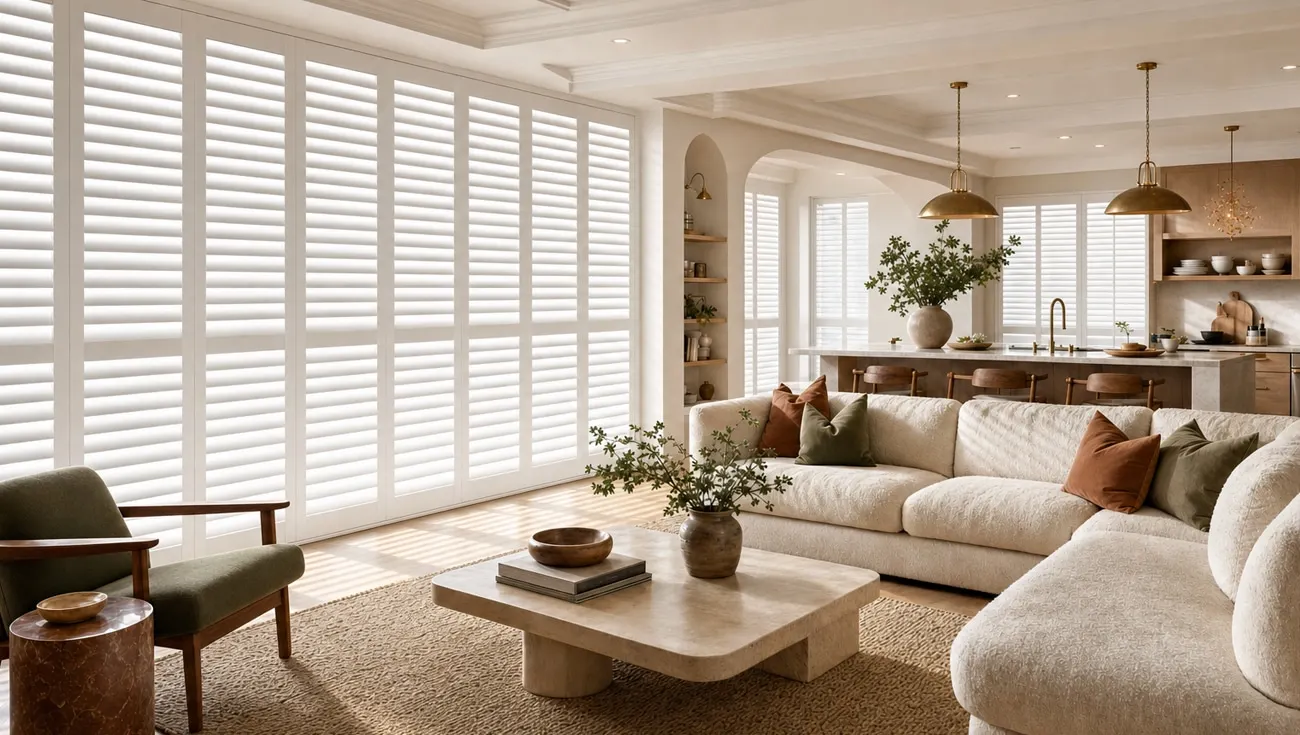
Plantation shutters put adjustable louvers inside framed panels. You can change the louver angle without lifting a fabric shade, which gives you a different way to manage light and sightlines.
Panel clearance matters as much as appearance. Check whether the panels can open around furniture, handles, and nearby walls before deciding that shutters suit the window.
Where plantation shutters shine
- Louvers adjust light and sightlines while the panels stay in place.
- The frame gives the window a defined, architectural finish.
- The treatment does not rely on fabric rolling up above the glass.
Where plantation shutters fall short
- Hinged panels need room to open.
- Frames and louvers remain visible across the window.
- Material suitability depends on the room and the specific product.
| Dimension | Plantation shutters | Solar roller-shade approach |
|---|---|---|
| Light control | Tilt louvers | Adjust shade height and select fabric |
| Open position | Louvers and frame remain; panels can open | Fabric rolls upward |
| Space planning | Allow for panel movement | Allow for mounting hardware and the rolled shade |
Best for: Homeowners who want framed windows and adjustable louvers.
Verdict: Buy shutters when louver control matters; skip them where panel clearance does not work.
4. Custom drapes: best for fabric coverage and layering
Custom drapes change both the window treatment and the space around it. They can stand alone or work alongside a shade, giving you separate ways to manage daytime light and evening coverage.
Plan where the fabric goes when it is open. A narrow wall beside the window, a nearby door, or furniture beneath the treatment can change the practical layout.
Where custom drapes shine
- Fabric panels add a different texture from blinds or roller shades.
- Drapes can layer with another treatment rather than replace it.
- Lining and fabric choices let you address light control deliberately.
Where custom drapes fall short
- Open panels occupy space beside the window or across part of the glass.
- Fabric care requires attention to the specific material.
- Light can still enter around edges unless the layout addresses it.
Best for: Living rooms and bedrooms where fabric coverage and layering suit the room.
Verdict: Buy drapes when you have space for the panels; hold the order until the open and closed positions are planned.
5. Slatted blinds: best for adjustable light and sightlines
Slatted blinds let you tilt the slats rather than raise the whole treatment each time you want a change. They are a practical alternative when you prefer adjustable openings to a continuous fabric panel.
Compare the material and cleaning needs for the actual room. Kitchens and bathrooms need a different material discussion from dry living spaces.
Where slatted blinds shine
- Slats adjust the balance between light and visibility.
- You can raise the blind when you want the window more exposed.
- The operation differs clearly from a roller shade.
Where slatted blinds fall short
- Slats need regular dusting.
- Openings between slats and around edges prevent complete darkness.
- Material selection matters in damp spaces.
Best for: Rooms where you want frequent adjustments without fully raising the treatment.
Verdict: Buy blinds for tilt control; skip them when your main requirement is complete darkness.
How to choose an alternative for your room
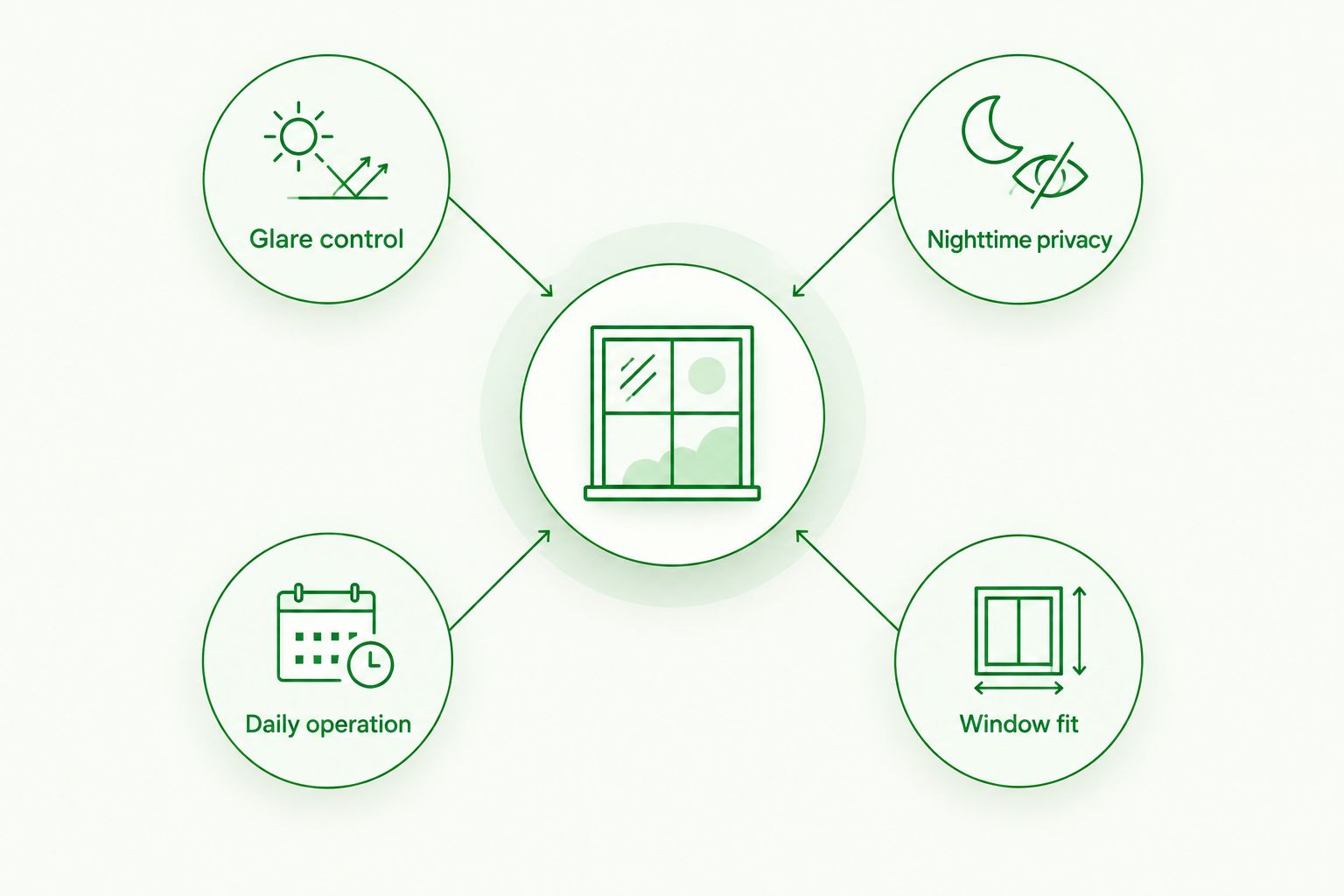
Before requesting a quote in 2026, write down what the treatment must do. Use these four checks to keep the conversation focused on your home rather than a long product list.
Glare control
Identify where sunlight interrupts daily use. Is it on a television, a work screen, or your usual seat? Ask how the proposed fabric handles glare and how much view it preserves.
Nighttime privacy
Assess privacy after dark as a separate requirement. When indoor lights are brighter than outdoors, an open-weave solar fabric does not provide the same privacy as an opaque treatment. Ask to see the fabric’s intended privacy characteristics.
Daily operation
Decide whether manual operation suits your routine or whether motorization solves a real access problem. Motorization moves the treatment; it does not change the fabric’s light transmission. Confirm controls, power arrangements, and any requested smart-home connection for the exact proposed system.
Window fit
Look at handles, trim, nearby furniture, and access to the window. Discuss the inside or outside mounting position before placing an order. Fit affects both daily use and the light that enters around the treatment.
Why people consider switching from Insolroll
A switch makes sense when your requirements call for a different construction or buying process. It does not require a problem with Insolroll.
- You want insulating construction. Compare cellular shades rather than treating every fabric shade as equivalent.
- You want tilt control. Shutters or blinds change light through adjustable louvers or slats.
- You want fabric layering. Drapes answer a different design and coverage need.
- You need a local installation service. Compare measurement, product selection, and installation responsibilities separately from the manufacturer.
For a 2026 comparison, ask each provider to address the same room requirements. A proposal for a manually operated light-filtering shade is not equivalent to one for an opaque motorized treatment. Compare what is specified, not just the name at the top.
How to request a useful consultation or quote
Start with the room that gives you the most trouble. Describe the issue in plain language: afternoon glare, visibility after dark, awkward access, or a treatment that gets in the way of a door.
When you inquire about an in-home consultation, ask what the appointment includes and who handles measurement and installation. Request a written proposal that identifies the treatment, material, operation, mounting position, and installation scope. Ask about any policies directly before agreeing to an order.
You do not need to choose the final fabric before starting the conversation. Explain your priorities first. If motorization is important, name the controls or smart-home equipment you want to use and request confirmation for the proposed system.
Start your window-treatment inquiry
Ask about custom measurement, installation, and the treatment options that fit your rooms.
When staying with Insolroll is the right call
Keep Insolroll on your shortlist if solar roller shades address your actual needs. You do not need to change categories just because shutters or drapes offer a different appearance.
For a 2026 purchase, the useful test is the specified treatment: fabric, mounting, operation, privacy, and installation. If those details meet your requirements, staying with the original choice is reasonable. A different brand name is not a benefit by itself.
FAQ
What’s the best Insolroll alternative in Columbus?
Olsson Smart Shades is the local-service choice if you want custom-measured, professionally installed window treatments in Columbus and Central Ohio. It offers blinds, shades, plantation shutters, drapes, and motorized smart shades, so the comparison extends beyond roller shades.
Is a local installer the same as an Insolroll alternative manufacturer?
No, a local installer and a shade manufacturer serve different roles. Compare the proposed product separately from the business responsible for measurement and installation.
Are cellular shades better than solar roller shades?
Cellular shades are the better category to compare when insulating construction is your priority. Solar roller shades address a different starting need: managing sunlight and glare through the selected fabric.
Do solar shades give me privacy at night?
An open-weave solar shade should not be treated as a nighttime privacy solution. Ask about an opaque treatment or a separate privacy layer if people outside must not see into the room after dark.
Are motorized shades automatically smart-home compatible?
No, motorization does not establish smart-home compatibility. Confirm the exact motor, controls, power arrangement, and any required connection before ordering.
Should I choose plantation shutters or drapes?
Choose plantation shutters for adjustable louvers and drapes for fabric coverage and layering. Check panel clearance for shutters and fabric stacking space for drapes before deciding.
What should I ask before booking a window-treatment consultation?
Ask what the appointment includes, who measures, and who installs the treatment. Describe your light, privacy, and operation needs, then request a proposal identifying the product and installation scope.
One last thing
Check the window after dark before choosing a daytime shade. Glare is easy to notice when the sun hits a screen. Privacy becomes a different problem once the lights inside are on.
For your 2026 project, make those two requirements explicit. That simple distinction keeps a good solar-shade choice from becoming the wrong bedroom treatment.