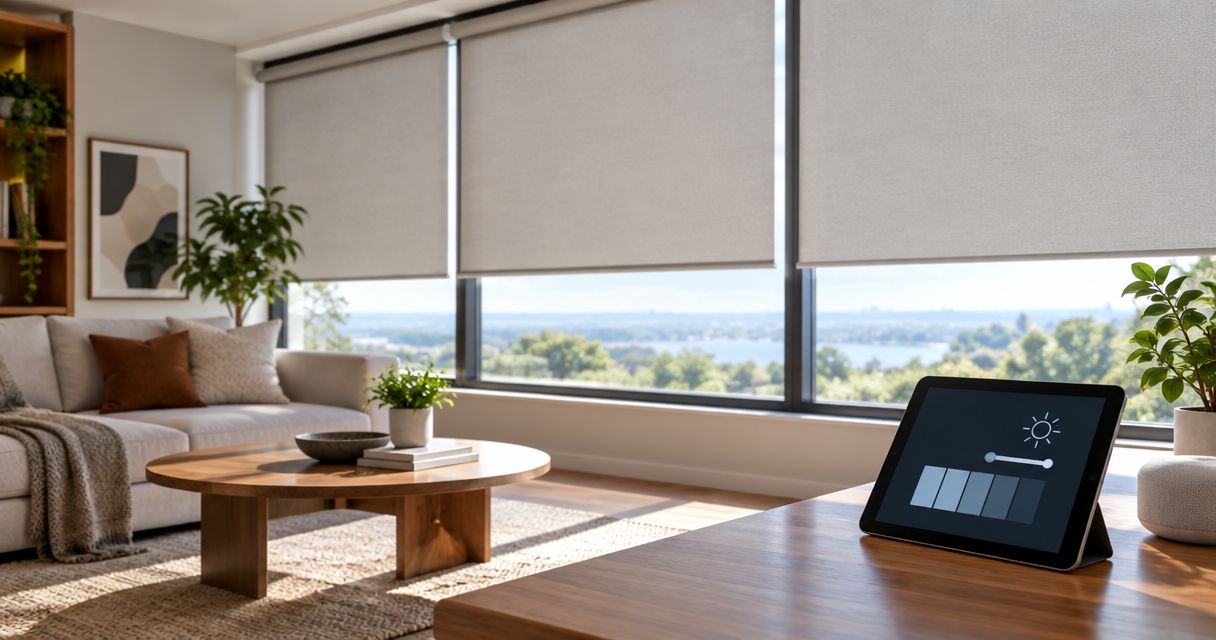
Best for easy charging: rechargeable motorized shades. Best for avoiding charging cables: replaceable-battery shades. Best for sun-exposed windows: solar-assisted battery shades, after checking panel requirements. This 2026 guide explains how to compare battery-life claims and choose a practical setup with Olsson Smart Shades.
- Motorized shades ranked by battery life need comparable testing; advertised months alone do not establish a winner.
- Rechargeable motorized shades suit homeowners who can reach the charging connection comfortably.
- Solar-assisted battery shades require suitable panel placement; sunlight does not guarantee uninterrupted operation.
- Olsson Smart Shades provides custom-measured motorized shades and installation for Columbus and Central Ohio homeowners.
Why this matters
Long battery life sounds simple. You want the shades to work without another household chore. But a runtime claim means little unless you know the shade size, movement schedule, and conditions behind it.
A bedroom shade that opens each morning and closes each evening has a different workload from a living-room shade you adjust throughout the day. Battery access matters, too. A long interval between charges does not make an awkward charging connection convenient.
For your 2026 purchase, choose the maintenance routine before choosing the motor. The ranking below separates battery-powered approaches by household fit. It is not a manufacturer leaderboard or a measured runtime comparison.
What makes the best motorized shades for battery life?
Use these criteria before comparing names or advertised operating periods:
- Comparable runtime: Look for the same movement frequency, shade dimensions, and test conditions. Months from different tests are not directly comparable.
- Battery access: Find out where you connect a charger or remove the battery pack after installation.
- Shade workload: Ask whether the stated runtime applies to your fabric, width, height, and full travel distance.
- Power requirements: Confirm the specified charger or replacement battery type. Do not assume different systems use interchangeable parts.
- Low-battery behavior: Ask how you receive a warning and what happens when the battery runs out.
- Household fit: Choose a routine you can manage comfortably, including windows behind furniture or above normal reach.
For smart-home controls, read the best motorized shades for smart homes. Control features and battery maintenance are separate decisions; check both for the exact system you choose.
Motorized shade power options at a glance
This 2026 comparison ranks practical ownership choices, not unverified battery durations. The hardwired option is a reference for homeowners whose main goal is avoiding battery maintenance altogether.
| Rank and option | Best for | Standout feature | Key limitation |
|---|---|---|---|
| 1. Rechargeable battery shades | Accessible windows and a repeatable charging routine | Recharge the battery rather than replace it at each depletion | Charging access still needs planning |
| 2. Replaceable-battery shades | Homeowners who prefer battery swaps | Replace depleted batteries without a charging session | Requires the specified replacements and accessible pack |
| 3. Solar-assisted battery shades | Windows with suitable panel exposure | A compatible panel supplies charging energy | Performance depends on panel placement and conditions |
| 4. Hardwired motorized shades | Avoiding battery chores | No operating battery to recharge or replace | Requires an appropriate electrical installation |
Olsson Smart Shades is best for Columbus and Central Ohio homeowners seeking custom-measured, professionally installed motorized shades. Choose the power arrangement during that planning process, not after the shades are fitted.
1. Rechargeable shades: best for accessible windows
Rechargeable motorized shades run from a battery that you recharge using the system's specified equipment. Depending on the design, charging involves connecting a cable or removing a battery pack. Confirm the arrangement for the exact shade before ordering.
This is the first choice when you can reach the charging connection comfortably. You still need a plan for the cable, charger storage, and any furniture between you and the window.
Rechargeable shades pros:
- Reuse the battery between charging sessions.
- Avoid replacing disposable batteries at each depletion.
- Let you plan charging around a familiar household routine.
Rechargeable shades cons:
- Require access to the charging connection or removable pack.
- Need charging equipment that matches the system.
- Do not eliminate eventual battery servicing or replacement.
Best for: Homeowners with reachable windows who prefer charging to battery swaps.
Before committing in 2026, ask the installer to show the charging position. Imagine reaching it with the shades installed, the curtains hanging, and the furniture in its usual place. A connection that is easy to reach in an empty room is not necessarily easy to reach behind a sofa.
Verdict: Buy rechargeable shades when the charging connection is comfortably accessible. Do not select them solely because an advertised runtime sounds longer than another system's claim.
2. Replaceable-battery shades: best for simple battery swaps
Replaceable-battery motorized shades use a pack designed for the manufacturer's specified batteries. When the batteries are depleted, you replace them rather than connect the shade to a charger. Follow the system's instructions for battery type and installation.
The appeal is straightforward. You can restore power with the correct replacements, without arranging a charging session. The battery pack still needs to be reachable.
Replaceable-battery shades pros:
- Avoid routing a charging cable to the shade.
- Offer a maintenance method based on battery replacement.
- Let you keep the specified replacement batteries ready.
Replaceable-battery shades cons:
- Require repeated battery replacement and appropriate disposal.
- Depend on access to the battery compartment.
- Need the correct battery specification; substitutions require manufacturer approval.
Best for: Homeowners who prefer a battery swap to connecting and storing charging equipment.
Ask to see how the pack opens and where it sits. Check whether you must remove a cover, move a curtain, or work around a mounting bracket. These details determine whether a simple maintenance task stays simple.
Verdict: Buy replaceable-battery shades when the pack is accessible and battery swaps suit your routine. Skip this approach for a difficult-to-reach window unless the proposed installation provides safe maintenance access.
3. Solar-assisted shades: best for suitable window exposure
Solar-assisted motorized shades pair a compatible battery-powered system with a charging panel. The panel supplies energy to the battery. It does not turn every window into a maintenance-free installation.
The right question is not whether the room feels sunny. It is whether the proposed panel location meets the system's requirements, accounting for glass, obstructions, and changing daylight conditions.
Solar-assisted shades pros:
- Use sunlight to contribute charging energy.
- Offer an alternative to relying entirely on manual charging.
- Address battery maintenance at windows where suitable panel placement is possible.
Solar-assisted shades cons:
- Require verified compatibility between the panel and shade system.
- Depend on the panel's exposure and placement.
- Add a visible component and can still require another charging method.
Best for: Homeowners with a suitable panel location who want sunlight to support battery charging.
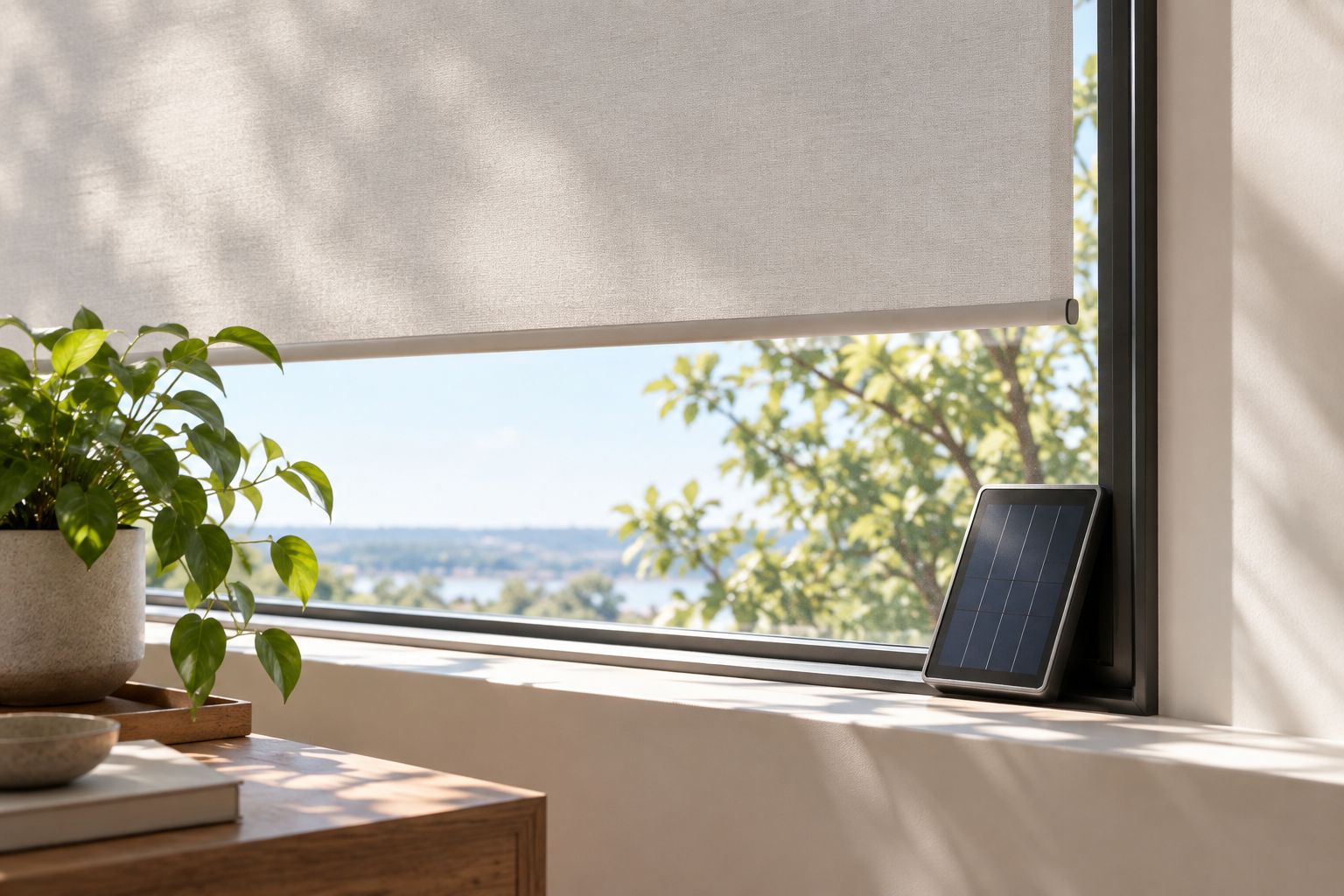
For a 2026 installation, ask how the panel will fit with your chosen treatment. Curtains, window trim, and the shade's own position deserve attention. Also ask how you recharge the battery if sunlight does not keep up with use.
Verdict: Hold until panel compatibility and placement are confirmed. Choose solar assistance for a suitable window, not as a blanket promise that you will never charge a battery.
4. Hardwired shades: best for avoiding battery maintenance
Hardwired motorized shades receive power through an electrical connection rather than an operating battery. They belong in this guide as the alternative to battery-life shopping. There is no battery runtime to rank.
The trade-off moves from recurring battery work to installation planning. Power routing, electrical requirements, and access need to be resolved before you order.
Hardwired shades pros:
- Eliminate operating-battery charging and replacement.
- Avoid planning recurring access to a battery compartment.
- Put the power arrangement into the installation design.
Hardwired shades cons:
- Require a suitable electrical supply and installation.
- Can involve more work in a finished room.
- Do not guarantee operation during a power outage; backup depends on the system.
Best for: Homeowners planning renovations or prioritizing freedom from battery chores.
Discuss hardwired power early if a window is particularly difficult to reach. Do not wait until the shade and trim decisions are finished.
Verdict: Buy hardwired shades when suitable power can be planned into the project. Skip them when electrical work conflicts with the scope of your installation.
How to compare battery-life claims without guessing
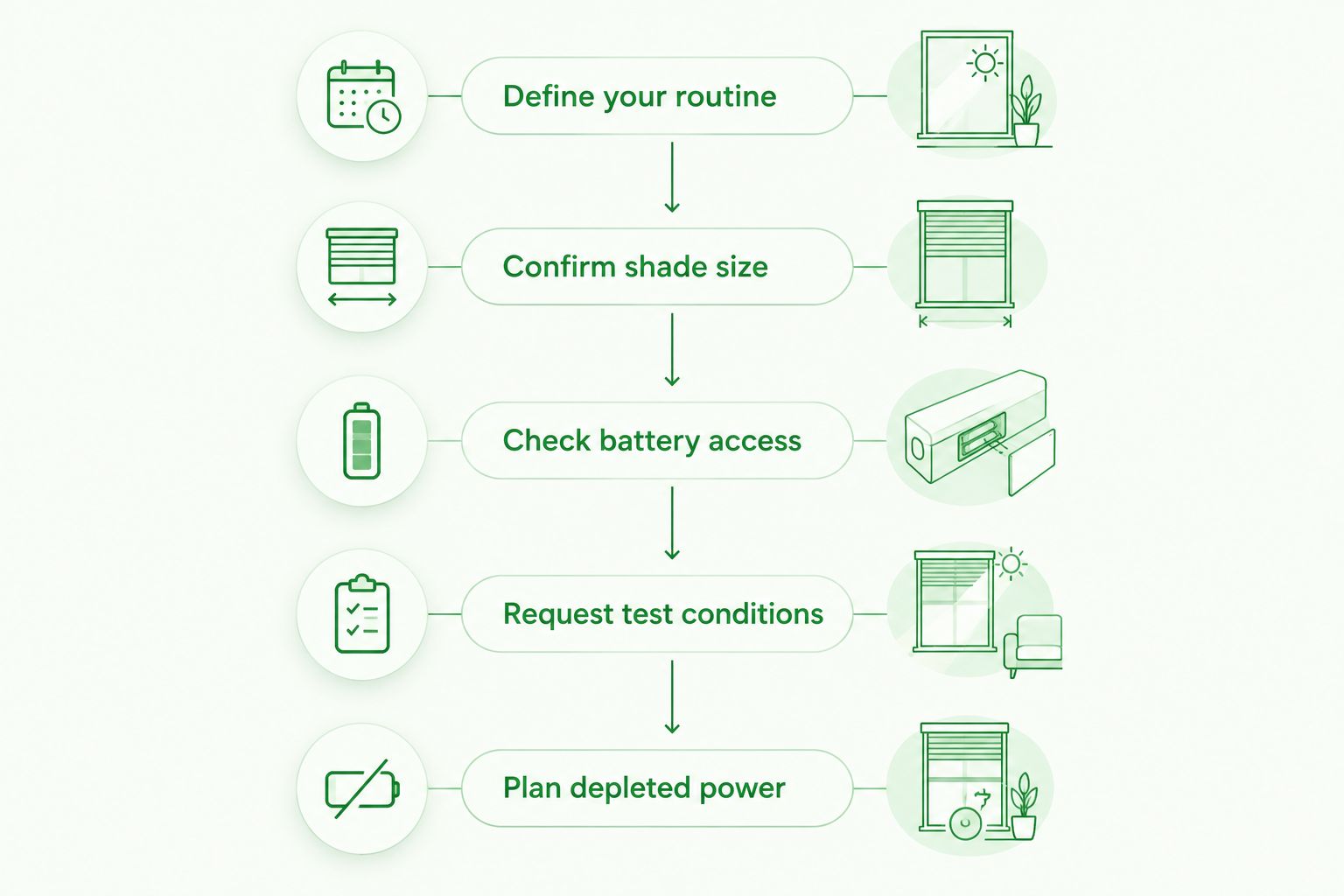
A useful 2026 comparison starts with your windows and your routine. Follow this sequence before treating any advertised duration as a buying advantage.
Define your routine
Write down when each shade opens, closes, and receives extra adjustments. Use a planning example of 2 full movements per day: one complete opening and one complete closing. Across 7 days, that equals 14 full movements.
Those figures describe a schedule, not predicted battery life. Add partial adjustments separately so the installer understands how you intend to use the shades.
Confirm shade size
Compare runtime information for the proposed dimensions and fabric. Do not transfer a claim for a small demonstration shade to a large window without checking its scope. Motor selection and the treatment itself must be considered together.
Check battery access
Locate the charging connection or battery pack on the proposed installation. Ask what you need to move, remove, or reach during maintenance. Include the room's normal furniture arrangement.
Request test conditions
Ask what the stated runtime assumes: movement frequency, shade dimensions, battery configuration, and operating conditions. A duration without those details is not a fair basis for ranking two systems.
Plan depleted power
Ask what happens when power runs low and when it is exhausted. Confirm whether you receive a warning, whether controls stop responding, and how you restore operation. Manual operation is not a feature to assume.
How this ranking works
Rechargeable shades rank first for accessible windows because charging offers a repeatable maintenance routine without replacing batteries at each depletion. Replaceable-battery shades serve a different preference: swapping batteries instead of connecting a charger. Solar assistance requires an additional placement and compatibility check.
Hardwired shades are separate because they remove the battery question. None of these positions establishes which manufacturer's motor runs longest. A battery-life winner needs comparable runtime evidence, not the largest advertised month count.
Which motorized shades should you choose?
Start with rechargeable shades if the charging connection is easy to reach. Choose replaceable batteries if you prefer swaps. Investigate solar assistance only after checking the actual panel location, and discuss hardwired power when avoiding recurring battery access is the priority.
For your consultation with Olsson Smart Shades, describe the rooms, daily movements, and difficult-to-reach windows. Ask for a quote that identifies the power arrangement and explains maintenance. You do not need to decide on a battery system before having that conversation.
Discuss your motorized shade project
Ask about custom measurement, installation, and a power arrangement that fits your windows.
FAQ
What are the best motorized shades ranked by battery life?
A reliable ranking requires runtime results measured under comparable conditions. For buying decisions, compare rechargeable, replaceable-battery, and solar-assisted shades by workload and maintenance access rather than advertised months alone.
Do rechargeable motorized shades last longer than replaceable-battery shades?
Rechargeable shades do not automatically run longer than replaceable-battery shades. Compare the exact systems under the same shade dimensions, movement schedule, and operating conditions.
How often will I need to charge motorized shades?
The charging interval depends on the specific system and how you use the shade. Ask for runtime information that matches your dimensions and movement routine, then confirm how you access the charging connection.
Are solar-powered shades completely maintenance-free?
Solar-assisted battery shades are not automatically maintenance-free. Panel exposure, compatibility, and daily use affect the charging arrangement, so confirm an alternative charging method and any battery servicing requirements.
What happens when a motorized shade battery dies?
A depleted battery cannot supply power for motorized movement. The shade's warning behavior, resting position, and any manual operating option depend on the exact system; confirm those details before ordering.
Are hardwired shades better for high windows?
Hardwired shades avoid battery charging and replacement at high windows. They still require suitable electrical planning, and their controls and any backup-power arrangement need separate confirmation.
Can Olsson Smart Shades help me choose a power setup?
Olsson Smart Shades provides custom-measured motorized shades and installation for homeowners in Columbus and Central Ohio. Describe your window access and daily routine when asking about a consultation or quote, and request details for the proposed power setup.
One last thing
The longest advertised runtime is not always the easiest shade to own. Before approving your 2026 order, have the charging connection or battery pack pointed out on the proposed installation. Picture maintaining it with the room fully furnished.
That small check keeps battery life tied to everyday comfort. Choose a setup you can maintain, not a claim you cannot compare.