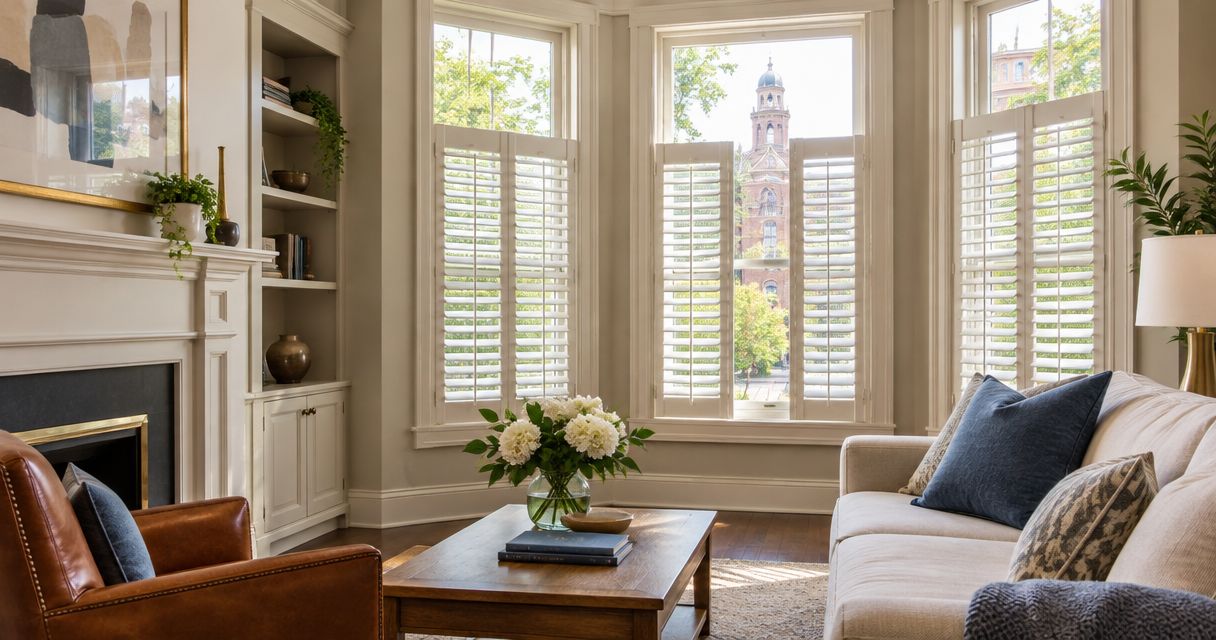
Historic Columbus homes’ plantation shutters are adjustable interior window coverings fitted to older openings with the aim of improving privacy and light control while respecting original details. This 2026 guide explains how to choose frames, materials, and panel layouts without hiding the trim or blocking window access.
- For plantation shutters for historic homes Columbus homeowners should prioritize trim protection, window access, and accurate measurements.
- Olsson Smart Shades fits homeowners seeking custom-measured plantation shutters and professional installation in Columbus and Central Ohio.
- Compare wood and composite shutters against drapes and shades before choosing a treatment for each room.
- Confirm mounting details and any applicable preservation requirements before ordering custom window treatments.
Why plantation shutters matter for historic Columbus homes
Older windows deserve a room-by-room decision, not one specification repeated throughout the house. Deep casing, projecting sills, window handles, and uneven openings all affect how an interior shutter fits. A shutter that looks right when closed can still interfere with everyday use.
Choose the installation around the window, not the window around the installation. Preserve access to locks and handles. Keep decorative trim visible where that is part of the room’s character, and decide where mounting holes are acceptable before selecting a frame.
Olsson Smart Shades provides custom-measured plantation shutters and professional installation for Columbus and Central Ohio homeowners. That service suits a project where the opening and mounting details need attention. It does not replace a preservation decision or repair damaged window components.
For your 2026 project, separate three goals: daytime light, evening privacy, and the appearance of the original woodwork. Shutters can address those goals, but they are not automatically the right treatment for every historic window. A bedroom, front sitting room, and bathroom deserve separate decisions.
How to plan plantation shutters for an older home
Inspect the window before choosing a shutter
Start with a simple inspection you can do yourself. Open the window, operate the lock, and look at the sill and casing. Photograph anything that sticks out into the space where the shutter frame or panels would sit.
Record concerns rather than trying to correct them during measurement. Loose trim, deteriorated finishes, and a sticking sash need their own assessment. Do not use a new covering to hide a window problem that still needs attention.
This first pass gives you a useful consultation brief. It also separates what you want to preserve from what you want the new treatment to change. A distinctive casing profile deserves an explicit note, not an assumption that the installer will know your preference.
- Photograph the full window and its surrounding trim.
- Mark the handles, locks, and other projecting hardware.
- Check whether the sash opens and closes normally.
- Identify damaged surfaces before discussing mounting.
- Note which original details must remain visible.
Measure the opening and test the clearances
You can take preliminary measurements with a tape measure and keep a sketch for each window. Use 3 width readings and 3 height readings at different points to spot variation. These are planning notes, not a substitute for the installer’s final order measurements.
Depth matters as much as width. The panel needs room to operate, and the louvers—the adjustable slats—need clearance when tilted. Furniture, adjacent walls, and a projecting sill can interfere even when the frame itself fits.
At this stage, Olsson Smart Shades plantation shutters offer a custom-measured, professionally installed route. The practical advantage is having the treatment specified for the opening rather than choosing from rough measurements alone. You still need to agree on the mounting approach and acceptable changes to the trim.
- Record widths at the top, middle, and bottom.
- Record heights at the left, center, and right.
- Note the available depth inside the opening.
- Mark nearby walls, furniture, and sill projections.
- Have the professional confirm final ordering dimensions.
Choose a mount that respects the casing
An inside mount places the shutter assembly within the window opening. An outside mount places it around the opening. Neither is universally better for a historic home; the available depth, frame design, and original woodwork determine the fit.
An inside mount can leave surrounding casing exposed, but shallow openings and projecting hardware can limit it. An outside mount can provide another fitting route, but its frame can cover details you wanted to keep visible. Ask to see the proposed frame position, not just a material sample.
In 2026, make trim protection part of the written scope. Discuss where fasteners will go and what will remain after removal. Do not assume that a custom fit means a reversible installation. Those are separate questions.
- Compare inside-mount and outside-mount positions.
- Identify the exact surfaces proposed for fasteners.
- Check how much original casing stays visible.
- Review clearance for the window’s existing hardware.
- Record any limits on drilling or altering woodwork.
Match the material to the room
Choose material after you understand the room’s conditions. A living room and a bathroom do not present the same moisture exposure. Ask for the proposed shutter’s care instructions and suitability for its location rather than treating all wood or composite products alike.
Real wood offers a wood surface and grain where those are part of your design goal. Composite is a broad category, so the actual construction and finish matter. Neither label alone proves resistance to moisture, fading, or wear.
Bring samples beside the existing casing in daylight and under your usual lamps. A finish that looks neutral in a showroom can look different next to aged paint or stained wood. Matching every surface is not necessary, but the contrast should be deliberate.
- Identify rooms exposed to moisture or splashes.
- Request material-specific cleaning and care guidance.
- Compare samples against the actual window casing.
- View finishes in daylight and evening lighting.
- Confirm suitability for the room before ordering.
Plan the panels around daily use
Decide how you will operate the shutters before deciding how symmetrical they should look. Tilting louvers adjusts light and visibility; opening panels gives access to the window. You need both motions to work in the furnished room.
A divided upper and lower louver arrangement lets you adjust those areas separately when the selected design supports it. A café-height shutter covers the lower portion of the window while leaving the upper glass uncovered. That can suit daytime privacy, but it does not address views through the uncovered glass.
Check 2 operating movements during the layout review: louver tilt and panel swing. For a 2026 installation, include the furniture you intend to keep, not just an empty-room photograph. A panel that hits a chair is a layout problem, even if its dimensions are correct.
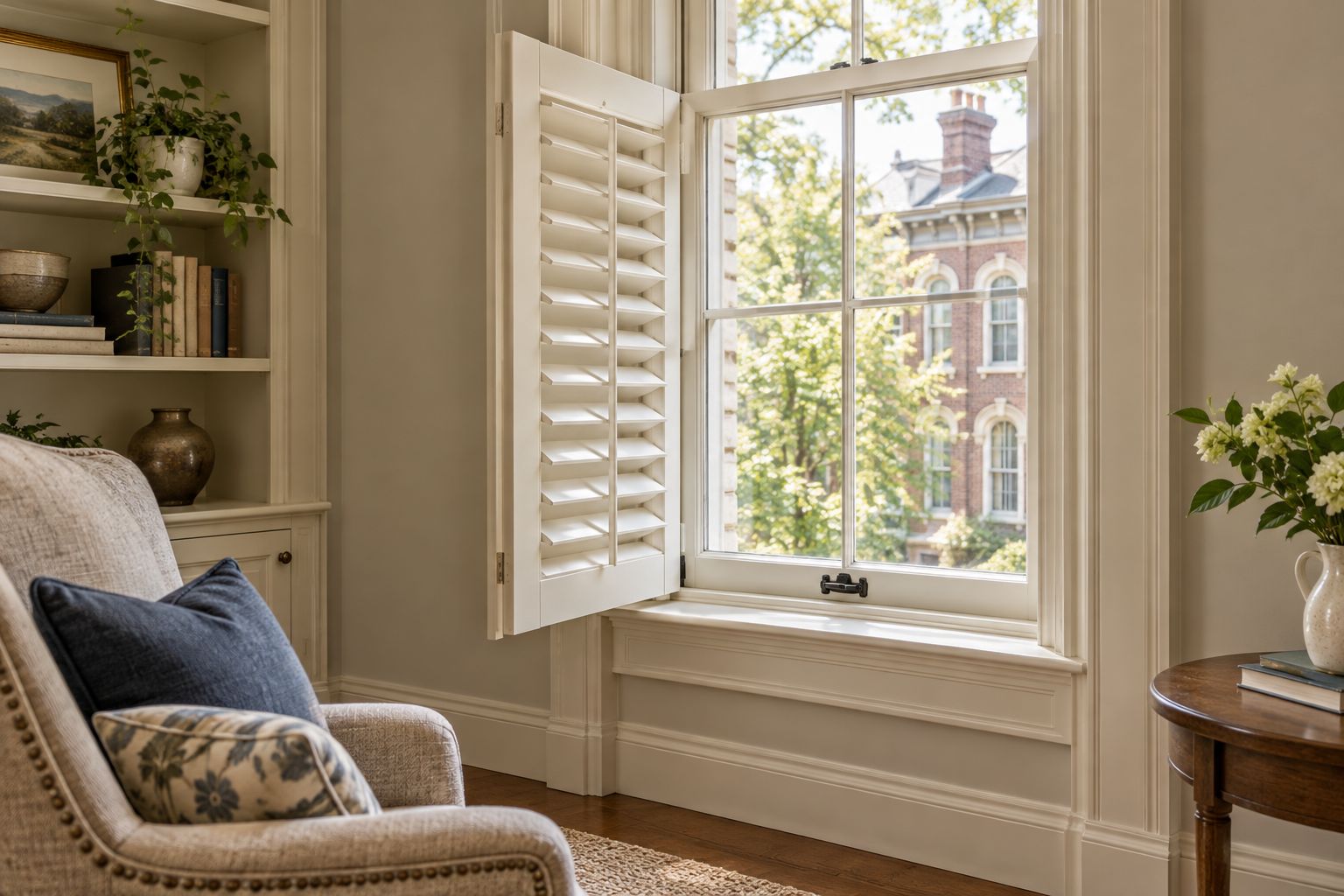
Panel layout also changes the view when shutters are closed. Ask where vertical frame members will sit and whether they align comfortably with the window’s existing divisions. The objective is a usable window with a considered appearance, not symmetry at any cost.
- Test louver tilt without contact with glass or hardware.
- Check panel swing beside furniture and walls.
- Confirm access to the window lock and sash.
- Discuss separate upper and lower light control.
- Review the position of visible panel divisions.
Confirm preservation requirements before ordering
A home’s age does not, by itself, tell you which approvals apply. Check the property’s designation and any applicable local requirements before work that affects protected features. Ask the relevant preservation office about your specific mounting proposal rather than assuming every interior treatment is exempt or restricted.
If drilling or repairs would disturb an old painted surface, discuss that work before installation. The EPA’s Renovation, Repair and Painting guidance addresses lead-safe practices for covered work in older housing. Treat suspected lead paint as a separate safety question, not a routine mounting detail.
Keep this step focused. You need a clear answer about the proposed work, not a general debate about whether shutters look historic. Do not order custom components while an unresolved mounting restriction could change their dimensions.
- Check whether the property has a historic designation.
- Describe the planned mounting surfaces and fasteners.
- Ask which approvals apply to that specific work.
- Resolve paint-disturbance concerns before installation.
- Keep any required approval with the project documents.
Request a quote with a written installation scope
For your 2026 quote, provide window photographs, room priorities, and the details you want protected. Ask how to arrange an in-home consultation and whether the existing windows need any preparation. You do not need to choose a finish before starting that conversation.
Olsson Smart Shades is best for Columbus and Central Ohio homeowners seeking custom-measured plantation shutters with professional installation. The service fit is clear; the material, mounting design, and operating layout still need to be agreed for your home.
Compare proposals by what they include, not by a product label alone. Request 3 written confirmations: the selected configuration, the installation scope, and responsibility for any window or trim work. A proposal is easier to evaluate when those decisions are explicit.
- Identify each window and its room-specific priorities.
- Confirm the material, finish, frame, and panel layout.
- Record measurement and installation responsibilities.
- State the agreed limits on changes to original trim.
- Ask how adjustments and care questions are handled.
Plan your window treatment project
Ask about an in-home consultation for custom-measured plantation shutters in Columbus and Central Ohio.
Compare treatments for historic rooms
Use this 2026 comparison to decide where shutters belong and where another treatment better serves the room. These are treatment types, not claims about a particular manufacturer. Final suitability depends on the selected construction and installation.
| Option | Best for | Main advantage | Key limitation |
|---|---|---|---|
| Wood plantation shutters | Rooms where a wood surface or grain is part of the design | Adjustable light control with a framed appearance | Material suitability and care need checking, especially around moisture |
| Composite plantation shutters | Rooms where the proposed material meets the care and exposure requirements | An alternative to real wood with adjustable louvers | Construction varies; the category name does not establish performance |
| Café-height shutters | Lower-window privacy while keeping upper glass uncovered | Leaves the upper window visually open | Does not provide privacy through the uncovered upper glass |
| Custom drapes | Rooms where fabric and an unobstructed opening are priorities | Can draw away from the window when properly positioned | Rod placement and fabric stack can cover trim or glass |
| Cellular shades | Rooms where a compact shade is preferred over hinged panels | No shutter-panel swing to plan around | Raised fabric still occupies space; edges and fabric affect light control |
Choose shutters for their adjustable louvers and architectural presence, not because every old house should have them. Choose drapes when fabric suits the room and the mounting position protects the details you value. Choose a shade when opening shutter panels would interfere with the space.
A mixed approach is a practical choice. Your front room can use shutters while a bedroom uses a different treatment for its light-control needs. Keep visible finishes coordinated where you want continuity, without forcing identical hardware into unlike openings.
Common mistakes historic homeowners make
Ordering every window from one measurement
Similar-looking windows are not proof of identical dimensions. Measure each opening and label it clearly. Grouping windows by appearance can hide a fitting problem until installation.
Choosing the finish before checking the frame
The frame determines what gets covered and where the assembly attaches. Review its position first. A pleasing paint sample cannot correct a frame that hides the casing you intended to preserve.
Expecting closed louvers to guarantee blackout
Shutter joints and edges can admit light. If sleeping darkness is your priority, explain that before choosing the treatment. Do not equate privacy with complete light exclusion.
Treating shutters as a window repair
An interior covering does not repair a sticking sash, damaged wood, or a failed window component. Assess those problems separately. The shutter installation should not make maintenance harder.
Ordering before resolving mounting restrictions
A later change to the mounting position can change the required frame and dimensions. Settle preservation and trim-protection questions first. Then approve the order against the agreed plan.
FAQ
Are plantation shutters a good choice for historic Columbus homes?
Plantation shutters are a good choice when the frame preserves valued details and the panels leave the window usable. Check mounting surfaces, hardware clearance, and room-specific privacy needs before ordering.
Is an inside mount better for original window trim?
An inside mount can keep surrounding casing visible when the opening has enough usable depth. It is not automatically better: projecting hardware and panel clearance can require a different approach.
Should I choose wood or composite plantation shutters?
Choose according to the room, the desired finish, and the specific material’s care requirements. Wood and composite labels alone do not establish moisture resistance or durability.
Do plantation shutters make a bedroom completely dark?
Plantation shutters do not guarantee complete darkness because light can enter at joints and edges. Tell the installer that sleeping darkness is a priority before selecting the treatment.
Do historic homes need approval for interior shutters?
Approval depends on the property’s designation and the applicable rules for the proposed work. Ask the relevant preservation office about your mounting plan before drilling or ordering.
Can I measure old windows myself?
You can take preliminary measurements to plan the project and identify differences between openings. Have the professional confirm final order dimensions, mounting depth, and operating clearances.
How do I arrange a plantation shutter consultation in Columbus?
Ask Olsson Smart Shades about an in-home consultation for custom-measured plantation shutters. Share window photographs, your privacy and light-control goals, and any original trim you want protected.
One last thing
Before approving the order, stand where you normally sit and look at the proposed panel divisions. Then stand beside the window and rehearse opening it. The shutter needs to work from both positions: where you enjoy the room and where you operate the window.
Make window access an acceptance check, not an afterthought. At installation, operate each panel, tilt the louvers, and reach the lock. A finished appearance matters, but so does keeping an old window useful.