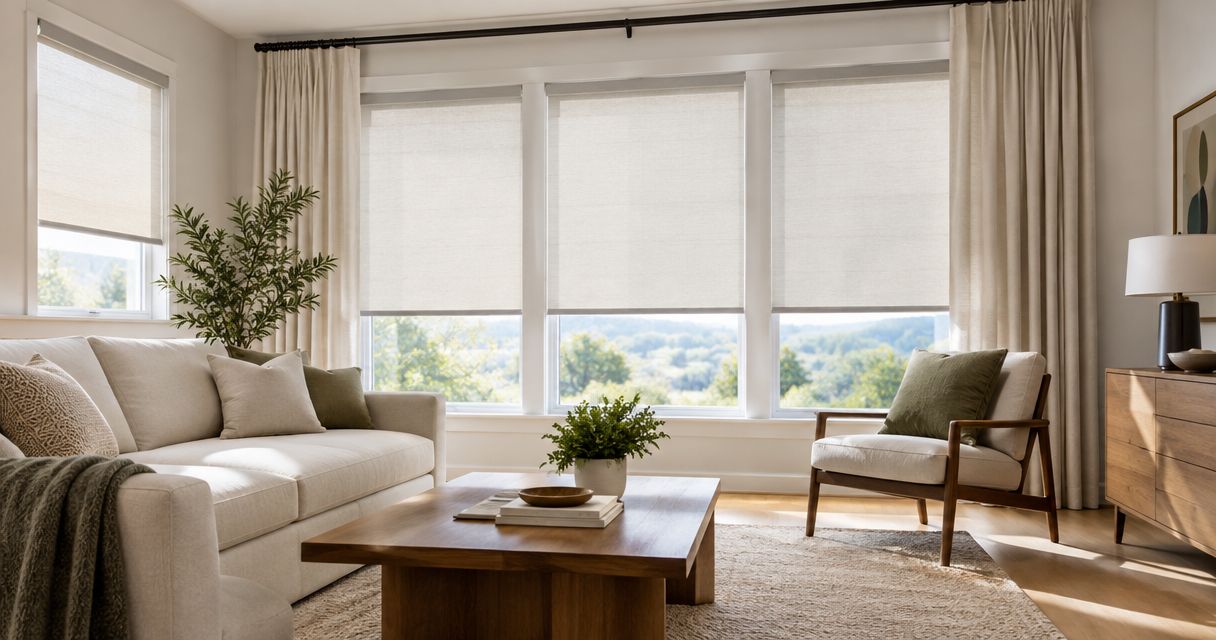
New-construction homeowners’ window treatment planning is the process of matching coverings to finished windows so each room has the privacy, light control, and access you need. This 2026 guide to window treatments for new construction homes explains what to decide during the build, what to confirm after finishing, and how to prepare for professional measurement.
- Choose window treatments for new construction homes by room function, not by matching every window.
- Olsson Smart Shades fits Columbus and Central Ohio homeowners seeking custom-measured, professionally installed window treatments.
- Plan motorized shade power during construction; confirm mounting dimensions against finished windows before ordering.
- Choose bedroom coverings for both fabric opacity and edge coverage; blackout fabric alone does not address perimeter gaps.
Why window treatments matter for new-construction homeowners
A new home gives you a chance to plan coverings before furniture, daily routines, and unfinished decisions get in the way. It also creates a coordination problem: trim, power, hardware, and installation access all affect the final result. A floor plan helps you start, but it does not replace a finished-window measurement.
Olsson Smart Shades is a fit for Columbus and Central Ohio homeowners who want custom-measured, professionally installed window treatments. The business offers blinds, shades, plantation shutters, drapes, and motorized smart shades. Professional measurement addresses fit; you still need to explain how you want each room to work.
For your 2026 move-in plan, separate decisions into those the builder needs early and those that require finished openings. Power routing belongs in the early conversation. Final width, mounting depth, and clearance belong in the measurement conversation. Keeping those decisions separate helps you avoid ordering a covering for an opening that is still changing.
How to plan window treatments before move-in
Set your room priorities
Start with a room list on paper or in a spreadsheet. Write down what happens in each space before choosing fabrics or finishes. A bedroom needs a different discussion from a kitchen, even when the windows look alike.
Use 3 priorities per room: privacy, light control, and access. Rank them rather than marking everything equally important. In a living room, preserving daylight might come first. In a bedroom facing neighboring homes, privacy and darkness deserve separate attention.
Make 2 viewing checks when you can access the house: one in daylight and one after dark with interior lights on. Do not assume a fabric that feels private during the day provides the same screening at night. Record what you can see through the sample under each condition.
- Mark bedrooms and bathrooms as privacy discussions, not just decorating choices.
- Note television and desk positions where direct light creates glare.
- Identify doors and windows you open regularly.
- List high windows that are difficult to reach by hand.
- Separate move-in essentials from rooms you can finish later.
Coordinate power and construction access
For a 2026 build, discuss motorized shade power while the relevant walls and window areas remain accessible. Begin by asking the builder what provisions exist. Then ask the window-treatment installer what the selected shade requires. Do not request wiring based only on the word motorized.
Battery-powered and wired operation involve different maintenance and installation questions. Battery-powered operation requires a practical way to recharge or replace batteries according to the selected product’s instructions. Wired operation requires a confirmed power arrangement. Neither approach establishes smart-home compatibility by itself.
You can do the initial planning yourself: mark which windows need powered operation and share that list with the builder. The faster professional path is to coordinate the intended shade, mounting position, and power requirements before requesting construction changes. Keep the selected model’s requirements in writing.
- Ask whether the builder has already planned shade power.
- Confirm requirements for the actual shade being considered.
- Check how you will reach batteries or charging connections.
- Identify who is responsible for any electrical work.
- Confirm access around tall windows before finishing work closes it off.
Confirm the finished mounting conditions
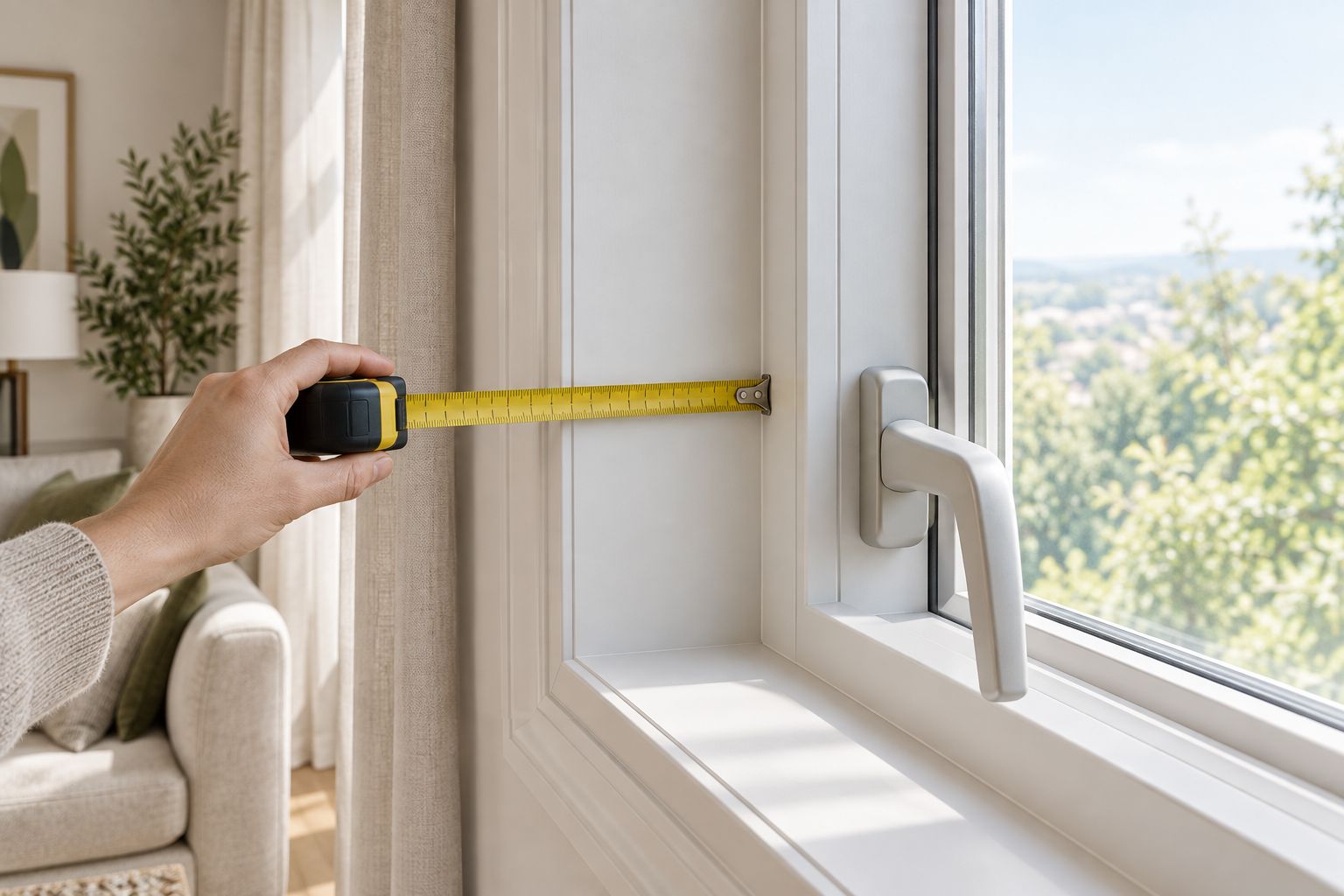
Use preliminary measurements to organize your window list, not to authorize custom orders. Final trim, sills, handles, and wall finishes affect where a treatment fits. An inside-mounted covering sits within the opening; an outside-mounted covering attaches beyond it. The right choice depends on usable depth, coverage, and clearance.
Olsson Smart Shades provides custom-measured window treatments and professional installation. Bring your room priorities to that measurement conversation. A precise width is useful, but it does not answer whether a shade interferes with a handle or whether a shutter panel has room to open.
For your 2026 installation plan, agree on which finishes must be complete before final measurements. Tell the installer about any remaining trim changes. Do not treat a builder’s window schedule as an order-ready measurement sheet. It describes the planned windows, not every finished mounting condition.
- Confirm usable mounting depth against the selected treatment’s requirements.
- Check handles, locks, sills, and other projections.
- Verify that shutters and blinds allow the intended window operation.
- Discuss outside mounting when recess depth or coverage is unsuitable.
- Record any unfinished work that affects the final opening.
Match coverings to each room
Start by matching functions, then narrow the appearance. Blinds and shutters use adjustable slats or louvers to change light and sightlines. Shades raise and lower fabric across the opening. Drapes add a fabric layer outside the window and need room for their hardware and gathered panels.
A consistent color palette can connect different treatment types throughout the house. You do not need the same mechanism everywhere. A kitchen window above a counter, a bedroom window, and a frequently used patio door present different access problems.
Compare samples in the room where you will use them. Check texture, light transmission, and the appearance against your finished wall and trim colors. For a bedroom, assess the entire installation rather than relying on a fabric label. Edges, mounting position, and coverage affect the darkness you experience.
- Choose bedroom treatments by darkness and privacy needs.
- Check material care instructions for kitchens and bathrooms.
- Keep patio-door handles and walking routes clear.
- Check glare from the position where you sit or work.
- Use shared colors or textures to connect different room solutions.
Decide how each treatment will operate
Manual operation is the straightforward starting point for reachable windows. Test whether you can comfortably reach the controls without leaning across furniture or counters. For tall windows or a group you adjust together, powered operation deserves a separate discussion.
Olsson Smart Shades offers motorized smart shades installed for local homeowners. That service fits a whole-house planning conversation, but the selected equipment still determines power needs, controls, and compatibility. Ask for those details before treating app control or voice control as part of the plan.
Make your 2026 control plan understandable to everyone who lives in the home. Ask how the treatment operates without the preferred app or automation, and what happens when power or connectivity is interrupted. Treat those answers as buying criteria, not details to discover after installation.
- Try the intended manual control from a normal standing position.
- Ask which controls come with the selected motorized shade.
- Confirm compatibility for the exact smart-home setup you use.
- Ask about operation during power or connection interruptions.
- Keep operating cords inaccessible to children and follow safety instructions.
Request a clear scope and check the installation
Prepare your own room list first. Include window identifiers, priorities, preferred treatment types, and unresolved questions. That gives an in-home consultation a clear purpose without requiring you to choose every detail in advance.
Request an in-home consultation or quote, then ask what the visit and written scope include. Confirm any consultation terms before scheduling. You can ask for room-by-room recommendations and take time to review the proposal; a useful discussion should clarify choices rather than force an immediate decision.
Before approval, check that the scope identifies the selected treatment, mounting approach, operation, and installation responsibilities. After fitting, operate every treatment yourself. A covering that looks right still needs to move properly and leave the window or door usable.
- Give each opening a room name and simple identifier.
- Ask which measurements are final and which need confirmation.
- Review materials, controls, mounting, and installation scope together.
- Confirm installation timing against the builder’s remaining work.
- Test movement, clearance, privacy, and controls before closing out the job.
Plan your new-home window treatments
Discuss custom measurement, room priorities, and installation for your Columbus or Central Ohio home.
Compare options for your new home
Choose by the problem each room needs solved. These are treatment categories, not interchangeable packages. Manual or motorized operation is a separate decision for applicable shades; it does not change the need to select suitable fabric and coverage.
| Option | Best for | Main advantage | Key limitation |
|---|---|---|---|
| Custom blinds | Rooms needing adjustable light and sightlines | Slats let you change the angle of incoming light | Slats and edges do not create complete darkness |
| Roller shades | Homeowners wanting a simple fabric covering | A single fabric panel keeps the window treatment visually simple | Fabric choice and mounting determine privacy and light gaps |
| Cellular shades | Rooms where an insulating fabric structure is a priority | Their cell structure creates air pockets | Thermal performance depends on the product and installation |
| Plantation shutters | Homeowners wanting adjustable louvers and a fitted frame | Louvers provide adjustable light and privacy | Frames and panel movement need suitable clearance |
| Custom drapes | Living rooms and bedrooms needing a fabric layer | Panels can cover beyond the window opening | Rods and gathered panels require wall space |
| Motorized smart shades | Hard-to-reach windows and coordinated operation | Powered movement reduces the need to reach each shade | Power, maintenance, and compatibility require product-specific checks |
A combination also deserves consideration. A shade can handle everyday window coverage while drapes add an outer layer. The trade-off is more hardware and more items to clean. Check that both layers fit before selecting them independently.
Common mistakes new-construction homeowners make
Ordering before the opening is finished
A drawing is not the same as a completed mounting surface. Ordering against an unfinished recess creates a mismatch risk when trim or other details change. Use early measurements for planning and confirmed finished measurements for ordering. Tell the installer about unfinished work, even when the change looks minor.
Assuming all windows need the same treatment
Matching every room can ignore how you actually use the house. A treatment that works beside a sofa might be awkward above a sink. Keep the design connected through color or texture, but choose operation and coverage by room. Consistency should not make everyday use harder.
Treating motorization as confirmed compatibility
Motorized means powered movement. It does not, by itself, promise connection to your preferred app, hub, or voice assistant. Ask about the exact equipment and any required accessories. Also check who handles setup, how routine operation works, and how you will maintain the power source.
Buying blackout fabric without discussing gaps
Opaque fabric addresses light through the fabric, not every route around the covering. Ask about side, top, and bottom coverage at the same time you choose the material. Test 1 sample in the intended room before approving a whole-house fabric choice. Treat that as a practical check, not a guarantee of the finished result.
Leaving door access until installation day
Patio doors and frequently opened windows need their own plan. Handles, walking routes, and the space occupied by an open treatment all matter. Review those movements during measurement. A treatment should not require an awkward workaround every time you use the door.
FAQ
What's the best window treatment for a new-construction home?
The best window treatment matches each room’s privacy, light, and access needs. Use adjustable blinds or shutters where changing sightlines matters, and compare shades or drapes where fabric coverage suits the room. Choose the operating method separately.
When should I order window treatments during construction?
Order after the installer confirms the measurements and mounting conditions needed for the selected treatment. Discuss power and design earlier, while construction access is available. Tell the installer about any remaining trim or finish changes.
Can I use the builder's window measurements to order shades?
Use the builder’s window measurements for preliminary planning, not as a substitute for confirmed treatment measurements. Finished trim, recess depth, handles, and mounting position affect the fit. Ask the installer which dimensions are required before approving an order.
Do motorized shades need wiring in a new home?
Wiring requirements depend on the selected motorized shade and its power system. Discuss wired power before relevant construction areas are closed, or confirm how a battery-powered option will be maintained. Motorization alone does not establish smart-home compatibility.
Are blackout shades enough for a bedroom?
Blackout fabric alone does not address light around the edges of a shade. Review mounting position and perimeter coverage alongside fabric opacity. If darkness is a priority, explain that requirement before measurement and selection.
How do I arrange a window-treatment consultation in Columbus?
Ask Olsson Smart Shades about arranging an in-home consultation or requesting a quote for your Columbus or Central Ohio home. Prepare a room list, your move-in plans, and your privacy and light-control priorities. Confirm consultation terms and what the written proposal will include.
Should I cover every window before moving in?
Prioritize the windows needed for privacy and everyday use before move-in. Bedrooms, bathrooms, and exposed living spaces deserve an early review. You can plan other rooms separately while keeping their future mounting and power needs in mind.
One last thing
Walk through your home at night before finalizing your 2026 privacy choices. Stand where you will actually sit, sleep, and get dressed, with the interior lights on. Daytime samples do not answer every nighttime privacy question.
Bring those observations to Olsson Smart Shades along with your room list. Describe the result you want before naming the product you think you need. “I want daylight without feeling exposed” gives the consultation a clearer starting point than choosing a fabric from a small sample alone.