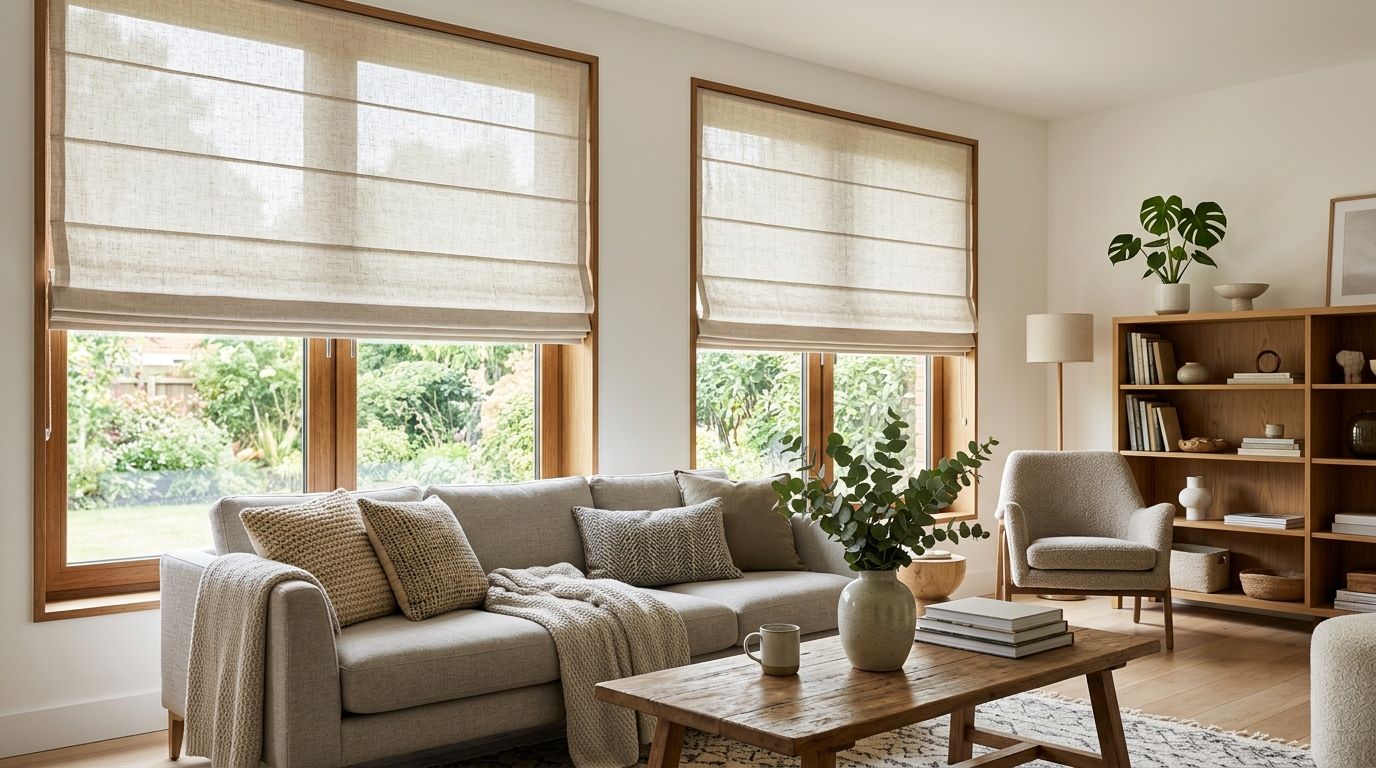
Best overall: flat Roman shades for living rooms that need a clean, flexible look. Best for a softer room: relaxed Roman shades. Best for visible fabric folds: hobbled Roman shades. Best for a hard-to-reach window: motorized Roman shades, if the fabric and lift system are offered together. This 2026 guide compares the styles by how they look, operate, and fit your windows.
- Flat Roman shades are the best roman shades for living rooms when you want a clean look that works with many furnishings.
- Relaxed Roman shades suit softer rooms; hobbled Roman shades make the folds more visible.
- Motorized Roman shades fit hard-to-reach windows, but confirm that your chosen fabric supports the lift system.
- Olsson Smart Shades installs custom-measured shades in Columbus and Central Ohio; ask which Roman styles are available.
Why this matters
Roman shades stack fabric into folds when raised and lie across the window when lowered. That makes the fabric, fold shape, and fit unusually visible in a living room. A style that looks right in a small sample can feel different across a wide window or beside drapes.
For Columbus and Central Ohio homeowners, Olsson Smart Shades offers custom-measured shades and professional installation. Ask which Roman styles, fabrics, and operating options are available before settling on a design. The right first decision is not a fabric color. It is what you need the window to do during the day and how you want it to look when the shade is raised.
What makes the best Roman shades for living rooms?
Use these criteria before comparing styles. They separate a shade that suits your room from one that only looks good in a photograph.
- Light control: Decide whether you want to soften daylight, reduce glare, or darken the room more substantially. Fabric appearance alone does not tell you how much light will pass through a finished shade.
- Privacy: Check what you can see through the fabric from outside when interior lights are on. Daytime privacy and nighttime privacy are different questions; examine both if the living room faces a street or neighboring windows.
- Fold shape: Flat shades look relatively smooth when lowered. Relaxed shades curve at the bottom; hobbled shades keep visible folds. Picture each style both raised and lowered, because you will see both positions.
- Window fit: Note the frame, trim, window handles, and any drapes that will share the space. Confirm where the shade will sit and whether its raised stack will cover part of the glass.
- Daily operation: Consider how often you will adjust the shade and whether you can reach it comfortably. A motorized option is useful only if the specific Roman shade you choose supports it.
- Fabric behavior: Ask to see how a fabric hangs and folds at a size relevant to your window. A fabric that looks appealing as a swatch still needs to work as a full shade.
In 2026, start with the room rather than a trend: where you sit, when glare bothers you, and what people can see from outside. Bring those observations to a consultation. They give you practical questions to ask without requiring you to choose every detail beforehand.
Roman shade styles at a glance
| Style | Best for | Standout feature | Key limitation |
|---|---|---|---|
| Flat Roman shades | A clean, adaptable living room | Smooth appearance when lowered | Creases and fabric movement can be more noticeable |
| Relaxed Roman shades | A soft, informal look | Curved lower edge | Less suited to a sharply tailored finish |
| Hobbled Roman shades | Visible texture at the window | Folds remain visible when lowered | More fabric detail can compete with busy furnishings |
| Motorized Roman shades | A hard-to-reach window | Operation without reaching the shade | Fabric and lift-system choices need to work together |
The table ranks looks and uses, not product lines. A motorized shade also has a fold style, so settle the appearance and operation together. In 2026, confirm the actual choices available for your window rather than assuming every fabric can be made in every configuration.
1. Flat Roman shades: best for a clean living room
Flat Roman shades have a relatively smooth face when lowered and form folds as they rise. They put the focus on the fabric instead of a permanently visible fold pattern. That makes them the clearest starting point if your living room already has patterned upholstery, artwork, or drapes.
Flat Roman shades pros:
- The quiet shape works with both simple and layered room designs.
- A smooth lowered face makes a fabric's color or pattern easy to see.
- You can assess the shade's look in two clear positions: open and closed.
Flat Roman shades cons:
- A plain face can show uneven hanging or creasing more clearly.
- They will not give you the soft curve of a relaxed shade or the constant folds of a hobbled shade.
Best for: You want one shade style to sit comfortably beside furniture and window trim without becoming the room's main feature.
Before choosing fabric, ask to see a full shade or a representative sample raised and lowered. Pay attention to the bottom edge, where the fabric gathers, and how the raised shade sits against the window. Verdict: Buy if you want the most adaptable Roman shade look for a living room. Hold if visible folds are the reason you want Roman shades in the first place.
2. Relaxed Roman shades: best for a softer room
Relaxed Roman shades have a curved lower edge rather than a straight, tailored finish. The shape draws attention to the fabric's drape. Choose this style when you want the window to feel softer and do not need every edge to look crisp.
Relaxed Roman shades pros:
- The curved edge gives the window a gentle outline.
- The fabric's drape becomes part of the design.
- They can provide a clear visual contrast to straight window trim and furniture lines.
Relaxed Roman shades cons:
- The curved lower edge is a poor match if you want a precise, straight finish.
- The look depends heavily on the selected fabric and how it hangs at your window's size.
Best for: Your living room has a relaxed feel and you want the shade's shape, not just its fabric, to contribute to it.
Do not choose from a flat swatch alone. Ask what the finished bottom edge will look like at your window and how the shade will stack when raised. Compare that shape with the sightline from the seat you use most. Verdict: Buy if a soft curve is a deliberate choice. Skip it if you will spend every day wishing the lower edge looked straight.
3. Hobbled Roman shades: best for visible folds
Hobbled Roman shades keep a series of fabric folds visible when lowered. They make the treatment look layered even when the window is covered. This is the strongest choice here if you want the shade itself to supply texture.
Hobbled Roman shades pros:
- The folds remain a visible part of the room when the shade is down.
- The layered appearance can make a plain fabric more visually active.
- You can choose the style for its shape without relying on a bold print.
Hobbled Roman shades cons:
- The folds add visual detail that can compete with patterned drapes or furnishings.
- The raised stack deserves close attention if you want to keep as much glass visible as possible.
Best for: Your living room needs texture at the window, and you like the shade's appearance as much when lowered as when raised.
Look at the whole window, not just the fabric. If you also plan to hang drapes, decide which treatment should carry the visual detail. Ask to see the lowered folds and the raised stack before committing. Verdict: Buy when visible folds are the goal. Hold if you want the fabric to appear smooth across the glass.
4. Motorized Roman shades: best for hard-to-reach windows
Motorization changes how you operate a Roman shade; it does not replace the choice between flat, relaxed, and hobbled looks. It deserves its own slot when a window is difficult to reach or you expect to adjust the shade regularly. Confirm that the desired Roman style, fabric, and operating system can be specified together.
Motorized Roman shades pros:
- You can operate a suitable shade without reaching the window.
- It gives you an option for a window where manual adjustment is awkward.
- You can choose the fold style and operating method as part of the same decision.
Motorized Roman shades cons:
- Not every fabric and Roman construction is necessarily available with every operating system.
- You still need to check the raised stack, light control, and fabric in person; motorization does not solve those choices.
Best for: You have a living room window that is awkward to reach and want to confirm a compatible Roman shade design.
Ask how you will operate the exact configuration offered and what the installation needs at your window. Do not assume that a motorized shade is a better shade in a room where a manual one is easy to use. Verdict: Buy if reach is the real problem and the complete configuration fits your window. Hold until compatibility is confirmed.
Match the shade to the way you use the room
Start with the seat where you notice the window most. If daylight falls across a screen or into your eyes, ask to compare fabrics for glare control. If the room faces a public view, examine privacy with the shade lowered. These questions matter more than whether a fabric looks appealing on its own.
Next, look at the window from across the room. A flat Roman shade keeps the outline quiet. A relaxed Roman shade adds a curve; a hobbled Roman shade keeps its folds on display. If you already have drapes, picture both treatments together. The shade does not need to compete for attention to do its job.
Then check the practical fit. Point out handles, trim, furniture close to the window, and anything that makes reaching the shade difficult. Ask where the finished shade and its raised fabric will sit. A custom measurement solves the fit question only after you have chosen what the finished window should do and look like.
Olsson Smart Shades installs custom-measured window treatments for homeowners in Columbus and Central Ohio. During an in-home consultation, describe the light, privacy, fold shape, and operating needs you want addressed. Ask which Roman options are available and request a quote for the configuration you select. You do not need to arrive with a fabric already chosen.
How we ranked these Roman shade styles
The ranking puts visual flexibility first, then gives each other style a distinct reason to choose it. Flat Roman shades are the default because their smooth lowered face leaves room for different living room designs. Relaxed and hobbled styles move ahead when their particular fold shape is what you want. Motorized Roman shades answer an access problem, subject to a compatible configuration.
This is a style comparison, not a claim that one fabric blocks more light than another. Light control, privacy, and the way fabric hangs depend on the finished choice. Ask about those details for the actual shade you are considering in 2026.
Which Roman shades should you choose?
Choose flat Roman shades if you are undecided. They give you a clear starting point for comparing fabric, light control, and fit without adding a strong fold pattern. Choose relaxed Roman shades for a soft curve or hobbled Roman shades for folds you can see even when the shade is down. Choose motorization because you need the operating method, not because it sounds like an upgrade.
For a Columbus-area home in 2026, Olsson Smart Shades fits homeowners seeking custom-measured shades and professional installation. Ask which Roman styles the business offers, review the finished configuration, and request a quote before you decide.
Talk through your window options
Discuss fit, fabric, and operating choices for your living room.
FAQ
What are the best roman shades for living rooms?
Flat Roman shades are the best starting point for most living rooms because their smooth lowered face suits different furnishings. Choose relaxed or hobbled styles when you specifically want a curved edge or visible folds.
Are flat or relaxed Roman shades better for a living room?
Flat Roman shades are better for a clean, straight look; relaxed Roman shades are better when you want a soft curve. Compare both raised and lowered before choosing.
Do hobbled Roman shades look different when lowered?
Yes. Hobbled Roman shades keep visible fabric folds when lowered, while flat Roman shades have a smoother face. The folds add detail even when the window is covered.
Can Roman shades help with living room privacy?
Roman shades can cover a living room window, but privacy depends on the finished fabric and configuration. Check the fabric from outside with interior lights on if nighttime privacy matters.
Can Roman shades be motorized?
Motorized Roman shades are an option when the chosen construction, fabric, and lift system work together. Confirm the exact configuration before choosing motorization for a hard-to-reach window.
Should Roman shades go with drapes?
Roman shades can share a window with drapes. Decide which treatment should supply the visual detail, then check that both fit and operate as intended.
How do I choose Roman shades for a Columbus living room in 2026?
Start with the light, privacy, fold shape, and reach needs of your window. Olsson Smart Shades installs custom-measured shades in Columbus and Central Ohio; ask which Roman styles are available during your consultation.
One last thing
Look at the shade raised before approving a fabric. That is when its folds sit near the top of your window, where they can change the view you expected to keep open. In 2026, make the raised position part of your decision, not an afterthought.