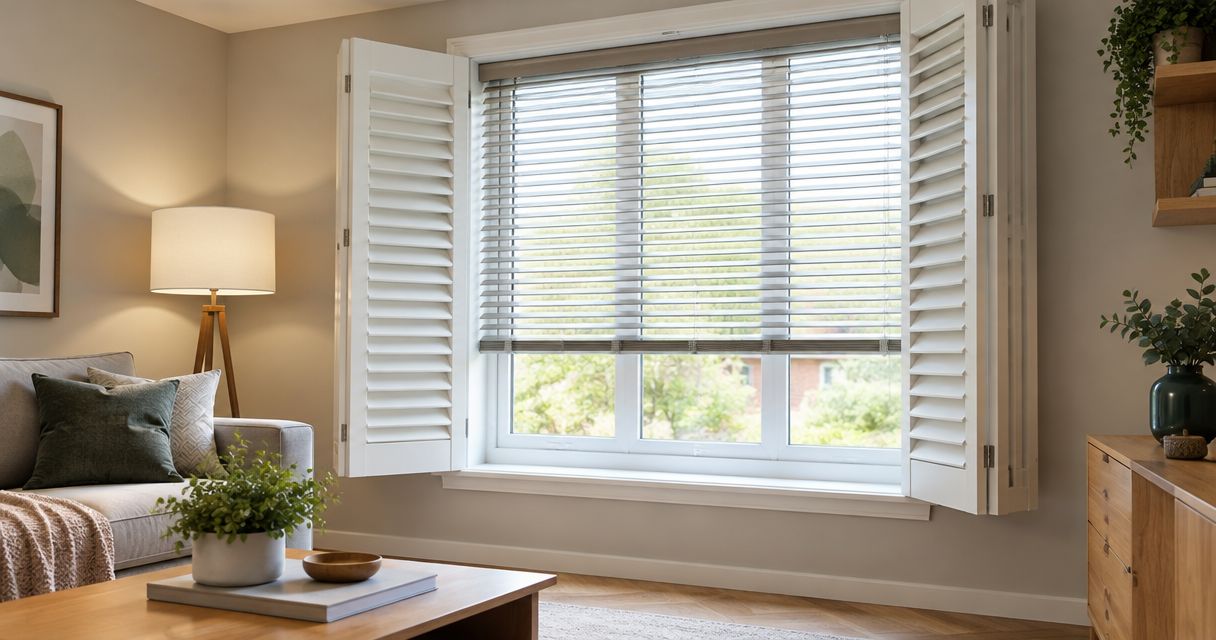
Yes, you can combine blinds and shutters on the same window if the mounting positions leave enough room for the blind to operate and the shutter panels and louvers to move freely. The extra layer also adds hardware, cleaning, and installation complexity, so choose it to solve a specific privacy or light-control problem—not just to add another covering.
- Can you combine blinds and shutters on same window? Yes, when mounting depth and moving parts allow both to operate.
- Check shutter panel swing, louver clearance, blind controls, and window access before ordering either treatment.
- Shutters alone are simpler; adding a blind makes sense only when it supplies a missing function.
- Olsson Smart Shades provides custom-measured window treatments for homeowners in Columbus and Central Ohio.
Can blinds and shutters be combined on the same window?
Yes—but fitting both treatments is not the same as making both usable. A blind mounted behind shutters must clear the shutter frame, tilted louvers, and any hardware. Its controls must remain reachable, too.
For a custom installation, Olsson Smart Shades offers blinds, shades, shutters, drapes, and motorized smart shades for Columbus and Central Ohio homeowners.
Start your 2026 window-treatment plan by comparing the function you need with the complexity you are willing to keep.
| Arrangement | Best for | Main advantage | Main drawback |
|---|---|---|---|
| Blinds and shutters together | Keeping both treatments when each serves a distinct purpose | Separate adjustment of the blind and shutter louvers | Requires clearance for both systems and access to their controls |
| Shutters alone | Homeowners who want adjustable privacy without another layer | Fewer moving systems to operate and clean | Light can still enter around edges and through gaps |
| Shutters with drapes | Adding a fabric layer outside the shutter frame | Separates the fabric mounting position from the window recess | Drapes need wall space and must stay clear of opening panels |
None of these arrangements guarantees complete darkness. The frame, edges, fabric, and installation details all affect the finished result.
Why this matters
A window covering should work with your daily routine. If you need to open a shutter panel every time you adjust the blind, the combination becomes less convenient than either treatment alone.
The same applies to ventilation and cleaning. A layered installation should still let you reach the window handle, open the sash where intended, and clean the glass without dismantling the coverings.
Choose the simplest arrangement that does the job. Keep the second layer only when you can explain what it adds: different light filtering, another privacy setting, or a finish you specifically want.
Blinds behind shutters: check the whole moving space
A blind behind a shutter is possible when the window opening and mounting arrangement accommodate both. The blind's headrail—the housing at its top—is only part of the fit check. The installer also needs to account for slats, brackets, controls, and the blind when raised.
Shutter louvers take up space as they tilt. A blind that clears closed louvers can still interfere when those louvers rotate toward the glass.
Check the following before approving this arrangement:
- Blind operation: Can the blind raise, lower, and tilt without touching the shutter assembly?
- Louver movement: Can the shutter louvers reach their intended positions without hitting the blind?
- Control access: Can you comfortably reach the blind's operating mechanism?
- Panel opening: Can the shutter panels open without catching the blind or its hardware?
- Window access: Can you still use the window as intended?
The benefit is a separate layer you can adjust independently. The drawback is that the shutter can hide or obstruct the blind's controls. Ask to see how you would operate the complete arrangement, not just how each covering works by itself.
Blinds in front of shutters: check panel opening first
Mounting a blind outside the shutter frame moves the blind away from the glass. That does not automatically solve the clearance problem. The blind's brackets, headrail, or lowered slats can obstruct the shutter panels as they swing into the room.
This arrangement needs a clear operating sequence. You might need to raise the blind before opening the panels, and the raised blind still needs to sit outside their path.
Do not approve an outside-mounted blind until the shutter panels have a clear opening path. Also check how the hardware looks from inside the room. Moving a treatment forward changes its relationship to the trim and makes the layered construction more visible.
The advantage is a different mounting position when space behind the shutters is unsuitable. The limitation is the potential for one covering to block the other. Review both the open and closed positions before deciding.
Shutters with drapes: a different layering approach
If your goal is a softer appearance rather than another set of adjustable slats, drapes deserve consideration. They mount outside the window opening and add fabric around the shutter installation.
For your 2026 room plan, decide where the open drapes will gather. Fabric left across the opening can block daylight and interfere with shutter panels. Rod brackets also need to sit outside the panels' movement path.
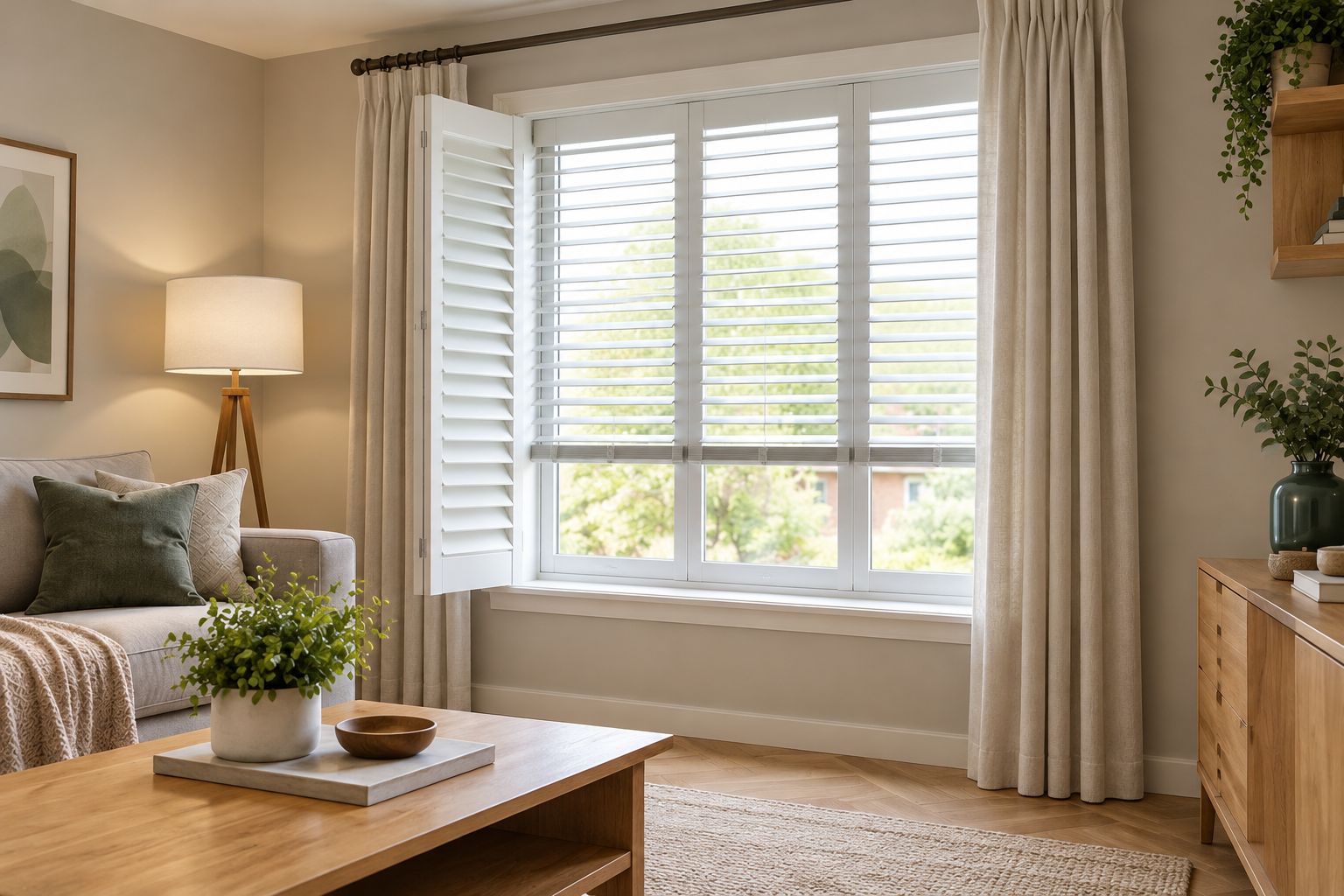
Drapes can add a fabric layer without putting another blind inside the recess. They also add fabric to care for and occupy space beside the window. Choose them because you want that function and appearance, not because every shutter installation needs another treatment.
For a closer look at the shutter itself, read the guide to plantation shutters for Columbus homes.
Why the fit varies from window to window
There is no single mounting arrangement that makes blinds and shutters compatible everywhere. These physical details determine what works:
- Window depth: The usable recess must accommodate the proposed hardware and its movement, not just the closed coverings.
- Shutter construction: Frame position, hinge placement, and louver movement determine where another treatment can sit.
- Blind design: The headrail, slats, raised blind, and operating controls each need space.
- Window hardware: Handles, locks, and projecting parts can interfere with coverings close to the glass.
- Surrounding space: Trim, walls, furniture, and drapery hardware can restrict panels that open into the room.
- Daily operation: A technically possible installation is still inconvenient if frequently used controls are difficult to reach.
For a 2026 replacement project, have the existing treatment assessed before ordering its companion. An existing blind or shutter fixes some mounting positions and can narrow your choices.
How do you check whether both treatments will work?
Use this sequence during an in-home assessment. Measure for the finished combination, not for two separate orders.
- Set the goal. Describe what the current covering does not do. Be specific about privacy, glare, nighttime light, or appearance.
- Inspect the opening. Identify the available mounting surfaces, trim, window handles, and anything that projects into the recess.
- Check movement. Review the blind raised and lowered, the louvers tilted, and the shutter panels open.
- Test access. Confirm how you will reach controls, operate the window, and clean the glass.
- Confirm the plan. Have the proposed mounting positions and operating sequence explained before placing the order.
If you are keeping an existing treatment, show how it works now. Point out any sticking panels, awkward controls, or window handles that already cause trouble. Adding another layer should not make an existing problem harder to fix.
What should you ask during an in-home consultation?
Bring the decision back to your room. Explain when sunlight bothers you, when privacy matters, and whether you regularly open the window or shutter panels. Those details help distinguish a useful second layer from an unnecessary one.
Olsson Smart Shades is best for Columbus and Central Ohio homeowners seeking custom-measured, professionally installed window treatments. Its offerings include blinds, shades, plantation shutters, drapes, and motorized smart shades. The right combination still depends on the opening and the function you need.
To arrange a consultation or request a quote, use the business's website and describe whether you want to keep an existing covering. Ask for an in-home fit assessment of the combined installation, rather than a quote based only on window width and height.
For your 2026 quote request, ask for these details in writing:
- Which existing parts will stay and which will be removed.
- Where each new treatment will mount.
- How you will operate each covering after installation.
- Whether the panels and window will retain their intended access.
- What work and components the proposed installation includes.
You do not need to arrive with a product decision. Start with the problem you want the window treatment to solve.
Discuss your window treatment plan
Ask about a custom-measured installation for your Columbus or Central Ohio home.
Will adding blinds make plantation shutters blackout?
Adding blinds does not guarantee a blackout result. Light can still enter around the perimeter, between components, or through the chosen blind material. A room-darkening goal needs an assessment of the entire window opening.
Explain where the unwanted light enters before choosing another covering. Adding slats behind existing slats does not automatically address light coming around the frame.
Can you keep existing blinds when adding shutters?
You can keep existing blinds only if the proposed shutter installation leaves them usable. The shutter frame, louvers, and opening panels must clear the blind and its controls.
Have the existing blind included in the measurement visit. Do not assume a blind fits simply because it currently sits neatly inside the window recess.
Is it better to mix blinds and shutters on different windows?
Using blinds and shutters on different windows avoids fitting both systems into the same opening. It can suit a home where each room has a different privacy or light-control need.
The trade-off is visual consistency. Review windows that are visible together, especially across an open living space, and decide which details you want to coordinate.
FAQ
Can you combine blinds and shutters on the same window?
Yes, you can combine blinds and shutters when the mounting positions allow both to operate freely. Check the blind, shutter louvers, opening panels, and window hardware together before ordering.
Should blinds go behind shutters or in front of them?
Neither position works for every window. Behind the shutters, check depth and control access; in front, check that the blind and its hardware do not obstruct opening panels.
Do plantation shutters need blinds behind them?
Plantation shutters do not automatically need blinds behind them. Add a blind only when it provides a specific function the shutter installation does not already supply.
Will blinds behind shutters stop all bedroom light?
Blinds behind shutters do not guarantee complete darkness. Light can enter through materials, joints, and perimeter gaps, so assess where the light comes from before choosing another layer.
Can I add shutters without removing my existing blinds?
You can retain existing blinds if the new shutter frame and moving parts leave sufficient clearance. The existing blind and its controls need to be included in the installation assessment.
Are drapes a better choice than blinds over shutters?
Drapes suit homeowners who want a fabric layer outside the shutter frame. They still need space to gather beside the window and hardware that stays clear of opening shutter panels.
What should I check before combining window treatments in 2026?
For a 2026 installation, check mounting space, moving parts, control access, and window operation together. Ask the installer to explain how you will use and clean the completed arrangement.
One last thing
Check the window with every covering fully open—not just neatly closed. A layered installation can look right while preventing a shutter panel from opening far enough to reach the glass.
Ask Olsson Smart Shades to walk through that open-window arrangement during your consultation. The best fit is one you can live with every day, not just one that fits when closed.