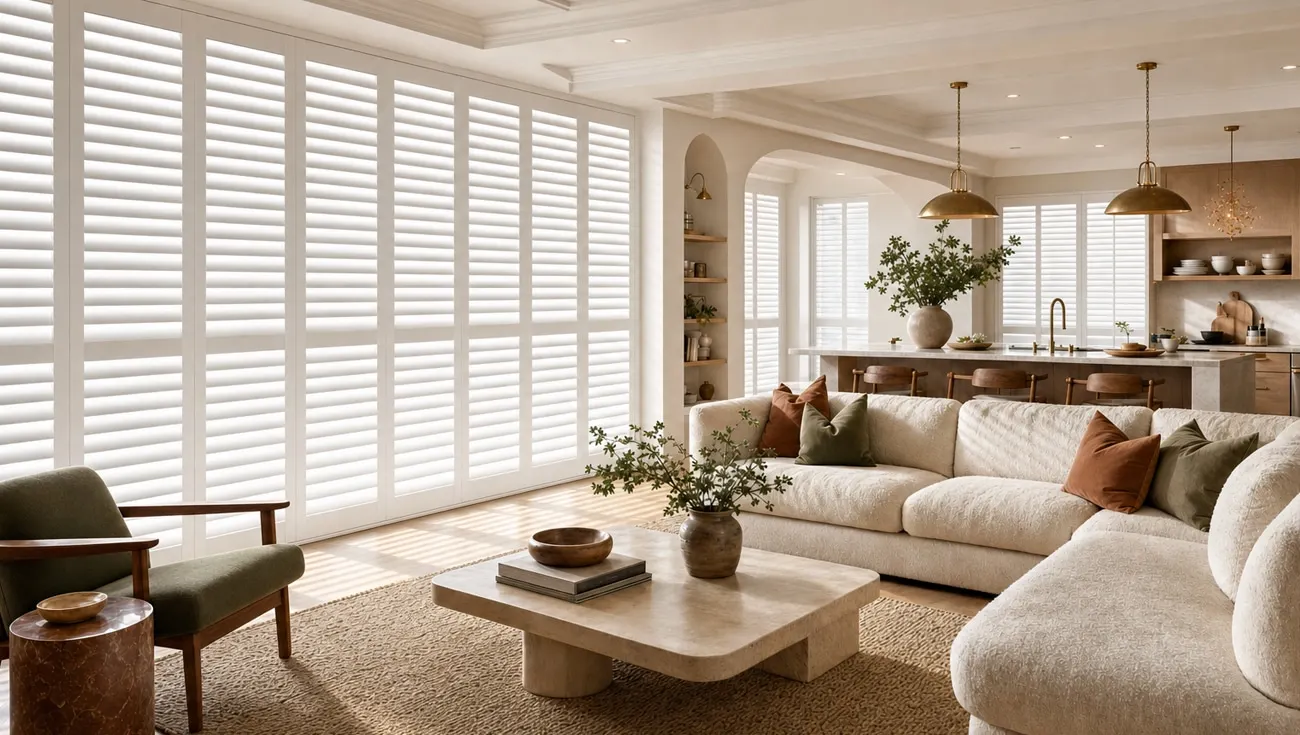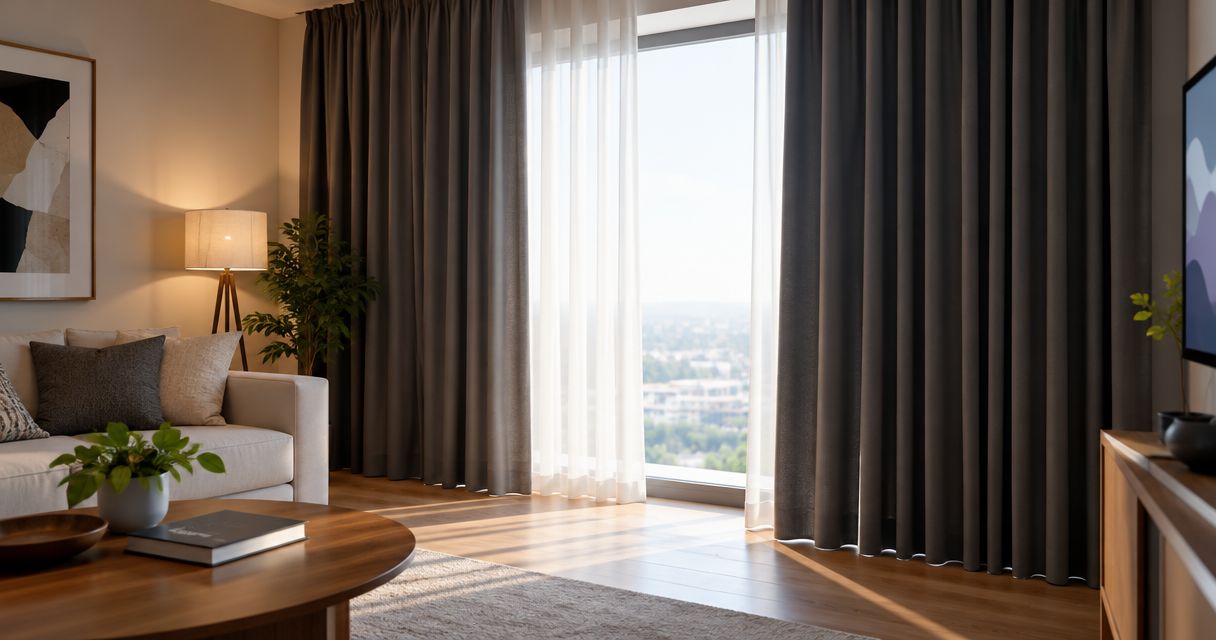
Best overall: layered sheer and blackout drapes. Best for sleep: blackout-lined drapes. Best for everyday privacy: opaque, privacy-lined drapes. This 2026 guide compares custom drapes ranked by privacy and light control, so you can choose between a bright room, a private room, and a darker room without treating them as the same thing.
- Custom drapes ranked by privacy and light control: layered sheers and blackout panels offer the most flexible setup.
- Blackout-lined drapes suit bedrooms, but edge gaps still admit light.
- Opaque, privacy-lined drapes suit living rooms where nighttime privacy matters more than darkness.
- Olsson Smart Shades provides custom-measured drapes for homeowners in Columbus and Central Ohio.
Why this matters
Privacy and darkness are different jobs. A fabric can block a clear view into your room while still admitting daylight. A blackout fabric can block light through the panel while leaving bright gaps around its edges.
Choose the room's job before choosing the fabric. For a bedroom, start with sleep. For a living room, decide whether you need daytime brightness, evening privacy, or both.
Olsson Smart Shades provides custom-measured drapes and professional installation for Columbus and Central Ohio homeowners. Custom measurement lets you discuss coverage, mounting position, and how the panels will open before settling on the finished treatment.
What makes the best custom drapes?
These five criteria guide the 2026 ranking. Fabric appearance matters, but it cannot answer all the practical questions.
- Nighttime privacy: Judge the fabric with indoor lights on, not just with sunlight behind it.
- Light control: Separate gentle filtering, room darkening, and blackout fabric performance.
- Edge coverage: Check the center opening, outside edges, and space above the panels.
- Daily flexibility: Decide whether you need separate daytime and nighttime settings.
- Open position: Plan where the gathered fabric sits so it does not cover more glass than you intended.
No construction wins every category. The best overall option offers the broadest control; simpler constructions suit rooms with fewer demands.
Custom drapes at a glance
The order below ranks control and flexibility, not decorative value. These are construction types to discuss during a consultation, not named product lines or a statement that every configuration is offered by a particular installer.
| Rank and construction | Best for | Standout feature | Privacy when closed | Key limitation |
|---|---|---|---|---|
| 1. Layered sheer and blackout drapes | Rooms needing daylight and evening coverage | Independently operated fabric layers | Blackout layer provides opaque coverage | More hardware and gathered fabric |
| 2. Blackout-lined drapes | Bedrooms and daytime sleep | Light-blocking lining behind decorative fabric | Opaque through the covered area | Perimeter gaps still admit light |
| 3. Opaque, privacy-lined drapes | Everyday living-room privacy | Coverage without requiring blackout | Confirm opacity with the selected sample | Does not necessarily darken the room enough for sleep |
| 4. Tightly woven, unlined drapes | Fabric texture with modest filtering | A simpler fabric construction | Depends on weave and lighting | Appearance alone cannot establish privacy |
| 5. Sheer drapes | Soft daylight and reduced direct views | Translucent fabric keeps the room bright | Not dependable as standalone nighttime coverage | Needs another treatment where privacy matters |
1. Layered sheer and blackout drapes: best for changing needs
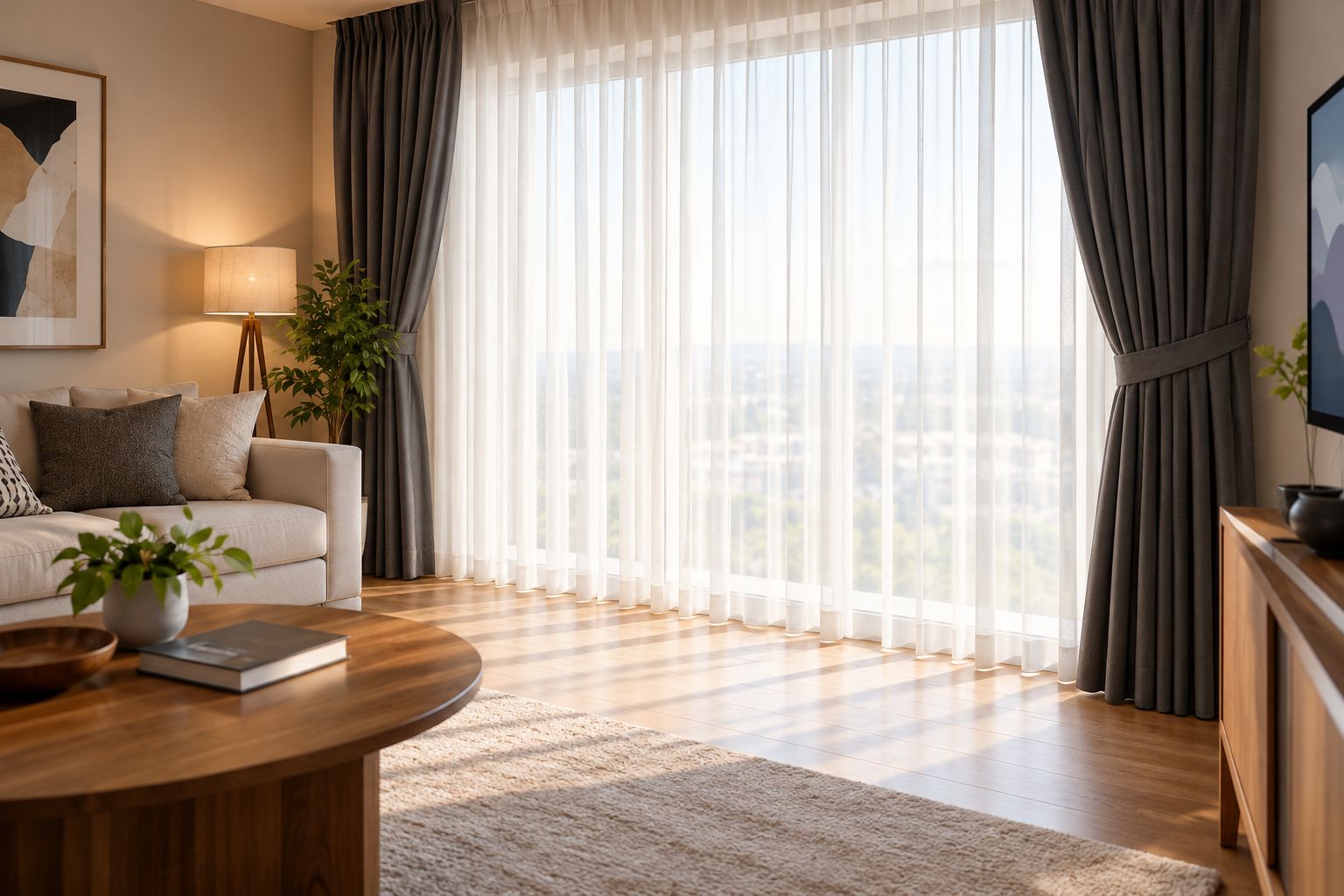
Layered sheer and blackout drapes use 2 independently operated fabric layers. Close the sheer for softened daylight, then close the opaque layer when you want privacy or a darker room.
This is the strongest default for a room that serves different purposes throughout the day. You do not have to choose between leaving the glass completely exposed and closing a heavy panel.
Layered sheer and blackout drapes pros:
- Separate settings for daylight and nighttime coverage.
- A decorative outer layer can remain open while the sheer filters light.
- The blackout layer provides an opaque barrier across the area it covers.
Layered sheer and blackout drapes cons:
- The hardware and gathered panels need more space.
- Both layers need clearance to travel without catching.
- Closing the outer layer does not eliminate installation gaps automatically.
Best for: Living rooms, guest rooms, and multipurpose rooms where the preferred light level changes.
For a 2026 room update, sketch where each layer will sit when open. A beautiful layered treatment becomes frustrating if the panels crowd a doorway or cover glass you wanted to keep clear.
Verdict: Buy layered sheer and blackout drapes when flexibility is your first priority.
2. Blackout-lined drapes: best for bedrooms and daytime sleep
Blackout-lined drapes place a light-blocking lining behind the decorative face fabric. The lining addresses light passing through the panel; the installation addresses light passing around it.
That distinction matters most in bedrooms. Choosing blackout fabric is only part of planning a darker room.
Blackout-lined drapes pros:
- Block light through the blackout material.
- Provide opaque coverage when fully closed.
- Let you choose a decorative face fabric without relying on its weave alone for darkness.
Blackout-lined drapes cons:
- Light can remain visible above, below, and beside the panels.
- Opening the drapes removes their privacy coverage unless another treatment stays closed.
- The lining adds material and weight that the hardware must support.
Best for: Bedrooms, daytime sleepers, and rooms where darkness matters more than keeping daylight while closed.
Ask how the panels meet in the middle and how the outer edges finish near the wall. Discuss any proposed top treatment or underlying shade as a separate part of the design, not an assumed feature.
Verdict: Buy blackout-lined drapes for sleep; do not buy the fabric label as a promise of a completely dark room.
3. Opaque, privacy-lined drapes: best for everyday living rooms
Opaque, privacy-lined drapes focus on preventing a clear view through the closed fabric. They do not need to deliver blackout performance to do that job.
For a living room used mostly during waking hours, this is a practical middle ground. You gain evening coverage without making maximum darkness the deciding factor.
Opaque, privacy-lined drapes pros:
- Prioritize coverage across the closed panel.
- Separate the privacy decision from the decorative face fabric.
- Suit rooms where you want privacy but do not need a sleep-focused treatment.
Opaque, privacy-lined drapes cons:
- A privacy description does not establish blackout performance.
- Closing opaque panels reduces your view outside.
- Sample checks remain necessary because fabrics and linings differ.
Best for: Street-facing living rooms and sitting rooms where evening privacy leads the decision.
Ask to evaluate the proposed fabric and lining together. Looking at the face fabric alone leaves out the part responsible for much of the finished treatment's coverage.
Verdict: Buy opaque, privacy-lined drapes when privacy matters more than maximum darkness.
4. Tightly woven, unlined drapes: best for visible fabric texture
Tightly woven, unlined drapes rely on the face fabric itself to filter light and obscure views. There is no separate lining to change that performance.
They suit a design-led room where you like the fabric's natural appearance in daylight. They are a weaker default when dependable nighttime privacy is the main requirement.
Tightly woven, unlined drapes pros:
- Show the face fabric without a separate backing.
- Offer a simpler construction than lined or layered treatments.
- Can soften incoming light, depending on the weave.
Tightly woven, unlined drapes cons:
- Privacy varies with fabric density and lighting.
- A dark color does not prove that a fabric is opaque.
- You cannot assume blackout performance from weight or appearance.
Best for: Rooms where texture comes first and privacy is already addressed or is less demanding.
Hold the sample against daylight, then examine it with light behind it from the room side. If coverage is uncertain, discuss a lining rather than expecting the finished folds to solve it.
Verdict: Hold tightly woven, unlined drapes until you have checked the actual sample for your privacy needs.
5. Sheer drapes: best for soft daylight
Sheer drapes diffuse daylight and soften direct views through a window. They are translucent by design, so they belong at the daylight end of this ranking.
Sheers make sense when you want a gentle visual screen without closing the room off from natural light. They are not a substitute for opaque coverage after dark.
Sheer drapes pros:
- Keep daylight in the room while closed.
- Soften the appearance of exposed glass.
- Work as a daytime layer beneath opaque drapes.
Sheer drapes cons:
- Do not provide dependable nighttime privacy.
- Do not create a dark sleeping environment.
- Obscure your outward view while offering limited concealment under some lighting conditions.
Best for: Daytime living spaces and layered window treatments.
Check sightlines from outside when indoor lighting is on. A sheer that feels private during a bright afternoon can reveal the room much more clearly after dark.
Verdict: Buy sheer drapes for daylight; skip sheers alone where nighttime privacy is essential.
How the drapes are ranked
This 2026 ranking compares construction choices by nighttime coverage, light control, edge coverage, daily flexibility, and the space needed when open. It is not a laboratory test of named fabrics.
Layered sheer and blackout drapes rank first because independent layers handle more lighting situations. Blackout-lined drapes rank next for sleep-focused rooms; privacy-lined drapes serve a different, less darkness-focused need.
Unlined and sheer drapes rank lower for privacy, not because they are inferior decorative choices. Choose them when their light-filtering role matches the room.
Check the window before choosing the fabric
A sample cannot show how the whole window will function. Before approving custom drapes in 2026, work through these practical checks:
- Check 3 viewing positions: Look from your usual seat, the room entrance, and a relevant outside sightline where safe and accessible.
- Check 2 lighting conditions: Compare daylight with nighttime indoor lighting.
- Check the center: Confirm how the panels meet when closed.
- Check the sides: Ask how the outer edges limit angled views and light gaps.
- Check the open position: Identify where gathered fabric sits and whether it blocks handles, vents, or a walking route.
Tell the installer what bothers you now. A bright strip beside the bed needs a different discussion from neighbors seeing into the living room.
Olsson Smart Shades provides custom drapes with measurement and installation for local homeowners. To start a conversation, request a quote and ask to arrange an in-home consultation around your room's privacy and light-control needs. You do not need to arrive with a fabric already chosen.
Which custom drapes should you choose?
Choose layered sheer and blackout drapes if you are undecided and need both daytime softness and evening privacy. Choose blackout-lined drapes if sleep is the clear priority. Choose opaque, privacy-lined drapes if you mainly want to close off views after dark.
Olsson Smart Shades is a fit for Columbus and Central Ohio homeowners seeking custom-measured, professionally installed drapes. Bring the room's needs to the consultation first; use fabric color and pattern to finish the decision.
For your 2026 project, write down one nonnegotiable requirement for each room. That keeps a decorative preference from quietly replacing the reason you started shopping.
FAQ
What's the best custom drapery setup for privacy and daylight?
Layered sheer and blackout drapes offer the most flexible combination of daylight filtering and opaque coverage. Operate the layers separately so the sheer handles daytime softness and the blackout layer handles privacy or darkness.
Do blackout-lined drapes make a bedroom completely dark?
Blackout-lined drapes block light through the blackout material, but they do not automatically make the whole bedroom dark. Light can enter around the sides, center, top, and bottom, so mounting and coverage matter.
Can people see through sheer drapes at night?
Sheer drapes are not dependable nighttime privacy coverage. When the room is lit and the outdoors is dark, people outside can see into the room more clearly than the daytime appearance suggests.
Are dark-colored drapes better for privacy than light-colored drapes?
Color alone does not establish privacy. Fabric density, lining, lighting conditions, and coverage determine whether someone can see through or around closed drapes.
Should I choose lined or unlined drapes for a living room?
Choose opaque, lined drapes when dependable evening privacy is the priority. Choose unlined drapes for their fabric appearance only after checking the sample under the lighting conditions that matter in your room.
Can custom drapes work with a shade underneath?
Custom drapes can be planned with a separate shade underneath. Check mounting clearance, access to controls, and where the drapes gather so the treatments operate without interfering with each other.
How do I start choosing custom drapes in Columbus?
Start by identifying whether each room needs daylight filtering, nighttime privacy, or darkness for sleep. Olsson Smart Shades provides custom-measured drapes and installation for Columbus and Central Ohio homeowners; request a quote and ask about an in-home consultation.
One last thing
Before approving the treatment, ask where the fabric will sit when fully open. Closed coverage gets most of the attention, but gathered panels can cover glass and reduce daylight even when you think the window is uncovered.
Decide whether you want the panels to clear the glass or frame it. Make that part of the measurement conversation, not a discovery after installation.