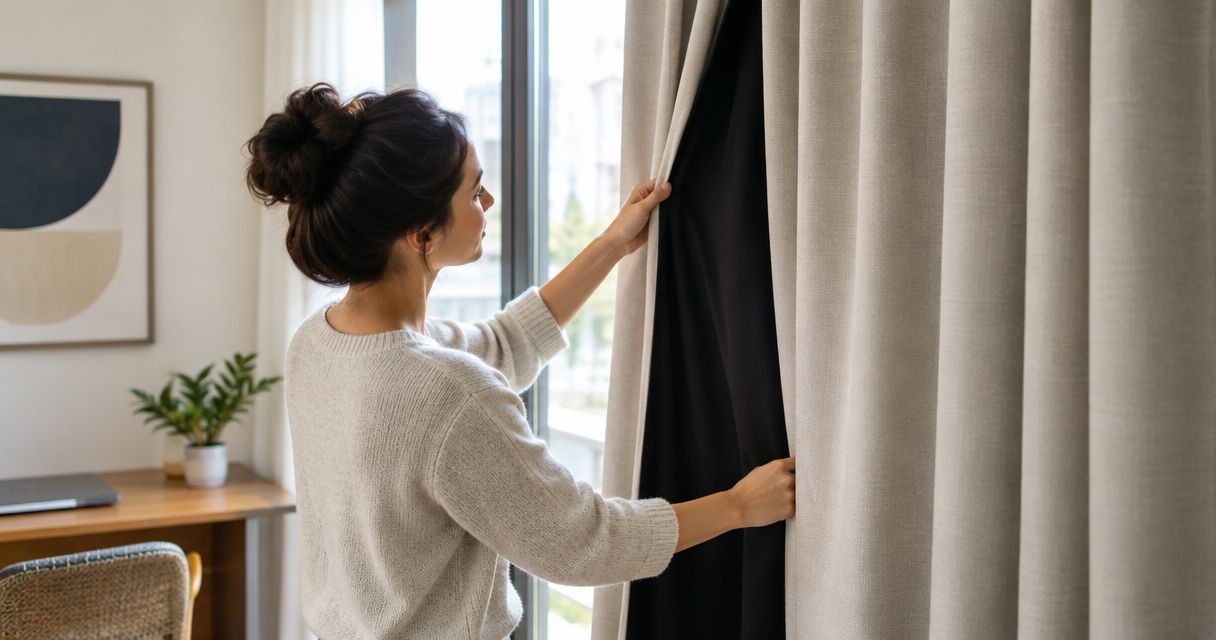
Yes, custom drapes can be lined for blackout by adding light-blocking lining behind the decorative fabric. The lining blocks light through the fabric, but gaps at the sides, top, bottom, and center can still brighten the room. For a darker bedroom, plan the lining and the fit together—not just the fabric.
- Can drapes be lined for blackout? Yes, but lining alone does not stop light around the edges.
- Blackout lining suits bedrooms; room-darkening lining suits spaces where some daylight is acceptable.
- Existing drapes need a fabric, construction, and hardware check before adding lining.
- Olsson Smart Shades offers custom-measured drapes for Columbus and Central Ohio homeowners seeking professional installation.
Can drapes be lined for blackout?
Yes. Blackout lining can be included when custom drapes are made, and some existing drapes can be altered to accept it. Whether an existing pair is suitable depends on its condition, construction, and hanging hardware.
Start by separating the fabric's job from the installation's job. The lining limits light passing through the panel. The panel dimensions, mounting position, and closing arrangement determine how much light travels around it.
For homeowners planning custom drapes in 2026, Olsson Smart Shades offers custom-measured window treatments and professional installation in Columbus and Central Ohio. Explain how dark you want the room before choosing the decorative fabric.
| Approach | Best for | Main benefit | Main limitation |
|---|---|---|---|
| Blackout-lined custom drapes | Bedrooms where darkness is the priority | Combines decorative fabric with light-blocking lining | Edge gaps still need attention |
| Room-darkening-lined drapes | Living spaces where reduced light is enough | Softens incoming light without requiring a blackout goal | Does not provide the same light blocking as blackout lining |
| Adding lining to existing drapes | Homeowners who want to keep suitable panels | Retains the existing decorative fabric | Construction and hardware can limit the alteration |
| Blackout shade behind drapes | Rooms needing a separate light-control layer | Lets the shade and drapes serve different purposes | Adds another treatment to measure, operate, and maintain |
Why this matters
A beautiful fabric sample does not show you what happens around a finished window. You can choose blackout lining and still see a bright strip above the rod or between the panels.
For your 2026 window-treatment project, describe the outcome in everyday terms: sleeping after sunrise, reducing streetlight, or making a guest room darker. That gives the person measuring your windows something useful to design around.
Ask for a room-darkening result, not just a lining label. The result depends on the whole arrangement.
Blackout-lined drapes: best for bedrooms that need less light
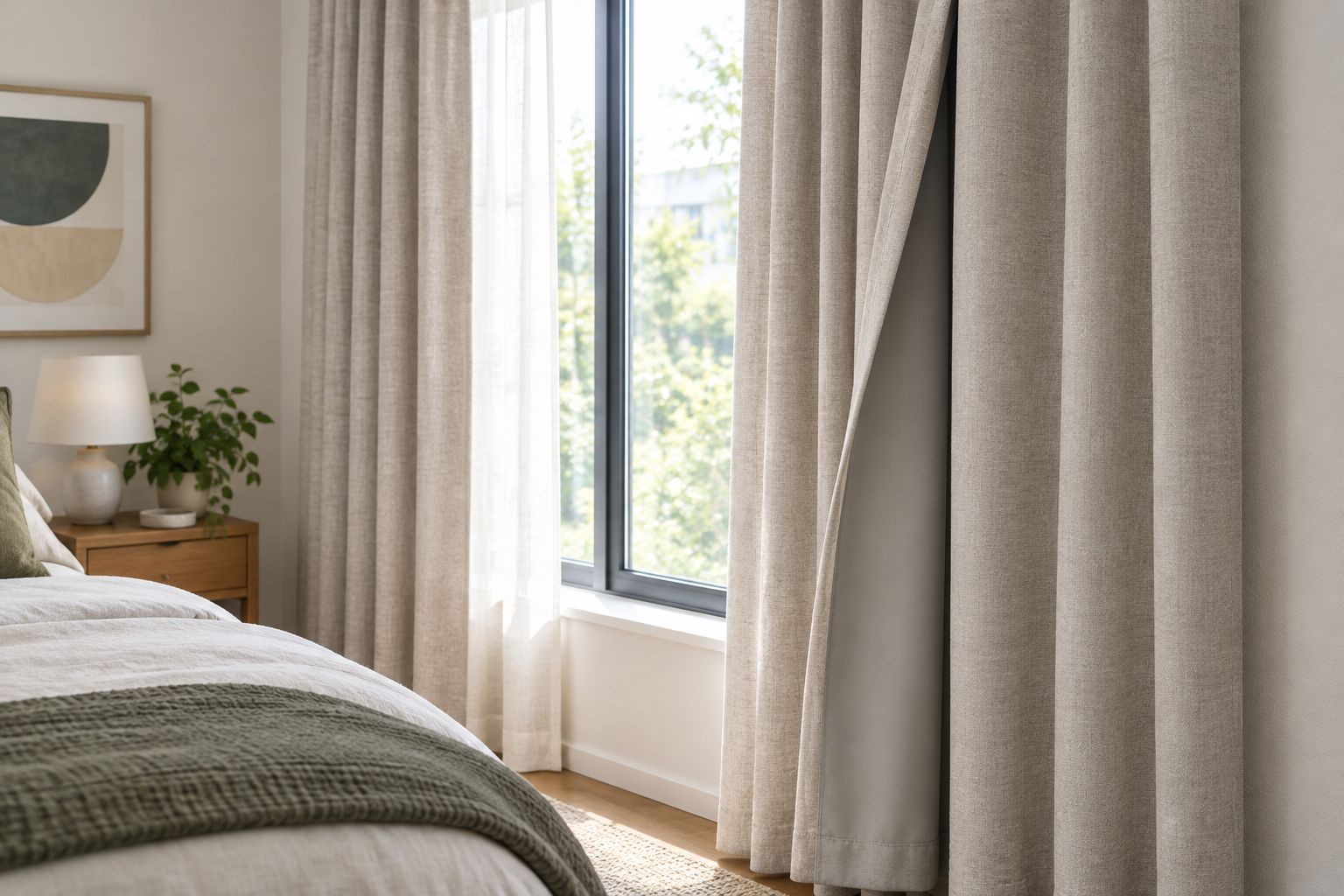
Blackout lining sits behind the decorative face fabric. That lets you choose the room-facing fabric for its appearance while choosing the lining for light control.
The main advantage is flexibility. You do not have to choose a dark decorative fabric simply because you want a darker bedroom; the lining does the light-blocking work.
The trade-off is added bulk and weight. The lining changes how panels fold, hang, and gather when open, so it belongs in the design discussion from the beginning.
Ask to see the face fabric and proposed lining together. Check how they hang, whether the lining shows at the edges, and whether the combined fabric feels right for the room.
Recommendation: choose blackout lining when blocking light through the panel is essential, then address the gaps separately. Do not treat a lining sample as proof that the installed room will be completely dark.
Room-darkening lining: best when some daylight is welcome
Room-darkening lining reduces incoming light without necessarily blocking it as completely as blackout lining. Product descriptions vary, so ask what the particular lining is intended to do.
This approach suits a room where you want less glare or a more sheltered feeling but do not need sleeping conditions during daylight. Its limitation is straightforward: reduced light is not the same as blackout.
For a 2026 fabric appointment, use the same question for every sample: does this lining block light through the fabric, or merely reduce it? That keeps attractive fabrics from distracting you from the room's main requirement.
Recommendation: choose room-darkening lining only when some transmitted light is acceptable. If daytime sleep is the goal, make that clear before approving it.
Existing drapes: best when the panels are worth keeping
Some existing drapes can accept a sewn-in lining. Others need a different approach, and some are not suitable for alteration at all.
A workroom needs to inspect the face fabric, heading, seams, and hem. Fragile fabric, limited seam allowance, or an unsuitable heading can make a seemingly simple addition more involved.
The rod and brackets matter, too. A lining adds weight, and existing hardware must be suitable for the finished panels—not just the unlined pair.
Before requesting an alteration, gather the following:
- Photos of the drapes open and closed.
- Close-up photos of the heading and attachment points.
- Information from the care label, if present.
- Photos showing the rod, brackets, and window trim.
- A clear description of where light currently enters.
Recommendation: have the drapes assessed before buying lining fabric. Keeping existing panels is useful only if the finished treatment will hang and operate properly.
A blackout shade behind drapes: best for separate control
A separate blackout shade lets you use the drapes for appearance while operating another layer for darkness. This is useful when you want to leave the drapes open during the day without giving up a dedicated light-control treatment.
The downside is another set of fitting decisions. A shade can also leave light gaps, and the shade, drapes, and hardware need enough clearance to work without interfering with each other.
Compare the layout options in the guide to blackout shades for bedrooms. Focus on mounting and edge coverage rather than assuming that adding another layer automatically fixes every gap.
Recommendation: consider a separate shade when independent operation matters. Choose the combination because it solves a specific room problem, not simply because more layers sound better.
Why blackout results vary
Blackout performance varies because light has more than one route into a room. These are the main details to discuss during measuring:
- Side gaps: Panels hanging away from the wall leave a path for light. A return brings the outer edge back toward the wall.
- Top gaps: Light can enter above the drapes. Mounting position and an appropriate top treatment affect that opening.
- Center overlap: Panels that only meet at the center can separate. An overlapping closing arrangement helps cover the join.
- Bottom coverage: Short panels leave an exposed strip below them. The finished length needs to suit both light control and daily use.
- Panel fullness: Fabric needs enough width to close properly while retaining its intended folds. Width is not just a styling choice.
- Hardware clearance: Rod projection, brackets, trim, and nearby obstacles affect how close the treatment can sit to the opening.
No single detail replaces the others. A carefully lined panel still needs an appropriate place to hang.
How do you plan blackout-lined custom drapes?
Use your 2026 consultation to work from the room's needs toward the fabric choice. A practical order prevents you from approving a look before checking whether it fits the window.
- Describe the goal. Say whether you need daytime sleeping conditions, less early-morning light, or reduced streetlight. These are different expectations.
- Show the problem. Look at the window when unwanted light is strongest. Photos help explain a problem that is not visible during the appointment.
- Review the opening. Include the trim, wall space, doors, furniture, and anything that affects panel movement or mounting.
- Compare fabric and lining. View the proposed combination together. Ask about its appearance, handling, and care instructions.
- Confirm the closing details. Discuss center overlap, outer returns, top coverage, and finished length before approving fabrication.
- Review operation. Make sure you can open and close the finished panels comfortably and that the proposed hardware suits their weight.
Olsson Smart Shades is best for Columbus and Central Ohio homeowners seeking custom-measured drapes with professional installation. For blackout-lined drapes, ask Olsson Smart Shades to discuss lining choices and edge coverage as part of the quote.
A custom treatment requires decisions before fabrication. The benefit is a coordinated fit; the trade-off is that changes to the agreed fabric, dimensions, or construction need discussion rather than an improvised fix after installation.
Discuss your drapery project
Ask about custom drapes, lining choices, and an in-home consultation for your window.
Can light-colored drapes still have blackout lining?
Yes, light-colored drapes can have blackout lining because the lining provides the light-blocking layer. You do not need to make the decorative face fabric dark simply to reduce transmitted light.
Check the assembled sample rather than judging the face fabric alone. Lining can affect its apparent color, texture, and folds, particularly with lightweight fabrics.
Can blackout lining be added without replacing the rod?
Sometimes, but the existing rod needs a weight and fitting check before you add blackout lining. The brackets, attachments, and ease of movement all matter.
Do not assume that hardware suitable for unlined panels will suit lined panels. Also check whether its position allows the side coverage and center closing arrangement you want.
Will blackout-lined drapes make the room completely dark?
Blackout-lined drapes do not automatically make a room completely dark. Light can still enter around the panels, through an uncovered part of the window, or from elsewhere in the room.
Check the finished treatment in daylight with the panels closed. Identify whether remaining light comes through the fabric or around an edge before deciding what needs adjustment.
FAQ
Can drapes be lined for blackout if I already own them?
Yes, some existing drapes can be lined for blackout after their fabric, construction, and hardware are assessed. An alteration needs to preserve proper hanging and comfortable operation.
Is blackout lining the same as room-darkening lining?
No, blackout lining is intended to block light through the fabric, while room-darkening lining reduces it. Ask about the specific lining rather than relying on the name alone.
Do I need dark fabric for blackout drapes?
No, blackout drapes can use light-colored decorative fabric with a light-blocking lining behind it. Review the fabrics together because the lining can affect the finished appearance.
Why is light coming around my blackout drapes?
Light comes around blackout drapes when the installation leaves gaps at the sides, top, bottom, or center. Lining addresses light through the panels, not those openings.
Are blackout-lined drapes or a separate shade better for a bedroom?
Blackout-lined drapes suit homeowners who want light control built into the panels; a separate shade suits those who want independent operation. Both need careful fitting to address edge gaps.
Can I wash blackout-lined drapes at home?
Follow the care instructions for the complete lined treatment rather than assuming it is machine washable. The face fabric and lining must be cared for together.
What should I ask during a blackout drapery consultation in 2026?
Ask how the proposed lining, panel dimensions, center overlap, side returns, and mounting position work together. Explain when unwanted light enters and how dark you want the room to feel.
One last thing
Before replacing a treatment, close it during daylight and look for the brightest remaining light. A glowing panel points to a fabric issue; a bright outline points to coverage.
Match the fix to the light's path. Better lining cannot close an uncovered gap, and wider panels cannot turn a light-transmitting fabric into blackout fabric.