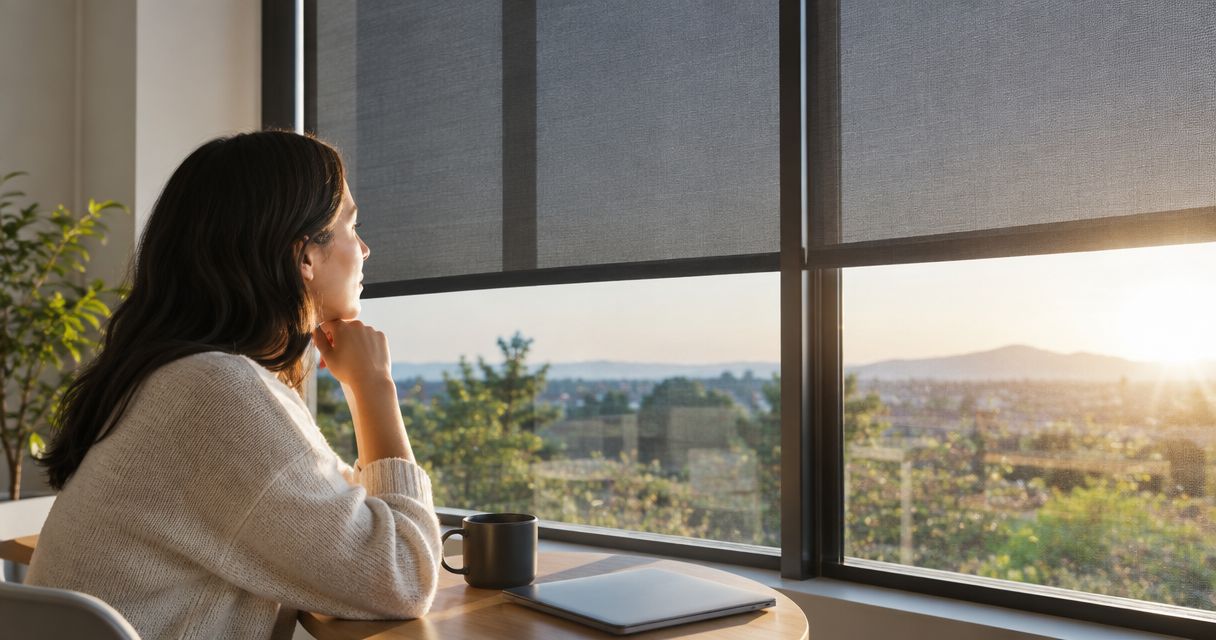
Solar shades filter sunlight, but there is no single blocking percentage that applies to every solar fabric. A 5% openness rating describes the fabric’s open area—not proof that it blocks 95% of visible light, UV rays, or solar heat. For your windows, compare the fabric’s separate performance ratings and remember that solar shades do not provide blackout or dependable nighttime privacy.
- How much sunlight do solar shades block? Openness alone cannot tell you; check the specific fabric’s performance ratings.
- A 5% openness rating describes open area, not a guaranteed 95% reduction in sunlight or heat.
- Lower openness generally favors glare control; higher openness generally favors a clearer view through the fabric.
- Olsson Smart Shades provides custom-measured window treatments for Columbus and Central Ohio homeowners.
Why this matters
A sunny room can have several different problems: glare on a television, uncomfortable afternoon sun, fading furnishings, or a lack of privacy. Those problems need different answers. A shade that softens glare does not automatically make a bedroom dark or keep neighbors from seeing inside after sunset.
Choose a solar shade by the problem you want to solve, not by one percentage on a sample card. For a custom-measured installation in Columbus and Central Ohio, Olsson Smart Shades is best for homeowners who want professional help fitting window treatments to their rooms. Solar shades still have limits: preserving a daytime view means accepting filtered light rather than complete darkness.
How much sunlight do solar shades actually block?
Solar shades reduce incoming sunlight according to their fabric construction, color, and optical properties. Their openness percentage tells you how much of the material consists of openings. It does not tell you everything that happens to sunlight when it reaches the fabric.
Some light passes through the openings. Some interacts with the yarns, where it can be reflected, absorbed, or transmitted. That is why subtracting openness from the whole does not produce a reliable visible-light, UV, or heat-blocking rating.
For a 2026 shade purchase, separate the measurements below before comparing samples. Ask for documentation for the exact fabric and color, not a different material from the same collection.
| Measurement | What it tells you | What it does not establish |
|---|---|---|
| Openness factor | The proportion of open space in the fabric | The total percentage of sunlight blocked |
| Visible-light transmittance | How much visible light passes through the material | Whether the room will feel cool or private |
| UV transmittance or blockage | How the fabric performs against ultraviolet radiation | Complete protection against all causes of fading |
| Solar transmittance, reflectance, and absorption | How the material handles solar energy | A guaranteed room-temperature reduction |
| Finished shade fit | Where the fabric covers the window | Blackout performance at uncovered edges |
Openness is a fabric description, not an all-purpose sunlight-blocking score. Keep that distinction in mind when a product description uses phrases such as sun protection or light filtering without identifying the measurement.
1% openness: best for stronger glare control
A 1% openness fabric has less open area than the other examples here. Within a comparable fabric family, that generally favors stronger glare control and a more screened view. It is a useful starting point when direct sun makes a room difficult to use.
The trade-off is visibility. You give up some connection to the outdoors, and the fabric still does not become a blackout material. Check how much light passes through the yarns as well as through the openings.
Best for: rooms where reducing harsh light matters more than keeping the clearest view. Ask to see the material against your actual window before deciding whether the room feels too enclosed.
3% openness: best for balancing glare and view
A 3% openness fabric sits between the tighter and more open examples in this guide. It gives you a useful comparison sample when you want glare relief but do not want to start with the most closed-looking fabric.
The limitation is that a middle openness rating is not automatically the right compromise. Fabric color and the direction of the sun still affect what you see. A sample that looks comfortable at one window can feel different at another.
Best for: homeowners comparing glare control and an outdoor view side by side. Treat 3% as a candidate to evaluate, not a default recommendation for every room.
5% openness: best for a more open daytime view
A 5% openness fabric provides more open area than a 1% or 3% fabric. Within comparable materials, that generally supports a less screened daytime view. It also leaves more opportunity for direct light to pass through the openings.
Do not read 5% openness as a promise to block 95% of sunlight. Visible light, UV radiation, and heat require their own measurements. The fabric’s appearance also changes with the contrast between indoor and outdoor lighting.
Best for: rooms where maintaining the view is a priority and complete light control is not the goal. Compare a sample during the period when sunlight bothers you most.
10% openness: best for prioritizing the view
A 10% openness fabric has the largest open area among these examples. It is a view-first comparison option, rather than the first place to start when severe glare is the main complaint.
Its limitation is the same feature that creates that openness: more exposed space between the yarns. Do not choose it expecting the screening effect of a tighter weave. Confirm the exact material’s ratings before drawing conclusions about UV protection or heat control.
Best for: homeowners who value a more open view and can accept less screening. It is not a substitute for a room-darkening treatment.
| Openness example | Best for | Main advantage within comparable fabrics | Main trade-off |
|---|---|---|---|
| 1% openness | Stronger glare control | More screening | A more restricted view |
| 3% openness | Comparing glare and view | An intermediate starting point | Still needs testing at your window |
| 5% openness | A more open daytime view | Less visual screening | More direct light through openings |
| 10% openness | Prioritizing the view | The most open example listed | Less screening than tighter examples |
Why solar shade performance varies
For a 2026 comparison, keep the fabric and the finished installation separate. A material’s laboratory rating describes that material; your experience also depends on the window, the room, and the way the shade fits.
- Openness: Less open area generally increases screening within comparable fabrics. It does not establish a universal blocking percentage.
- Fabric color: Darker fabrics often favor outward visibility and glare control. Lighter fabrics generally reflect more light, but the exact performance belongs to the specific material.
- Yarn and weave: The solid portions of the fabric also interact with sunlight. Two fabrics with matching openness do not necessarily transmit the same amount of light.
- Window exposure: Direct sun hitting the window creates a different viewing condition from indirect daylight. Compare samples when the problem actually occurs.
- Shade fit: Light can enter around uncovered edges. The fabric’s rating does not describe those gaps.
- Lighting contrast: A view through a solar shade changes when the brighter side changes. Daytime screening does not establish nighttime privacy.
Ask the installer to explain which of these factors the proposed shade addresses. A useful recommendation connects the material to your room, rather than repeating the percentage printed on the sample.
Do solar shades block heat as well as light?
Solar shades can reduce solar heat entering a room, but light control and heat control are not interchangeable measurements. You cannot calculate a room-temperature change from openness alone. Window glass, exposure, fabric properties, and installation all affect the result.
If heat is your main concern in 2026, ask for the fabric’s solar-performance information. Look beyond a claim that the material blocks sunlight. You want to know how it transmits, reflects, and absorbs solar energy.
Avoid treating a fabric rating as a promise about your cooling bill. The shade is one part of the window and room, not a measurement of the whole home’s energy use.
Can you see through solar shades at night?
Solar shades do not provide dependable nighttime privacy when the room is brighter than the outdoors. The same openings that help you see outside during the day can allow people outside to see into a lit room.
For bedrooms, bathrooms, or street-facing living spaces, discuss a separate privacy layer. Drapes can cover the window when closed, but their privacy and light control depend on fabric, lining, coverage, and fit. They add another treatment to operate and accommodate around the window.
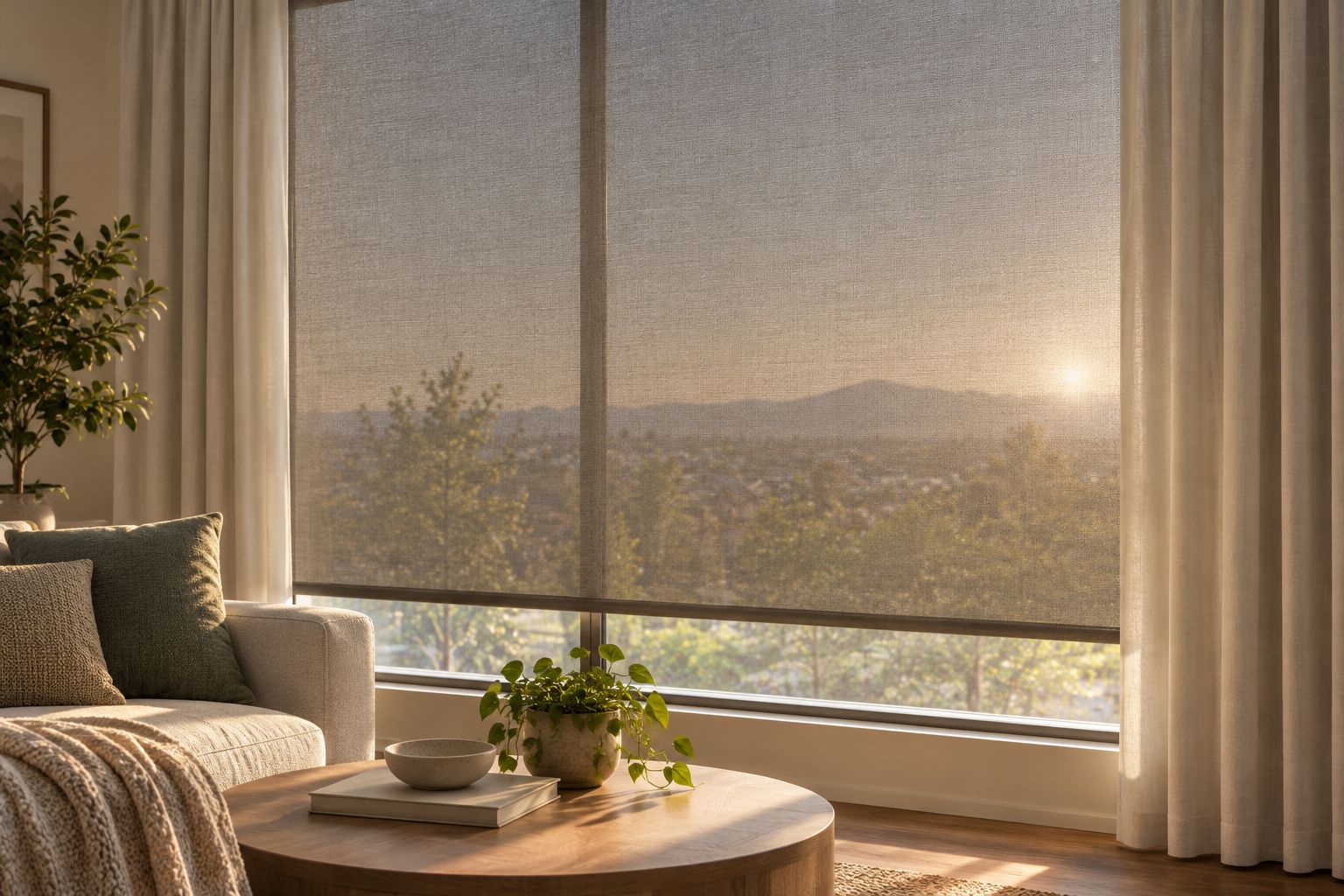
A layered window needs planning. Check where each treatment sits, whether the controls remain reachable, and whether the drapes can close fully without catching the shade.
How should you compare solar shade samples at home?
Use your 2026 consultation to answer practical questions before choosing a fabric. You do not need a technical vocabulary. You need to show where the sun causes trouble and explain what you want to keep.
- Name the problem. Identify glare, excessive brightness, privacy, or direct sun on furnishings. Put the most important concern first.
- Show the window. Point out the screen, chair, desk, or floor area affected. Mention when the problem occurs.
- Compare samples. Hold candidate fabrics against the same window. Compare openness and color together rather than judging either in isolation.
- Check coverage. Ask where the fabric will end and where light will remain visible around it. Discuss obstructions and how the window opens.
- Confirm controls. Decide whether manual or motorized operation fits the room. For smart controls, ask about the exact proposed system rather than assuming compatibility.
- Request a written quote. Ask it to identify the fabric, color, openness, operating method, and installation scope so you can compare the proposal accurately.
Olsson Smart Shades offers custom-measured shades and motorized smart shade installation for Columbus and Central Ohio homeowners. When requesting an in-home consultation or quote, describe the room and its sunlight problem; let the fabric choice follow that conversation.
Discuss your window treatment needs
Ask about custom-measured shades for your Columbus or Central Ohio home.
FAQ
How much sunlight do solar shades block?
Solar shades do not have one universal sunlight-blocking percentage. Check the exact fabric’s visible-light, UV, and solar-performance ratings; openness alone does not supply those answers.
Does a 5% solar shade block 95% of sunlight?
A 5% openness rating does not establish that the shade blocks 95% of sunlight. It describes open area, while light also interacts with the fabric’s yarns.
Is 1% or 5% openness better for glare?
A 1% openness fabric generally provides stronger screening than a comparable 5% fabric. The trade-off is a more restricted outdoor view, and color also affects the result.
Will solar shades make my bedroom completely dark?
Solar shades do not provide blackout. If darkness is your priority, compare a blackout treatment and discuss how the installation will address light around the edges.
Can people see through my solar shades at night?
People outside can see through solar shades when the room is brighter than the outdoors. Use a separate privacy treatment where nighttime privacy matters.
Do solar shades stop furniture from fading?
Solar shades can reduce UV exposure, but they cannot guarantee that furnishings will not fade. Visible light, heat, and material sensitivity also affect fading.
Can I ask for motorized solar shades during a consultation?
You can discuss motorized shade installation with Olsson Smart Shades. Ask which proposed fabrics and operating systems work together, and confirm any smart-home requirements for the exact system.
One last thing
Bring the sample to the problem, not just to the paint color. A fabric can coordinate beautifully with your walls and still leave distracting glare on the television. Compare it from the seat where you actually notice the sun.
For your 2026 decision, settle nighttime privacy before approving a view-focused solar fabric. It is easier to plan the complete window treatment together than to discover after installation that the daytime view was solving only half the problem.