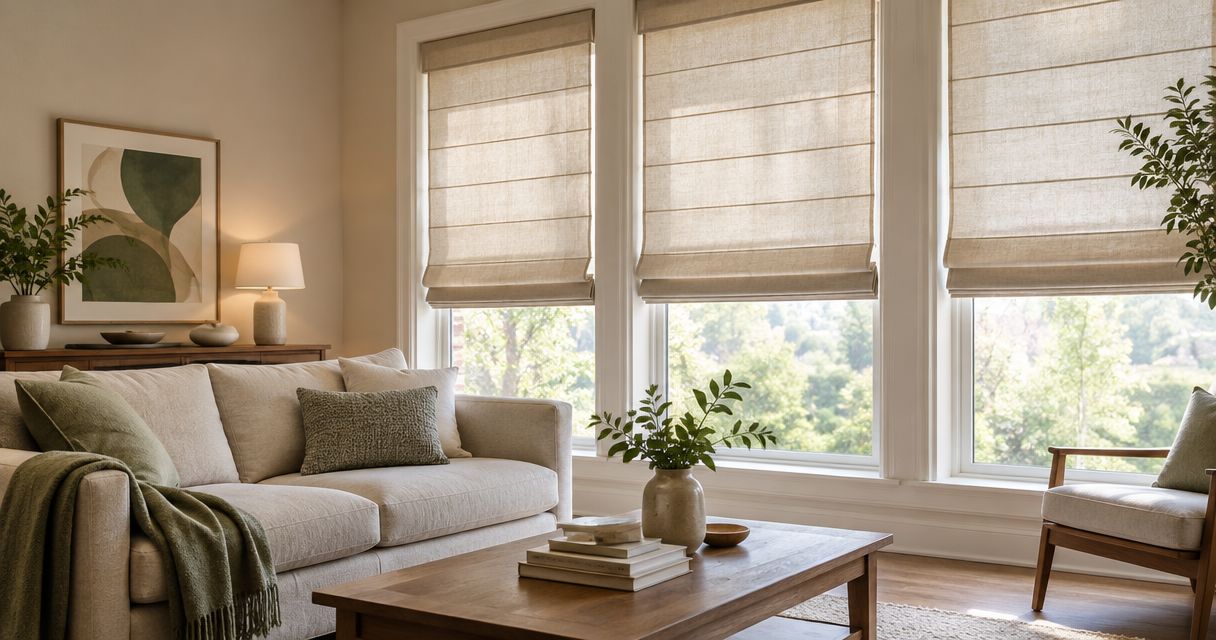
Yes—Roman shades still look at home in 2026, especially when the fabric, folds, and fit suit the room rather than compete with it. Choose Roman shades for a soft, tailored window treatment, but account for the fabric stack above the glass and the care the material requires.
- Roman shades still in style in 2026? Yes—choose folds and fabric that suit your room, not a trend label.
- Flat Roman shades suit a tailored look; relaxed folds create a softer finish.
- Check the raised fabric stack, nighttime privacy, and cleaning instructions before ordering custom window treatments.
- Olsson Smart Shades serves Columbus and Central Ohio homeowners seeking custom-measured, professionally installed window treatments.
Why this matters: A shade can look right when lowered and still cover too much glass when raised. Before choosing fabric, consider how you use the window throughout the day.
Olsson Smart Shades is best for Columbus and Central Ohio homeowners who want custom-measured, professionally installed window treatments. Start with your room’s needs, then choose the appearance.
Are Roman shades still in style in 2026?
Yes. Roman shades remain a sound design choice because they combine a fabric finish with an up-and-down shade. Whether that combination suits your home depends on the folds, proportions, and surrounding furnishings—not the year on a decorating article.
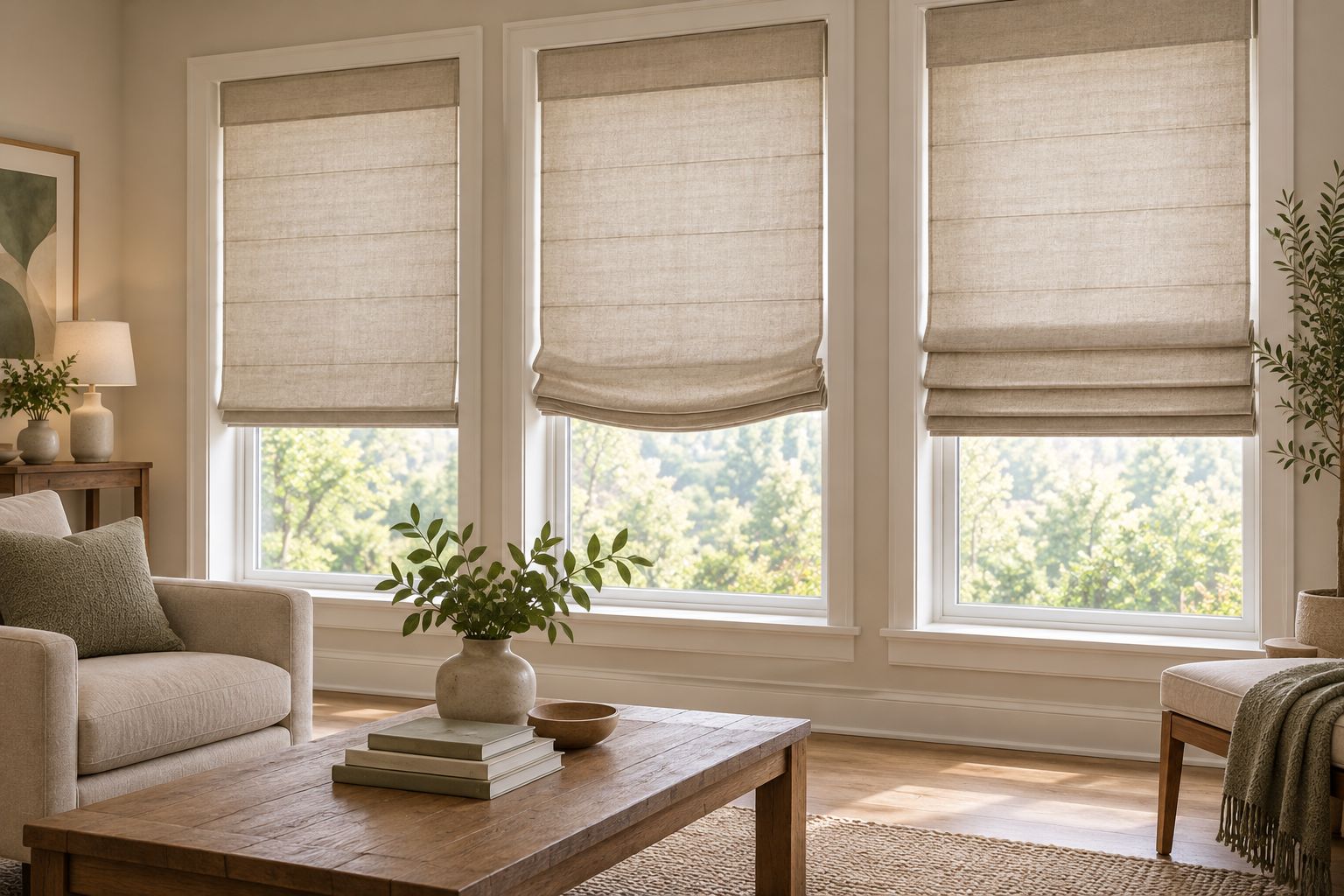
There is no single Roman shade look. A smooth front reads differently from a loose curved hem or a shade with visible folds while lowered.
| Roman shade style | Best for | What it adds | Main trade-off |
|---|---|---|---|
| Flat Roman | Rooms where you want a tailored finish | A relatively uninterrupted fabric face when lowered | Creasing and pattern alignment deserve close attention |
| Relaxed Roman | Rooms where you want a softer finish | A gently curved lower edge | The looser shape is less suited to a precise, straight-line look |
| Hobbled Roman | Rooms where you want visible fabric folds | Repeated folds even when lowered | More visible fabric creates a fuller appearance |
These are starting points, not rules about which home deserves which style. You can use a flat Roman in a traditional room or a relaxed Roman in a simple room. The result depends on the whole setting.
Flat Roman shades: best for a tailored finish
Flat Roman shades are the clearest starting point when you want fabric without a heavily folded appearance. The face lies relatively flat when lowered and gathers into folds as you raise it.
A plain fabric lets the shape stay quiet. A patterned fabric gives you a larger surface on which to see the design, although folds interrupt that design when the shade is raised.
Choose a flat Roman if you want the window to feel finished without becoming the room’s main feature. Check a sample beside your walls, upholstery, and trim. A fabric that looks calm on its own can look busy beside another strong pattern.
The trade-off is that a simple surface leaves less to distract from wrinkles, uneven hanging, or an awkward fit. Measurement and installation deserve as much attention as fabric selection.
Relaxed Roman shades: best for a softer finish
A relaxed Roman has a softer lower edge rather than a consistently straight hem. That shape works when you want fabric to feel less formal and more loosely arranged.
The curved edge is part of the design, not a flaw to straighten out. If you prefer an exact horizontal line across every window, choose another construction.
Choose a relaxed Roman because you like its shape—not because it appears in a 2026 inspiration photo. Ask to see the proposed style both raised and lowered so you understand how the bottom edge behaves.
Pay particular attention when several windows sit together. Repeated curves create a different rhythm from straight hems, and that difference becomes more noticeable across a group.
Hobbled Roman shades: best for visible fabric folds
Hobbled Romans retain a series of fabric folds when lowered. They bring more visible fullness to the window than a flat Roman.
This style makes sense when the folds are a feature you want to see. It is less suitable when your main goal is the simplest possible window surface.
Choose hobbled Romans when the room benefits from fabric depth; skip them when the window already feels crowded. Consider nearby drapes, patterned furniture, and decorative trim before adding another strong layer.
Do not judge fullness from a close-up fabric photograph alone. Look at the proposed treatment in relation to the entire window and the space around it.
Why the same Roman shade looks different from room to room
Roman shades are not automatically modern or traditional. Their appearance changes with a few choices you can evaluate before ordering.
- Fabric texture: A smooth fabric and a visibly textured fabric create different surfaces, even in a similar color.
- Pattern scale: A large motif looks different on a narrow window than on a broad one. Review where the pattern will fall.
- Fold construction: Flat, relaxed, and hobbled styles give the fabric a different shape.
- Mounting position: Placing the shade within the opening or over it changes how much trim remains visible.
- Raised stack: The gathered fabric affects the amount of glass you see when the shade is open.
- Surrounding layers: Drapes, furniture, and trim influence whether the window looks restrained or heavily dressed.
For a 2026 room update, start by identifying what you want to keep. Matching a shade to the room you actually have is more useful than rebuilding the room around a fabric sample.
How do you choose Roman shades without chasing a trend?
Use this sequence before committing to a fabric. It keeps appearance connected to daily use.
- Room priorities: Write down what matters most: daytime light, nighttime privacy, a darker sleeping space, or a softer appearance. Put competing needs in order.
- Fabric samples: View the actual samples beside the window during the day and under your evening lighting. Do not choose from a screen alone.
- Mounting fit: Have the opening, trim, handles, and surrounding wall space checked. Ask where the raised shade will sit.
- Daily operation: Decide how you want to raise and lower the treatment, then confirm which controls are available for the selected construction.
Take 2 photos per window as a planning aid: one showing the full wall and another showing the opening and trim. These photos help explain the setting, but they do not replace final measurements.
Also ask to understand the shade in 3 positions: fully lowered, partly raised, and fully raised. A treatment needs to work beyond the position shown in a styled photograph.
Should Roman shades sit inside or outside the window frame?
Choose the mounting position around the opening and the job the shade needs to do. Neither inside nor outside mounting is automatically more current in 2026.
An inside mount sits within the window opening and keeps more of the surrounding trim visible. It depends on sufficient mounting space and clearance for the selected shade.
An outside mount sits over the opening. It gives you more flexibility over coverage, but it also places the treatment across part of the wall or trim.
| Mounting choice | Best for | Advantage | Limitation |
|---|---|---|---|
| Inside mount | Showing the surrounding trim | Keeps the treatment contained within the opening | Available depth and obstructions limit the fit |
| Outside mount | Extending coverage beyond the opening | Allows the shade to overlap the opening | Covers more of the trim or surrounding wall |
The distinction between Roman shade mounting options is not just visual: placement affects trim exposure, clearance, and where the folded fabric sits when raised. A shallower opening and a deeper opening do not offer the same installation choices.
Before ordering, ask the installer to explain the raised stack and check handle clearance. Do not copy a mounting height from a photograph without checking your own window.
Will Roman shades give you enough privacy and darkness?
Fabric appearance alone does not tell you how much light a finished shade will admit. The fabric, lining, construction, and coverage all matter.
For privacy, discuss what someone outside can see after dark when the room is lit. A daytime sample check does not answer that question.
For a bedroom, separate “darker” from “complete darkness.” An opaque fabric does not eliminate light entering around the treatment’s edges.
Ask about the complete installed treatment, not just a blackout fabric label. If sleep is the priority, compare the proposed coverage with the guidance on blackout shades for bedrooms.
You should also check how the fabric looks with its proposed lining. The finished combination—not the face fabric by itself—is what you will live with.
Where do Roman shades need extra thought?
Roman shades are fabric furnishings. Their suitability depends partly on what happens near the window.
In a kitchen, consider grease, splashes, and the distance from food preparation. In a bathroom, discuss moisture and cleaning requirements rather than choosing by color alone.
For frequently opened windows, check access to handles and whether the raised shade leaves the opening usable. A beautiful treatment becomes frustrating if it interferes with the action you repeat every day.
Motorized operation is a separate decision from fold style. If you want it, confirm availability for the specific shade, the power arrangement, and the controls before approving the order. Do not assume every Roman construction supports every motor or smart-home system.
What should you ask during an in-home consultation?
Bring the problem you want solved, not a finished specification. You do not need to know a mounting term to explain that afternoon glare bothers you or that you want more privacy after dark.
Olsson Smart Shades provides custom-measured window treatments for Columbus and Central Ohio homeowners. To discuss your windows, request a quote and describe the rooms, your priorities, and the treatments you are considering.
Ask these questions before approving a proposal:
- Which Roman constructions and fabrics are available for this window?
- Where will the shade sit when fully raised?
- What lining and coverage address the room’s privacy needs?
- How will you clean the finished treatment?
- Which operating choices are available for this exact configuration?
- What measurements, installation work, and other items does the written quote include?
A custom-measured installation addresses fit; it does not remove the need to choose suitable fabric and coverage. Get the proposed construction and scope in writing.
FAQ
Are Roman shades still in style in 2026?
Yes—Roman shades still suit homes in 2026 when their fabric, folds, and proportions work with the room. Choose them for their soft appearance and daily function rather than a trend label.
Which Roman shade style looks the least fussy?
A flat Roman is the clearest starting point for a less fussy appearance. Its relatively uninterrupted fabric face looks simpler than a construction with folds that remain visible when lowered.
Do Roman shades work in a modern room?
Yes, Roman shades can work in a modern room. A flat construction and a fabric that sits comfortably beside the room’s existing finishes create a tailored starting point.
Should Roman shades go inside or outside the window frame?
The right mount depends on opening depth, clearance, trim, and coverage needs. An inside mount sits within the opening; an outside mount overlaps it and covers more surrounding surface.
Can Roman shades make a bedroom completely dark?
A Roman shade does not guarantee complete darkness simply because it uses an opaque fabric. Lining, construction, mounting, and light entering around the edges all affect the result.
Can I get motorized Roman shades?
Motorized operation depends on the particular Roman shade construction and system. Confirm the available controls, power arrangement, and any requested smart-home compatibility before ordering.
Who can help me plan custom window treatments in Columbus?
Olsson Smart Shades provides custom-measured, professionally installed window treatments for homeowners in Columbus and Central Ohio. Describe your privacy, light-control, and appearance priorities when requesting a quote.
One last thing
Before choosing Roman shades for a 2026 refresh, stand where you usually sit and look at the window. Ask how much glass you want to see when the treatment is raised.
The raised shade deserves as much attention as the lowered shade. Check that view before you approve the fabric, and you will make a decision based on the room you use—not just the picture you liked.