Best overall: solar roller shades for sunlit work areas. Best for presentations: blackout roller shades. Best for frequent adjustments: motorized shades. This 2026 guide compares commercial window treatments Columbus office decision-makers can choose by room function—not by appearance alone.
- For commercial window treatments Columbus offices need, solar roller shades are the default for daylight and glare control.
- Blackout roller shades suit presentation rooms; fabric alone does not guarantee complete darkness.
- Motorized shades suit frequent adjustments and hard-to-reach windows; confirm power and controls before ordering.
- Olsson Smart Shades measures and installs commercial window treatments for Columbus and Central Ohio offices, as well as homes.
Why this matters
An office window can create different problems throughout the day. A fabric that softens sunlight at a desk does not necessarily provide privacy after dark or enough darkness for a projected presentation.
Choose the room’s job first, then choose the covering. Treat glare, privacy, room darkening, and operation as separate decisions. That keeps a useful feature in one room from becoming a compromise everywhere else.
Olsson Smart Shades provides custom-measured, professionally installed window treatments for offices, commercial buildings and homes in Columbus and Central Ohio, with its own team doing the measuring and installing.
What makes the best commercial window treatments?
Use these criteria for your 2026 shortlist. Ask each prospective installer to address the same points so you can compare proposals on equal terms.
- Glare control: Judge the fabric from the desk, not just while standing beside the window. A bright window can remain distracting even when direct sunlight is reduced.
- Privacy: Decide whether you need daytime screening, nighttime privacy, or protection from recognizable shapes. These are different requirements.
- Room darkening: Separate light-blocking fabric from a complete installation. Light can still enter around the edges.
- Daily operation: Check whether someone can comfortably reach and adjust every covering. Motorization is an operating choice, not a fabric type.
- Fit and maintenance: Review mounting space, handles, cleaning instructions, and access for servicing. Keep windows and required access routes usable.
- Project documentation: Have the property manager identify applicable building requirements. Request product-specific documentation rather than relying on a general claim that something is commercial grade.
Commercial window treatments at a glance
These rankings compare treatment types, not named product lines. Motorization can be combined with different shade fabrics; its separate place reflects a different purchasing priority.
| Rank and option | Best for | Standout feature | Key limitation |
|---|---|---|---|
| 1. Solar roller shades | Sunlit desk areas | Screen fabric filters daylight while retaining some outward visibility | Not reliable nighttime privacy |
| 2. Blackout roller shades | Presentation rooms | Opaque fabric blocks light through the material | Edge gaps still admit light |
| 3. Motorized shades | Hard-to-reach windows and frequent adjustments | Powered operation replaces manual lifting | Requires a power and control plan |
| 4. Horizontal slat blinds | Private offices needing directional light | Tilting slats changes the angle of incoming light | Slats and openings interrupt complete room darkening |
| 5. Cellular shades | Perimeter offices prioritizing insulation | Cellular construction creates air pockets | The lowered fabric generally interrupts the view |
1. Solar roller shades: best for sunlit desk areas
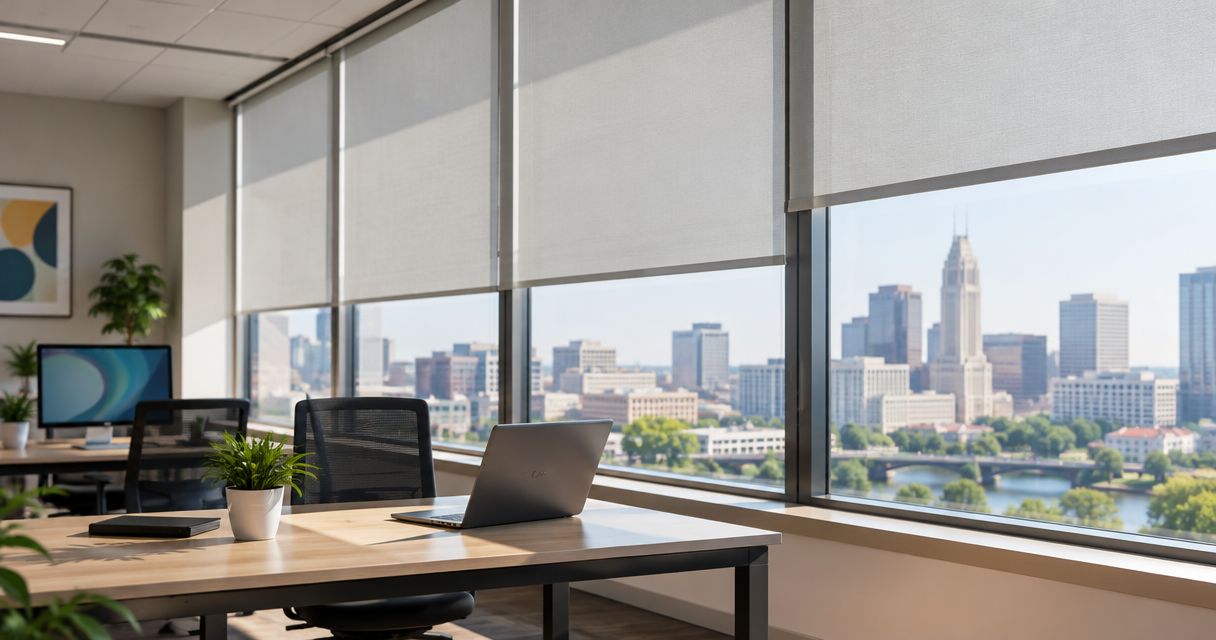
Solar roller shades use screen fabric to filter incoming light. They suit work areas where you want daylight without leaving the window fully uncovered.
The fabric’s openness matters. A more open weave preserves more view, while a tighter weave restricts it; color and lighting conditions also affect the result. Choose a physical sample, not a thumbnail.
For a 2026 office refresh, start your sample review at the workstation with the most troublesome sunlight. Look at the computer screen with the sample against the glass, then step back to judge the room.
Solar roller shade pros:
- Filters sunlight without requiring an opaque covering.
- Retains some outward visibility, depending on the fabric.
- Rolls up to uncover the window when shading is unnecessary.
Solar roller shade cons:
- Does not provide dependable privacy when the room is brighter than outdoors.
- Does not create presentation-room darkness.
- Requires sample review to balance view and light control.
Best for: Open desk areas where daytime glare matters more than nighttime privacy.
Verdict: Buy solar roller shades for daylight-focused workspaces; skip them as the only covering for confidential rooms.
2. Blackout roller shades: best for presentation rooms
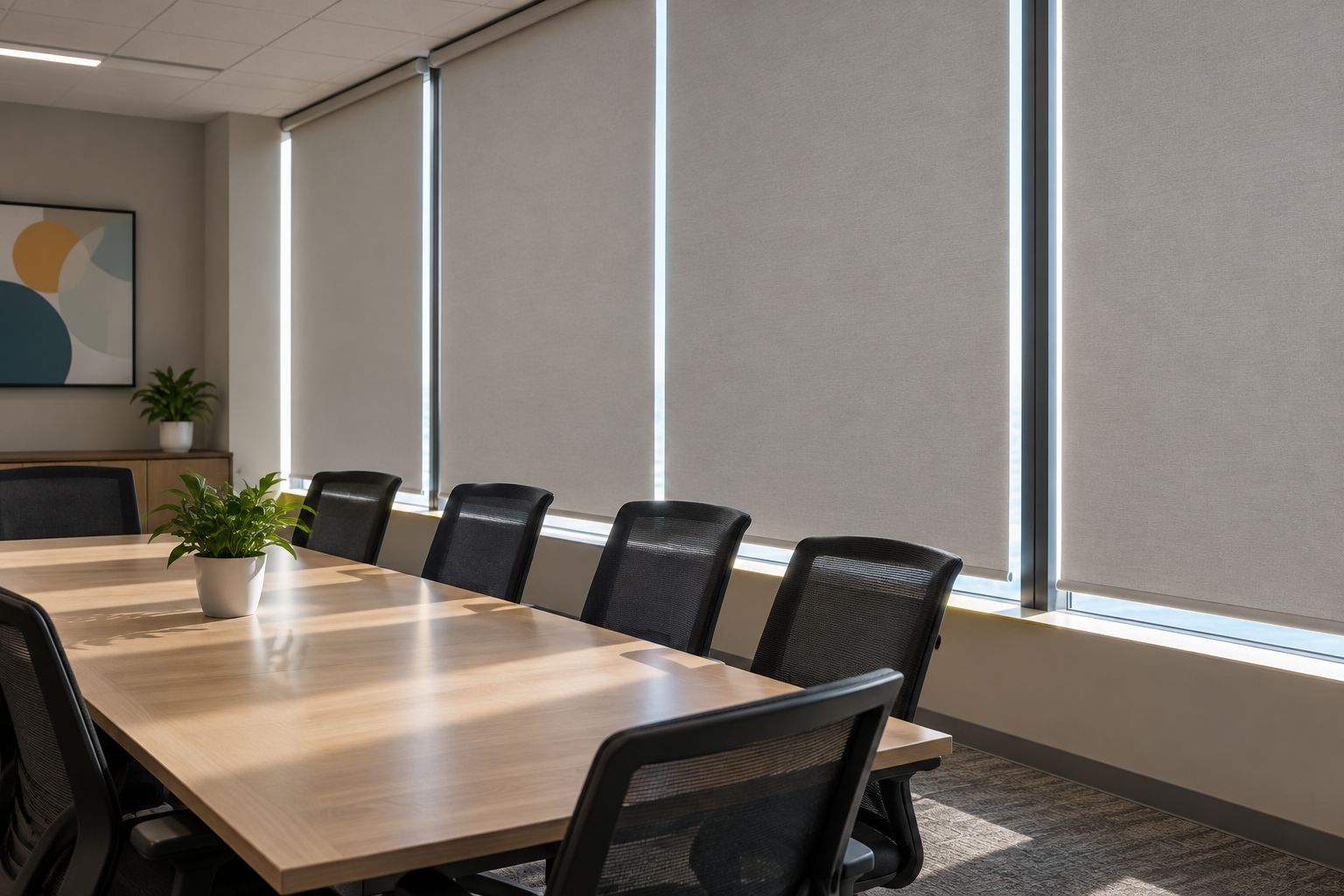
Blackout roller shades use opaque fabric to block light through the shade material. They suit meeting rooms where projection or other light-sensitive tasks take priority over keeping the view.
The fabric is only part of the system. Mounting position, coverage, and side gaps determine how much light enters around it. Ask the installer to explain those details before accepting a room-darkening promise.
A conference room can need both daylight and darkness. If people work there between presentations, discuss whether separate light-filtering and blackout layers fit the opening and the room’s routine.
Blackout roller shade pros:
- Blocks light through opaque shade fabric.
- Provides a direct solution when outward visibility is unnecessary.
- Can be paired with a separate daylight-filtering layer.
Blackout roller shade cons:
- Edge gaps prevent fabric alone from guaranteeing complete darkness.
- Removes the view when lowered.
- Requires attention to doors and other light sources as well as windows.
Best for: Conference and training rooms where projected content needs controlled ambient light.
Verdict: Buy blackout roller shades for presentation needs, but approve the complete light-control plan—not just the fabric.
3. Motorized shades: best for difficult access and frequent changes
Motorized shades use a powered mechanism instead of manual lifting. The motor does not determine privacy or glare performance; the selected fabric and installation still do that work.
Choose motorization when reaching the shades is inconvenient or the room requires repeated changes. Before ordering, establish how each shade receives power, who operates it, and how controls are grouped.
For a 2026 office project, specify the ordinary control method before discussing automation. A room needs a clear way for its users to adjust the shades. Confirm any scheduling, shared-control, or building-system connection against the exact proposed equipment.
Motorized shade pros:
- Removes the need to reach each shade manually.
- Can operate compatible groups of shades from a shared control.
- Supports different light-control fabrics rather than dictating one.
Motorized shade cons:
- Requires power planning and access for maintenance.
- Control and automation features depend on the selected system.
- Does not correct a poor fabric choice or an unsuitable mount.
Best for: Tall windows, obstructed openings, and rooms where users regularly change shade positions.
Verdict: Buy motorized shades when access or routine adjustments justify powered operation; hold until power and controls are defined.
4. Horizontal slat blinds: best for directional light in private offices
Horizontal blinds use tilting slats to change how light enters the room. You can adjust the slat angle without raising the whole treatment.
That makes blinds useful in a private office where one person wants hands-on control throughout the day. Material, slat dimensions, and operating hardware require their own review; the category name does not establish durability or suitability for a particular building.
Horizontal blind pros:
- Adjusts light direction through slat tilt.
- Offers privacy adjustment without fully lifting the covering.
- Can be raised when an unobstructed view matters.
Horizontal blind cons:
- Slat gaps and operating openings admit light.
- Individual slat surfaces require cleaning.
- Does not provide the continuous fabric appearance of a roller shade.
Best for: Private offices where adjustable light direction matters more than full room darkening.
Verdict: Buy horizontal blinds for individual control; skip them when presentation darkness is the main requirement.
5. Cellular shades: best for insulation-focused perimeter offices
Cellular shades have pockets within the fabric structure that trap air. They belong on the shortlist when the window’s insulating performance matters alongside privacy and light control.
Do not translate the cellular structure into a promised reduction in energy bills. Results depend on the window, fit, operation, climate, and building. Choose the fabric opacity separately from the insulating construction.
Cellular shade pros:
- Adds an insulating layer at the window.
- Offers light-filtering and opaque fabric choices.
- Covers the opening with a continuous fabric surface.
Cellular shade cons:
- Generally blocks the outward view while lowered.
- Requires care suited to the fabric and construction.
- Cannot establish a specific energy-saving result by category alone.
Best for: Perimeter offices where insulation and privacy outweigh keeping a view through the lowered treatment.
Verdict: Buy cellular shades for insulation-focused rooms; skip them when seeing outside through the lowered covering is essential.
How these options are ranked
The order follows room function: daylight control first, presentation darkness second, operating access third, then directional light and insulation. It is a buying framework, not a product test or a claim that one treatment outperforms every alternative.
For your 2026 specification, change the order when the room’s priority changes. A presentation room starts with blackout coverage. A tall window behind fixed furniture starts with access and power planning.
Before you request a quote
Prepare a short brief rather than choosing a matching fabric for the entire office. Give each room a primary need, then ask the installer to explain the proposed trade-off.
- Review 2 viewing positions: Check the seated desk position and the doorway. A shade should work where people actually use the room.
- Check 3 lighting conditions: Review morning daylight, afternoon daylight, and the room after dark with interior lights on. Record glare and privacy separately.
- Approve 1 representative window: Where practical, evaluate the proposed fabric and mounting approach at a representative opening before approving repeated applications.
- Confirm responsibility: Establish who handles measurements, mounting approval, power, controls, removal of existing coverings, and final operation checks.
- Request documentation: Ask for care instructions and any product-specific information your property manager requires.
Olsson Smart Shades provides custom-measured blinds, shades, plantation shutters, drapes, and motorized smart shades for Columbus offices and homes. To start an office or mixed-use project, request a quote with the address, approximate window count and room uses.
Which office window treatment should you choose?
Choose solar roller shades as the starting point for a sunlit workspace, not as a universal office solution. Use blackout roller shades where presentations demand darkness, and add motorization where access or frequent operation calls for it.
Keep horizontal blinds on the shortlist for directional light. Choose cellular shades when insulation is the main concern and the view is secondary. Different rooms can use different treatments while sharing a coordinated appearance.
Olsson Smart Shades measures and installs commercial window treatments across Columbus and Central Ohio. For a bid package, send the drawings or window schedule with your quote request.
FAQ
What are the best commercial window treatments Columbus offices should consider?
Solar roller shades are the starting choice for sunlit desk areas because they filter daylight while retaining some outward visibility. Choose blackout roller shades for presentations, and consider motorization separately when access or frequent adjustments matter.
Are solar shades private enough for an office at night?
Solar shades are not dependable nighttime privacy coverings. When the interior is brighter than outdoors, visibility into the room becomes a concern; use an opaque covering where privacy is required.
Will blackout shades make a conference room completely dark?
Blackout fabric alone does not guarantee a completely dark conference room. Light can enter around shade edges, doors, and other openings, so review the entire installation.
Are motorized shades better than manual blinds for an office?
Motorized shades are better suited to difficult access and frequent adjustments; manual blinds suit straightforward individual control. Fabric, fit, power, and operating needs determine the better choice for each room.
Can office shades connect to an existing control system?
Connection depends on the exact shade motor, controls, and existing system. Require written confirmation for the proposed equipment before ordering rather than assuming all motorized shades are compatible.
What should I include when requesting an office window-treatment quote?
Include the project location, room uses, approximate window count, access concerns, and your main glare or privacy problems. Ask who will confirm measurements, mounting conditions, power needs, and required product documentation.
Does Olsson Smart Shades provide commercial office installation?
Yes. Olsson Smart Shades measures and installs commercial window treatments for Columbus and Central Ohio offices, including roller, solar and motorized shades, with its own install team.
One last thing
Test privacy from outside the room, not just from your chair. With permission and safe access, check the window after dark while interior lights are on. A covering that looks reassuring from inside does not necessarily conceal the room from outside.