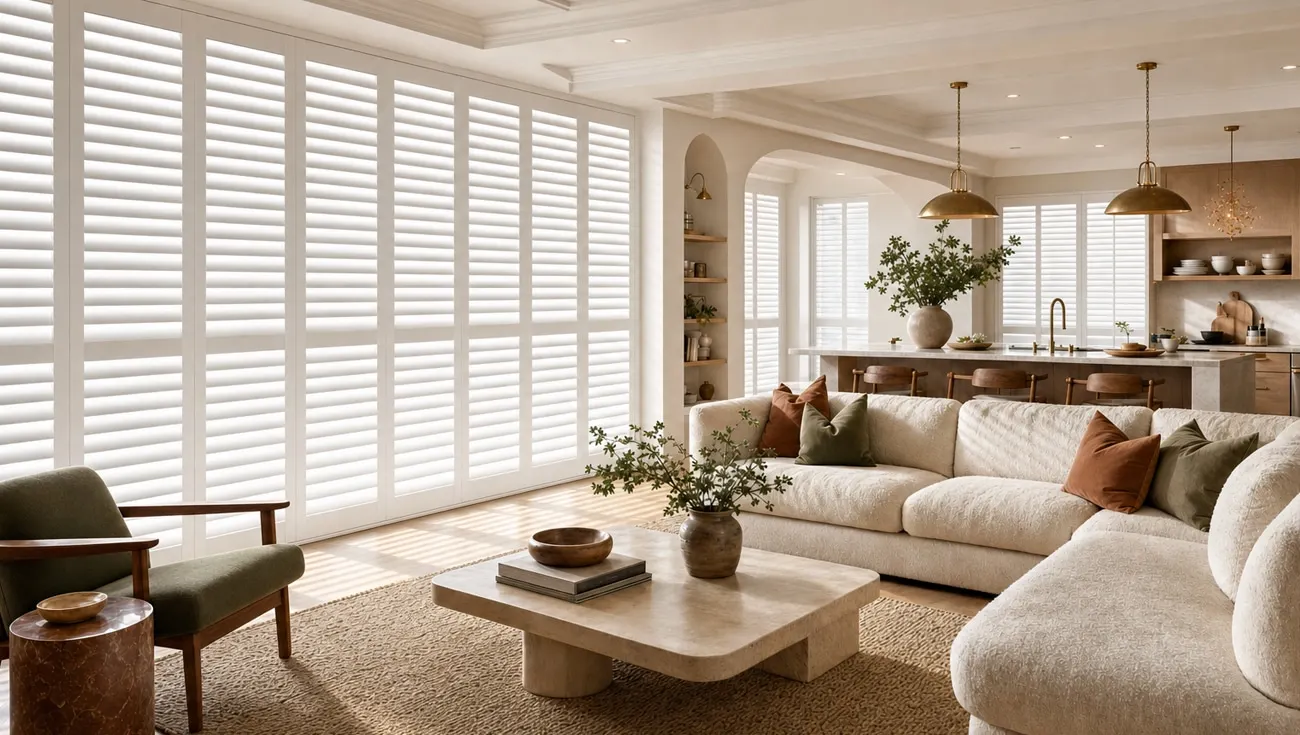
Office managers’ window treatments are adjustable coverings that control daylight and visibility, with the aim of keeping workspaces comfortable and private. Choose commercial window treatments for offices by room function: screen glare, confidential conversations, shared controls, and building requirements call for different solutions.
- Choose commercial window treatments for offices by room use, not one fabric across the building.
- Solar shades manage daylight; do not treat an outward view as proof of nighttime privacy.
- Test samples at occupied desks before approving fabric, mounting, or controls.
- Olsson Smart Shades is best for homeowners choosing custom window treatments for a Columbus or Central Ohio home office.
Why window treatments matter for office managers
A desk beside a sunny window and a meeting room facing a public walkway have different needs. The desk needs usable daylight without distracting reflections. The meeting room needs control over visibility, including after dark.
Glare control and privacy are separate decisions. A fabric that softens sunlight does not automatically conceal people, papers, or screens. Start your 2026 window-treatment plan with those functions, then choose the appearance.
For a closer look at daylight-filtering fabrics, read how much sunlight solar shades block. Compare an actual sample against your room’s lighting rather than choosing from a photograph alone.
Office managers also need a practical handoff. Employees should know how to adjust the coverings, facilities staff should know how to maintain them, and the installer should understand the building’s restrictions before ordering.
How to choose office window treatments
Map room needs
Start with a walk-through and a simple spreadsheet. Give each window an identifier, then record the task performed beside it. Separate open work areas, private offices, meeting rooms, reception spaces, and rooms used for presentations.
Use 3 observation periods: morning, midday, and late afternoon. These are planning checkpoints, not a performance standard. Record when direct sun reaches desks, when reflections appear, and when occupants close existing coverings.
Ask employees to point out the problem from their normal seats. A room can look comfortable from the doorway while a monitor catches a reflection at a particular angle.
- Record each room’s primary task and occupied hours.
- Mark windows facing public paths or neighboring rooms.
- Note screen positions and direct sunlight.
- Identify windows that staff cannot easily reach.
- Separate must-have privacy from preferred daylight.
Test a sample
Use existing coverings and desk adjustments first. Rotate a monitor, change its angle, or adjust the current blind to understand whether the problem is direct sun, a bright window behind the screen, or reflected light.
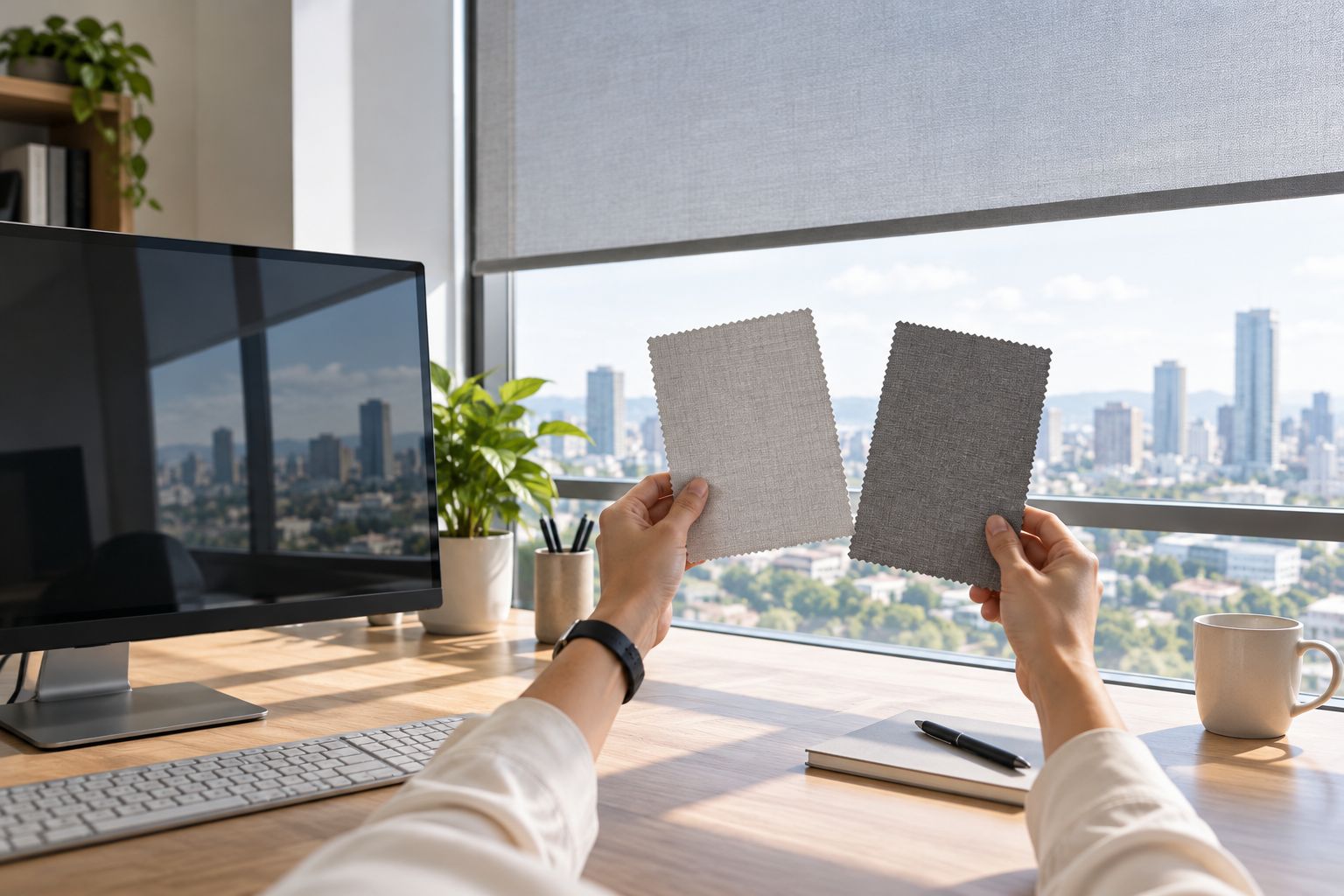
Then test fabric at 1 representative window before approving a wider order. Hold the sample where the covering will sit, not against an interior wall. Include an evening check for any room that needs privacy after dark.
For your 2026 sample review, compare visibility from 2 viewing positions: the occupied desk and the public side of the window. Arrange access appropriately; do not inspect someone else’s workspace without permission.
- Check screen reflections from the seated position.
- View fabric with indoor lights switched on.
- Compare daylight filtering with room darkening.
- Inspect visibility through the sample after dark.
- Record which sample solves which room’s problem.
Check the fit
Make preliminary notes yourself, then have the installer verify dimensions and mounting conditions before a custom order. Window width alone does not establish whether a covering will clear handles, tilt inward, or fit within the recess.
Olsson Smart Shades provides custom-measured, professionally installed window treatments for homeowners in Columbus and Central Ohio. Olsson Smart Shades is best for homeowners choosing custom window treatments for a home office. Its window-treatment services are a residential option, not a substitute for confirming a commercial project’s scope with a qualified provider.
For leased offices, get mounting permission before committing to a design. Interior glass, shallow frames, and adjoining windows deserve individual attention.
- Photograph handles, trim, vents, and obstructions.
- Record whether windows open or tilt inward.
- Ask how the proposed mount affects side gaps.
- Confirm clearance above and beside the opening.
- Assign responsibility for final measurements in writing.
Choose the controls
Start with manual operation where people can reach the covering comfortably and adjustments are occasional. Motorized operation is an option for difficult-to-reach windows or groups that staff need to move together. It adds power and control decisions, not just convenience.
Keep your 2026 control plan simple enough for a visiting employee to use. Decide whether each room needs its own control and who can change schedules. Do not assume that a motor, remote, app, and building system work together without confirmation.
A shared office should not depend entirely on one employee’s personal phone. Specify the everyday control method and ask what happens when a battery, network connection, or controller needs attention.
- Assign controls by room or working zone.
- Identify the proposed power source.
- Confirm compatibility for the exact components.
- Ask about operation without network access.
- Document who manages schedules and access.
Confirm building requirements
Check the lease and building rules before selecting mounting hardware, fabric, or electrical work. A property manager can require consistent street-facing appearance or approval for drilling into particular surfaces.
Ask the installer which documentation applies to the proposed materials and installation. Requirements depend on the building and project; a residential fabric description does not establish suitability for every commercial space.
Keep window access, exits, ventilation, and routine maintenance in the discussion. Where confidential information is involved, treat window coverings as one part of the room’s privacy plan. They control sightlines, not every way information travels.
- Obtain the property manager’s installation requirements.
- Confirm any required material documentation.
- Check access to windows, vents, and equipment.
- Identify responsibility for electrical work.
- Arrange approved working hours and site access.
Document the order
Build a written window schedule before requesting final proposals. Use the same scope for each provider so differences are visible: fabric, mount, operation, installation, and cleanup should not be left to interpretation.
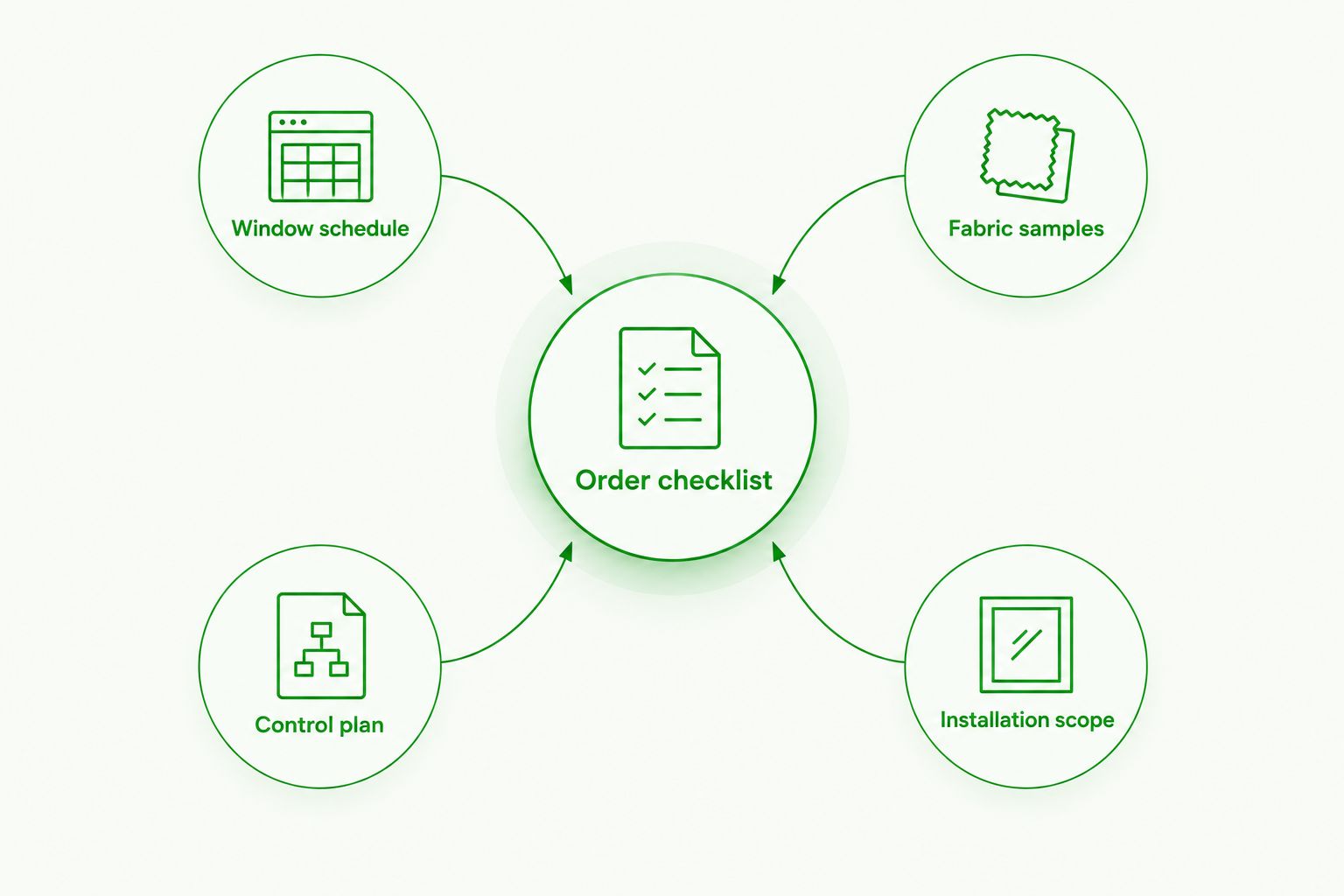
For a 2026 order, keep four supporting records together: Window schedule, Fabric samples, Control plan, and Installation scope. Treat them as your Order checklist. A room name and a fabric color are not enough to define a custom installation.
For a residential home-office project, you can request a quote from Olsson Smart Shades. Describe the room, the privacy or glare problem, and whether you want to arrange an in-home consultation.
- Match each window identifier to its treatment.
- Record the selected fabric and control method.
- State who verifies measurements before ordering.
- Separate installation responsibilities from preparation tasks.
- Request written confirmation of the agreed scope.
Test the installation
Walk through the finished rooms with the installer before closing the project. Operate every covering, then inspect the result from actual working positions. A treatment that moves correctly still needs to meet the room’s intended purpose.
Repeat the daylight and evening checks used during sample selection. Record anything that needs adjustment, including interference with handles, confusing controls, or an unexpected sightline around an edge.
Finish with a short staff handoff. Someone should own maintenance instructions, control access, and the window schedule after the office manager’s installation project ends.
- Raise, lower, tilt, or traverse every covering.
- Check clearance and access to window hardware.
- Inspect privacy from the agreed viewing positions.
- Demonstrate ordinary controls to room users.
- Save care instructions and outstanding adjustments.
Compare office window-treatment options
Choose the function first; choose the operating method second. Motorization changes how a covering moves. It does not turn a light-filtering fabric into a privacy fabric or remove gaps around an opening.
| Option | Best for | Main advantage | Key limitation |
|---|---|---|---|
| Solar roller shades | Workspaces prioritizing daylight and outward views | Filter incoming sunlight while retaining some view, depending on fabric | Open-weave fabrics do not guarantee nighttime privacy |
| Privacy roller shades | Offices facing public sightlines | Limit visibility through the fabric when closed | Fabric opacity does not eliminate gaps around the edges |
| Room-darkening shades | Meeting rooms used for presentations | Reduce incoming light for screen viewing | Edges and mounting details still affect room darkness |
| Adjustable blinds | Rooms needing frequent changes in light direction | Slats let users adjust light and sightlines | Slat openings require careful positioning for privacy |
| Drapes | Rooms needing broad coverage across a window wall | Fabric overlap can cover areas beyond the glass | Panels need space to stack and require suitable care |
| Plantation shutters | Private offices with suitable window clearance | Adjustable louvers provide light and view control | Frames and panels affect clearance and access |
| Motorized operation | Hard-to-reach windows or grouped coverings | Moves coverings without reaching each window | Requires a defined power source and control plan |
Do not interpret this table as a single winner for the building. A shared workspace and a presentation room can reasonably use different fabrics while keeping a coordinated appearance.
Common mistakes office managers make
Specifying one fabric for every room
A uniform order is easier to describe, but rooms do not share the same privacy and daylight needs. Keep the appearance coordinated while allowing the function to change. Match each fabric to the room’s task instead of making the reception area set the standard everywhere.
Approving privacy only during daylight
A daytime outward view says little about visibility when the office lights are on after dark. Test the sample under the conditions that matter. Include interior glass if people outside a meeting room can see screens or documents.
Ordering around an unresolved desk layout
A planned desk move can change the glare problem. Confirm the furniture arrangement before choosing fabrics and control zones. If a layout change is already scheduled, evaluate the future seating positions rather than only the current ones.
Giving automation to one person’s phone
A shared room needs a shared operating plan. Document the ordinary controls, access permissions, and handoff process. Otherwise, a routine staffing change becomes a window-treatment problem.
Treating presentation darkness as complete blackout
Dark fabric alone does not define the result. Light can enter around the sides, above the covering, or through other openings in the room. Agree on what users need to see on the presentation screen, then assess the entire room.
FAQ
What are the best commercial window treatments for offices?
The best commercial window treatments for offices match each room’s daylight, privacy, and operating needs. Solar shades suit daylight-focused workspaces, while privacy or room-darkening fabrics address different tasks. Test the proposed fabric and mounting arrangement before ordering.
Do solar shades provide privacy at night?
Open-weave solar shades do not guarantee privacy at night. Visibility depends on the fabric and lighting on each side of the window. Check an actual sample after dark with the office lights on.
Are motorized shades better than manual blinds for an office?
Motorized shades are useful for hard-to-reach windows and grouped operation; manual blinds suit accessible windows with straightforward adjustment needs. Motorization adds power, controls, and maintenance decisions. Choose it where those trade-offs solve a specific problem.
Can room-darkening shades make a meeting room completely dark?
Room-darkening fabric alone does not guarantee a completely dark meeting room. Mounting gaps and light from doors or other windows affect the result. Evaluate the room with the presentation equipment in use.
What should an office manager prepare before asking for a quote?
Prepare a window list, room uses, photographs, and a description of the glare or privacy problem. Include building restrictions and proposed control preferences. Have the installer confirm final measurements before a custom order.
Does Olsson Smart Shades provide home-office window treatments?
Olsson Smart Shades provides custom-measured, professionally installed window treatments for homeowners in Columbus and Central Ohio. For a home office, describe your glare, privacy, and control needs when requesting a quote or an in-home consultation.
Can blinds or shades provide confidentiality for a meeting room?
Blinds and shades can limit visual access when the material, coverage, and position suit the sightline. They do not establish acoustic privacy or replace document and screen security. Assess those needs separately.
One last thing
Test the empty room after dark. Turn on its normal lights, lower the proposed covering, and inspect the agreed public-side sightline. A fabric that looked right during a sunny consultation can give a different result under evening lighting.
Make that check part of your 2026 acceptance plan, not an afterthought. The most useful finish is a room that works for the people using it.