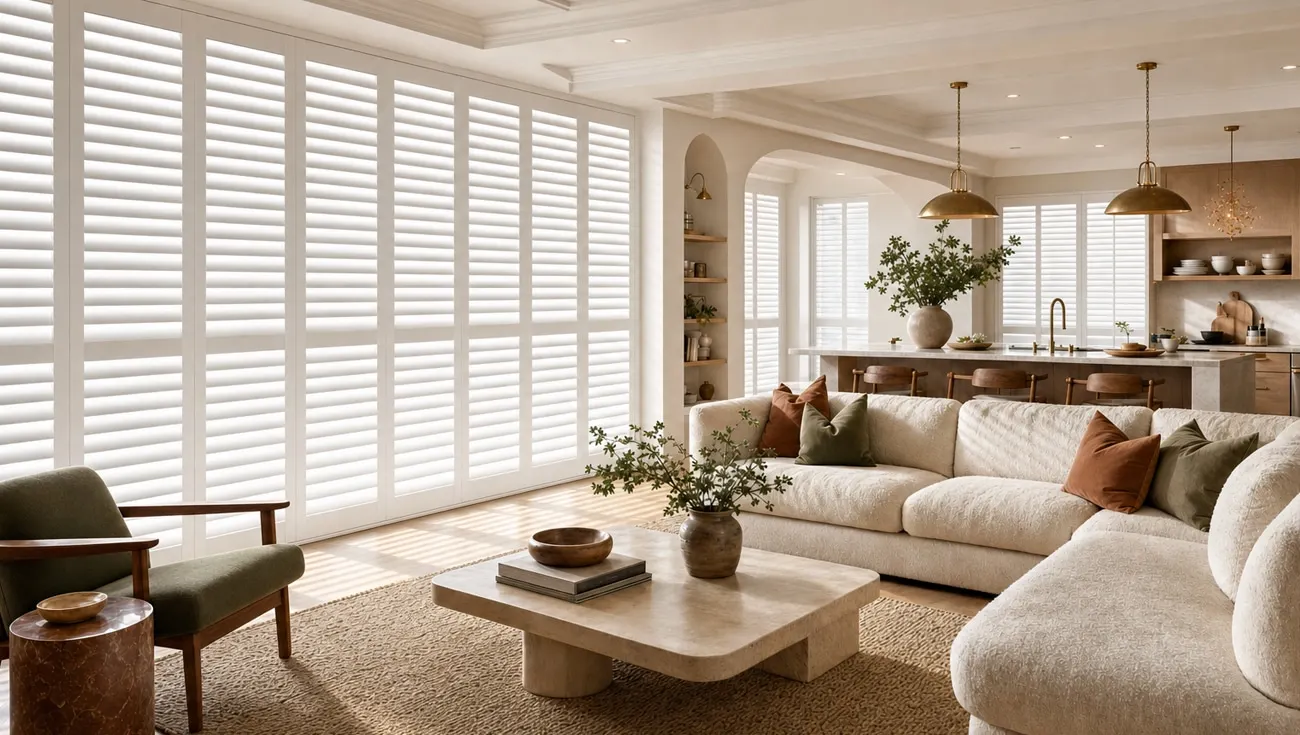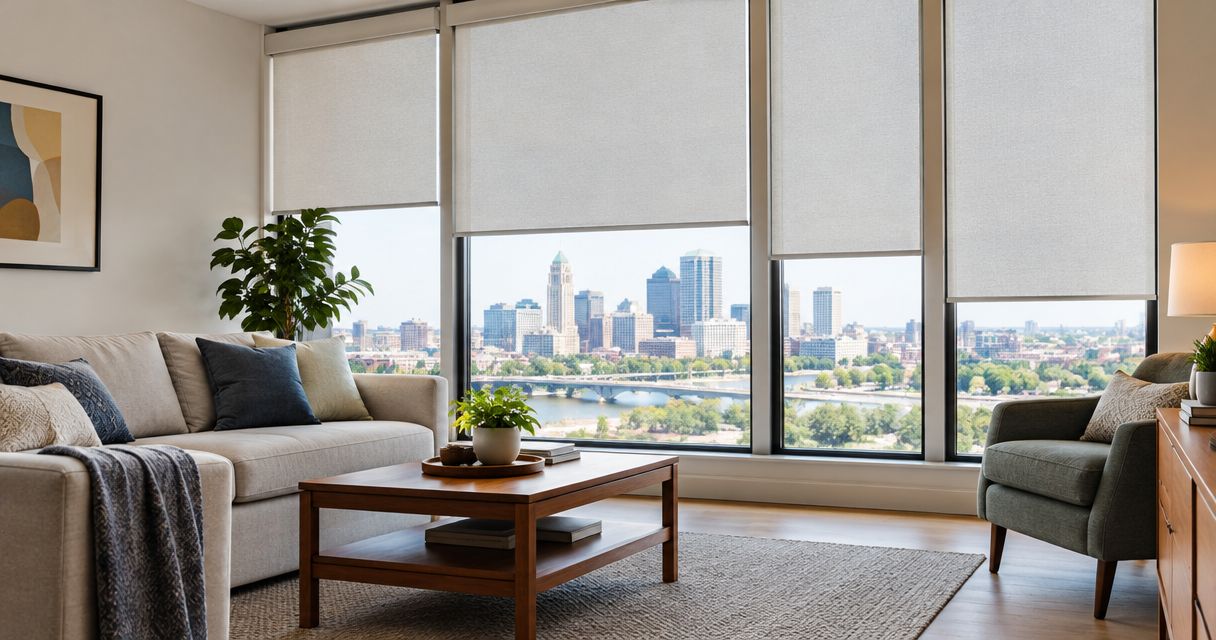
Best overall: light-filtering roller shades for everyday living spaces. Best for sleep: blackout roller shades. Best for glare with an outward view: solar roller shades. This 2026 guide helps you match fabric, fit, and controls to the way you use each room in your Columbus home.
- Roller shades Columbus Ohio: choose light-filtering fabric for living spaces and blackout fabric for bedrooms.
- Olsson Smart Shades offers custom-measured window treatments and professional installation for Columbus and Central Ohio homeowners.
- Solar roller shades reduce glare but do not replace nighttime privacy coverings.
- Choose motorized controls for difficult access; confirm power and smart-home requirements before ordering.
Why this matters
The best roller shade solves a room problem before it matches a paint color. A fabric that softens afternoon light in your living room can leave your bedroom too bright at sunrise.
Olsson Smart Shades is best for Columbus and Central Ohio homeowners seeking custom-measured roller shades with professional installation. Start with the room, the light, and the privacy you need—not a fabric name. You can explore Olsson Smart Shades before arranging an in-home consultation.
For your 2026 project, separate the fabric decision from the control decision. Blackout describes light blocking; motorized describes operation. You can need both on the same window.
What makes the best roller shades?
Use these criteria before choosing a style:
- Light control: Decide whether you want softened daylight, glare reduction, or room darkening. Those are different jobs.
- Privacy: Evaluate the fabric with indoor lights on, not just against a bright daytime window.
- Window fit: Check mounting depth, trim, handles, and the space needed for the rolled fabric.
- Daily operation: Choose a control you can reach and use comfortably without moving furniture.
- Power and maintenance: For motorized shades, confirm how you will power, recharge, or service the selected system.
- Room coordination: Decide whether neighboring shades need matching fabric, aligned hems, or separate controls.
Bring 2 fabric samples to the same window and compare them under the same conditions. This is a buying exercise, not a performance test: you are looking for the fabric that makes your room comfortable.
Best roller shades at a glance
These are recommended configurations, not named product models. Fabric, mounting, and controls work together, so the right choice can combine features from different rows.
| Roller shade configuration | Best for | Standout feature | Key limitation |
|---|---|---|---|
| Light-filtering roller shades | Everyday living rooms | Softens daylight without fully darkening the room | Privacy depends on fabric and lighting |
| Blackout roller shades | Bedrooms and daytime sleep | Blocks light through the fabric | Light can enter around the edges |
| Solar roller shades | Glare control with an outward view | Filters sunlight through an open weave | Not a nighttime privacy solution |
| Motorized roller shades | Hard-to-reach windows | Moves the shade without reaching the window | Requires a suitable power and control setup |
| Dual roller shades | Rooms needing both daylight and darkness | Places separate light-filtering and blackout layers at one window | Needs room for additional hardware |
1. Light-filtering roller shades: best for everyday living rooms
Light-filtering roller shades soften incoming daylight through a fabric panel. Choose them when you want a bright room without leaving the glass uncovered.
They are the default for living rooms where complete darkness is not the goal. You still need to check the actual fabric: light filtering does not automatically mean full privacy, especially when the room is brighter than outdoors.
Light-filtering roller shades pros:
- Softens daylight while keeping the room usable for daytime activities.
- Provides a simple fabric surface without slats.
- Works as a base layer beneath drapes.
Light-filtering roller shades cons:
- Does not provide blackout conditions for sleep.
- Some fabrics reveal silhouettes when indoor lights are on.
- A fabric that looks comfortable in the morning can leave afternoon glare unresolved.
Best for: Living rooms and gathering spaces where pleasant daylight comes first.
Hold your samples against the actual window rather than choosing from a tabletop alone. Look at the fabric from your usual seat, then from the hallway; both views matter in an open living space.
Verdict: Buy light-filtering roller shades as the everyday default when you want softened daylight rather than darkness.
2. Blackout roller shades: best for bedrooms and daytime sleep
Blackout roller shades use fabric intended to block light passing through the material. They suit bedrooms where early light, street lighting, or daytime sleep makes darkness a priority.
The fabric is only part of the result. Gaps beside the shade and around the mounting area can let light enter, even when the fabric itself is opaque.
Blackout roller shades pros:
- Blocks light through the selected blackout fabric.
- Provides an opaque covering when fully lowered.
- Can work with drapes to address remaining perimeter light.
Blackout roller shades cons:
- A standard installation does not guarantee a completely dark room.
- Lowering an opaque shade also removes the outward view.
- More demanding darkness requirements need careful attention to mounting and edge coverage.
Best for: Bedrooms, daytime sleepers, and rooms where darkness matters more than filtered daylight.
For a 2026 bedroom update, discuss the finished room condition—not just the word blackout. Ask where light will remain visible and whether an outside mount, additional overlap, or another treatment is appropriate for your window.
Verdict: Buy blackout roller shades for sleep, but settle the edge-light plan before ordering.
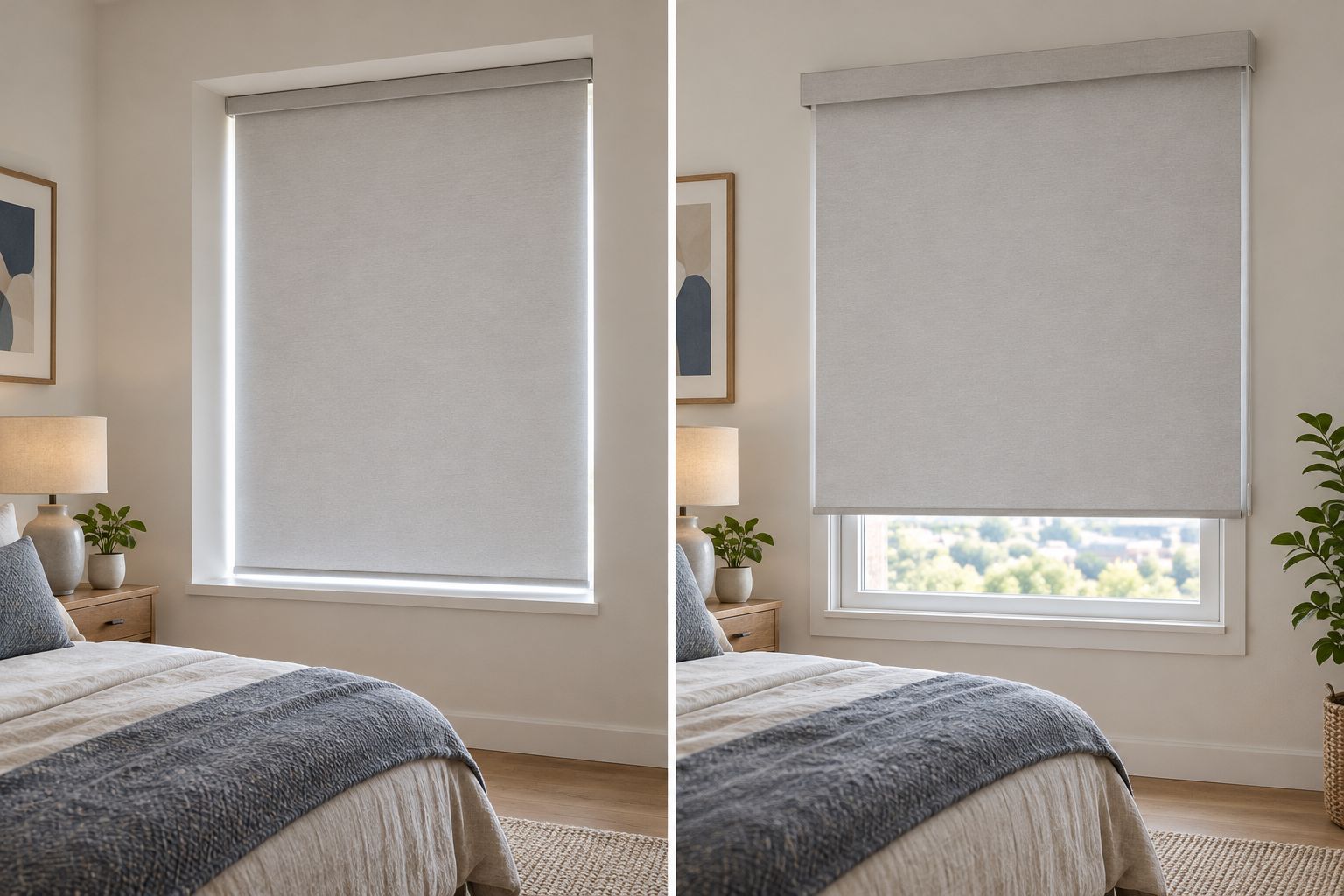
A shade mounted inside the window recess leaves its edges visible beside the frame. An outside-mounted shade can extend beyond the opening, though the finished result still depends on the window and installation.
3. Solar roller shades: best for glare control with an outward view
Solar roller shades use an open-weave fabric to filter sunlight while preserving some outward visibility. They suit a room where you want to soften bright light without covering the view with an opaque panel.
Do not treat a daytime view as proof of nighttime privacy. When indoor lights are on and it is darker outside, people outside can see through open-weave fabrics.
Solar roller shades pros:
- Reduces direct glare while retaining some outward visibility.
- Lets you compare different levels of fabric openness.
- Works alongside a separate privacy treatment.
Solar roller shades cons:
- Does not provide dependable nighttime privacy by itself.
- Does not create blackout conditions.
- The balance between view and glare control varies with the selected fabric.
Best for: View-focused living spaces and home offices where glare is the main problem.
Check a sample while seated at your desk or facing your television. A fabric that looks good when you stand beside the window is not necessarily comfortable from the spot where you work.
Verdict: Buy solar roller shades for glare and views; skip them as your only covering where nighttime privacy matters.
4. Motorized roller shades: best for hard-to-reach windows
Motorized roller shades move using a powered mechanism rather than requiring you to reach the shade itself. Motorization is a control choice, so begin by selecting the light-filtering, blackout, or solar fabric the room needs.
Olsson Smart Shades provides motorized smart shade installation. Confirm the proposed system's controls, power requirements, and any requested smart-home connection before approving the order.
Motorized roller shades pros:
- Avoids reaching over furniture or up to a high window.
- Provides an alternative to operating each shade by hand.
- Supports a control plan suited to the selected equipment.
Motorized roller shades cons:
- Requires a power arrangement suited to the window.
- Adds equipment and setup considerations to the project.
- Smart-home compatibility depends on the exact motor, controller, and associated equipment.
Best for: High windows, windows behind furniture, and homeowners who find manual operation uncomfortable.
In 2026, do not choose a motor solely because its description says smart. Ask how you will operate it every day and what happens when a battery needs attention or a network connection is unavailable.
Verdict: Buy motorized roller shades when access is the problem; wait until power and controls are confirmed.
5. Dual roller shades: best for changing daylight and sleep needs
Dual roller shades place separate fabric layers at the same window. A light-filtering or solar layer handles daytime use, while a blackout layer provides an opaque covering when needed.
This configuration suits a room that changes jobs, such as a guest bedroom used as a home office. It avoids asking a single fabric to preserve daylight and block it completely.
Dual roller shades pros:
- Gives you separate daylight and darkness options.
- Lets each fabric serve a clear purpose.
- Keeps both layers available at the same window.
Dual roller shades cons:
- Needs space for additional mounting hardware.
- Requires decisions about the appearance and operation of both layers.
- Blackout edge gaps still need attention.
Best for: Guest rooms, bedroom workspaces, and other rooms with conflicting light requirements.
Before committing, check the window depth and how the combined hardware will sit against the trim. Ask to understand the raised position too; the fabric rolls remain part of the finished appearance.
Verdict: Buy dual roller shades when the same room genuinely needs filtered daylight and darkness; skip the extra layer when it does not.
Check fit before choosing the finish
A good fabric cannot correct an unsuitable mount. Before you approve your 2026 roller shade order, review the window as a working opening, including locks, cranks, trim, and nearby doors.
Ask your installer to explain these points:
- Inside mount: Does the recess have enough usable depth for the chosen hardware?
- Outside mount: Where will the brackets attach, and how far will the shade overlap the opening?
- Fabric clearance: Will the material clear handles, locks, and projecting trim?
- Raised position: How much glass and trim will remain visible with the shade up?
- Control access: Can you operate the shade without leaning across furniture?
Review 3 shade positions: fully raised, partly lowered, and fully lowered. Each position reveals a different issue, from a visible roll at the top to a handle that interferes with the fabric.
For a group of windows, also decide whether you want independent operation. The window beside your reading chair does not always need to move with the window facing your television.
How these roller shade choices are ranked
This 2026 ranking puts everyday light control first, then separates the more specific jobs: sleep, glare, difficult access, and mixed-use rooms. It compares configurations by purpose rather than naming an unsupported product winner.
The criteria are privacy, fit, operation, maintenance, and room coordination. Light-filtering roller shades take the default position because this guide prioritizes usable daylight in living spaces—not because that fabric is right for every room.
Which roller shades should you choose?
Choose light-filtering roller shades for an ordinary living room and blackout roller shades for a bedroom. Add motorization when reaching or operating the shade is difficult. Choose solar fabric when glare and the outward view matter, with a separate plan for privacy.
Start your consultation with 1 priority window. Explain what bothers you there, when it happens, and what you want to keep: daylight, a view, darkness, or easier operation.
To arrange an in-home consultation with Olsson Smart Shades, request a quote and describe the rooms involved. Ask for the proposed fabric, mount, controls, and installation scope in writing so you can make a clear decision without guessing.
FAQ
What's the best roller shade for a Columbus living room?
A light-filtering roller shade is the best starting point when you want softened daylight rather than darkness. Check the selected fabric for privacy and glare at your own window before ordering.
Are blackout roller shades completely dark?
Blackout roller shades do not automatically make a room completely dark. The fabric blocks light through the material, but gaps around the edges and mounting area can admit light.
Can people see through solar roller shades at night?
Yes, open-weave solar roller shades can allow views into a lit room when it is dark outside. Use an opaque covering or another privacy layer where nighttime privacy matters.
Are motorized roller shades better than manual shades?
Motorized roller shades are better for difficult access or uncomfortable manual operation. Manual operation remains a practical choice for a reachable window when you do not need powered controls.
Should roller shades go inside or outside the window frame?
Choose the mount after checking window depth, obstructions, and your light-control goal. Inside mounting sits within the opening, while outside mounting can overlap it; neither choice guarantees complete darkness.
Can one roller shade provide daylight and blackout?
A single fabric does not provide both filtered daylight and blackout while fully lowered. A dual roller configuration uses separate layers so you can choose between those functions.
How do I arrange a roller shade consultation in Columbus?
Request a quote from Olsson Smart Shades and ask to arrange an in-home consultation. Describe your rooms, privacy needs, light problems, and interest in manual or motorized controls.
One last thing
Check privacy from outside after dark. Daytime samples tell you how light enters; an evening check tells you what someone outside can see when your lamps are on. Resolve that difference before choosing the fabric for a street-facing room.