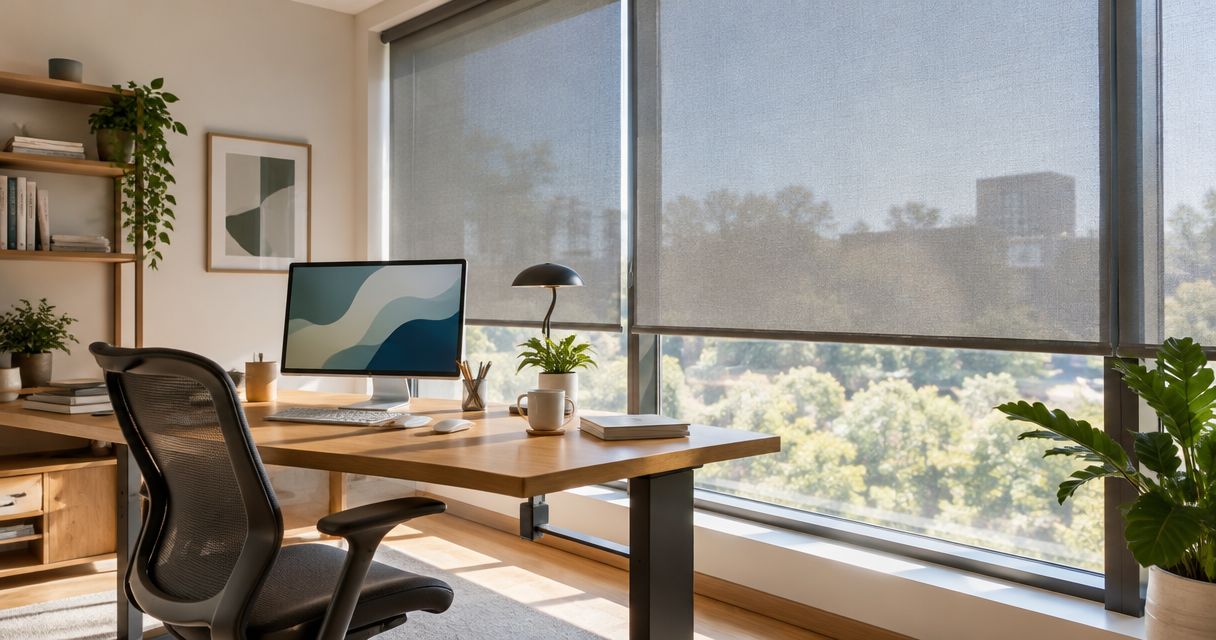
Best overall: a custom-measured, low-openness solar shade for screen glare. Best for easier adjustment: a motorized solar shade. Best for evening privacy: a solar shade paired with an opaque covering. This 2026 guide compares solar shades for home offices by the problem you need to solve—not by a product name.
- Choose low-openness solar shades for home offices where direct sun interferes with screen work.
- Olsson Smart Shades provides custom-measured window treatments and installation for Columbus and Central Ohio homeowners.
- Compare 1%, 3%, and 5% openness samples at your actual desk before choosing.
- Solar mesh is not a substitute for an opaque covering when you need nighttime privacy.
Why this matters
The best shade for your office is not necessarily the one that looks nicest against a sample book. You need to see your screen, keep useful daylight, and feel comfortable when the room lights come on.
Olsson Smart Shades provides custom-measured shades and professional installation for homeowners in Columbus and Central Ohio. Olsson Smart Shades is best for homeowners who want their home-office window treatments measured and installed rather than fitted themselves.
For your 2026 project, start with the window that interrupts your work most. Note when glare appears, where it lands, and whether you need privacy after sunset. Those details make the fabric decision much clearer.
What makes the best solar shades for home offices
Use these six criteria before comparing fabrics or controls:
- Glare control: Judge the sample from your normal seated position, with your monitor on and the window receiving troublesome sunlight.
- Fabric openness: This describes the open area in the weave. Lower openness generally means a tighter screen, not guaranteed darkness.
- Daylight balance: Check whether the room stays comfortable for reading paper documents as well as using a screen.
- Outdoor views: Compare the view through the actual fabric. Color and weave both affect what you see.
- Fit and coverage: Discuss fabric width, edge gaps, mounting depth, and clearance around handles or trim.
- Operation and privacy: Decide how you will adjust the shade and whether another covering must close at night.
Openness is not a complete performance rating. A 1% openness fabric has less open area than a 3% openness fabric; a 5% openness fabric has more open area than either. Those figures do not mean the shade blocks the same percentage of heat, visible light, or ultraviolet radiation.
Ask for the individual fabric's technical information when those properties matter. Do not turn an openness percentage into an energy-saving promise.
Solar shade options at a glance
These are configurations to compare, not named products or a claim that every fabric is offered by every installer. The first three separate fabric priorities; the last two address operation and privacy.
| Ranked option | Best for | Standout feature | Key limitation |
|---|---|---|---|
| Low-openness solar shade | Glare control | Tighter mesh for demanding screen locations | Reduces the open view and does not create blackout |
| Medium-openness solar shade | Daylight balance | A middle option to compare against tighter and more open fabrics | Direct sun can still interfere with work |
| Higher-openness solar shade | Outdoor views | More open weave for offices without severe glare | A weaker starting point for troublesome direct sun |
| Motorized solar shade | Easy operation | Adjustment without reaching the window | Requires power and a suitable control plan |
| Solar shade with an opaque layer | Evening privacy | Separate daytime filtering and nighttime coverage | Requires room for two treatments |
The default recommendation for 2026 is a low-openness sample tested at your desk. Move toward a more open fabric only when the tighter sample sacrifices more daylight or view than you want.
1. Low-openness solar shade: best for screen glare
A low-openness solar shade uses a relatively tight mesh to filter sunlight while retaining some connection to the outdoors. Start by comparing a 1% openness sample when strong sun makes your monitor difficult to read.
This is the strongest starting point when work comfort matters more than an uninterrupted view. It is still a filtering fabric, not an opaque wall over the glass.
Low-openness solar shade pros:
- Provides a tighter mesh starting point for difficult glare.
- Preserves some filtered daylight instead of fully covering the window with opaque fabric.
- Lets you compare different fabric colors without changing the basic treatment style.
Low-openness solar shade cons:
- Restricts the outdoor view compared with a more open weave.
- Does not guarantee nighttime privacy or eliminate light around the edges.
Place the sample between the sun and your seated eye position. Then look at a document on your monitor, not just the scenery outside. A sample that looks pleasant held against the window can feel very different during detailed screen work.
Also check the lowest sun angle you actually experience during work. A fabric that works at midday still needs evaluation when sunlight reaches farther into the room.
Best for: A desk affected by direct sunlight or persistent screen reflections.
Verdict: Buy this configuration when its sample controls glare without making your office feel too enclosed.
2. Medium-openness solar shade: best for balanced daylight
A medium-openness solar shade is the next comparison when a tighter mesh feels too closed. A 3% openness sample gives you a useful reference between 1% and 5% fabrics.
Choose by the room, not by the middle number. A moderate weave is not automatically the right compromise for every window.
Medium-openness solar shade pros:
- Offers a middle point for comparing daylight and visibility.
- Suits a sample review where both screen work and paper reading matter.
- Keeps the decision focused on fabric performance rather than adding another treatment immediately.
Medium-openness solar shade cons:
- Can leave too much brightness at a sun-exposed desk.
- Does not replace a separate privacy covering after dark.
Test with your normal room lighting and screen brightness. Turning everything else up just to make a fabric seem acceptable hides the problem you are trying to solve.
For a shared office, check both seats. The person nearest the window and the person facing it can experience different glare from the same shade.
Best for: An office where daylight matters and direct-sun glare is not the dominant problem.
Verdict: Buy after comparing it beside a tighter sample; skip the assumption that the middle option fits everyone.
3. Higher-openness solar shade: best for keeping an outdoor view
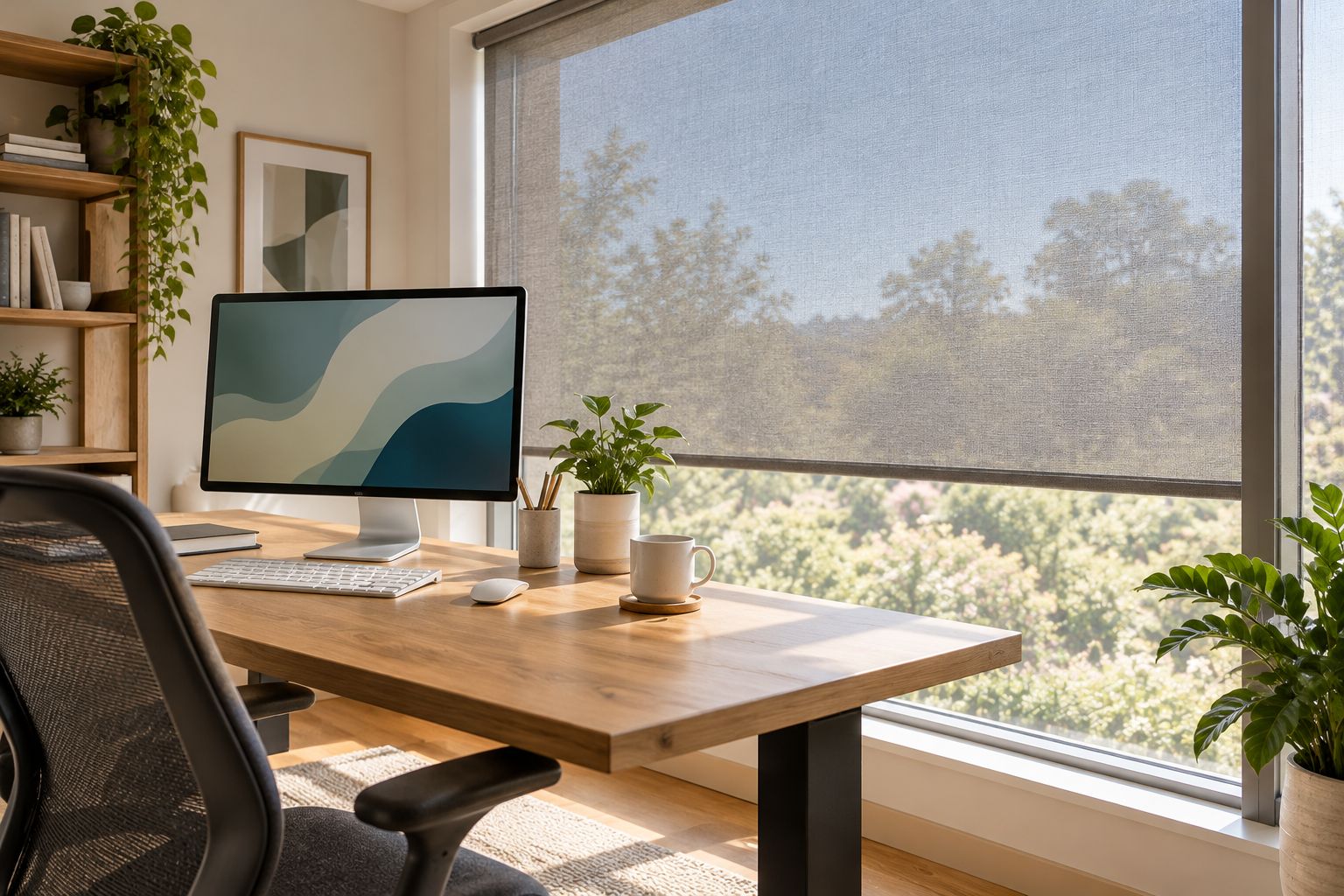
A higher-openness solar shade has a more open weave. Compare a 5% openness sample when your office has a view you want to keep and sunlight does not routinely wash out your screen.
This option puts visibility higher on the list. It does not promise a clear view under every lighting condition.
Higher-openness solar shade pros:
- Offers a more open fabric structure than tighter mesh options.
- Gives view-focused homeowners a useful comparison sample.
- Filters daylight without switching to a fully opaque covering.
Higher-openness solar shade cons:
- Is a less suitable starting point when severe direct-sun glare drives the purchase.
- Leaves nighttime privacy unresolved.
Fabric color deserves attention here. Darker screen fabrics generally improve outward visibility by reducing reflected light on the fabric, but color alone does not establish glare or heat performance. Compare the specific samples rather than choosing from a color name.
Look outward, then back at your monitor. Keeping the view is only a benefit if you can still work comfortably.
Best for: A view-focused office without demanding direct-sun glare.
Verdict: Buy when the view matters most and the sample passes your screen test; skip for an untested glare problem.
4. Motorized solar shade: best for hard-to-reach windows
A motorized solar shade changes how you move the fabric, not how the fabric filters sunlight. Choose openness first, then decide whether powered adjustment solves a daily inconvenience.
Olsson Smart Shades installs motorized smart shades. For a 2026 home-office project, ask which controls and power arrangements suit the proposed installation rather than assuming a particular app or voice assistant will work.
Motorized solar shade pros:
- Removes the need to reach behind a desk to operate the shade.
- Makes high or awkwardly placed windows easier to adjust.
- Can support scheduled movement when the selected system includes that capability.
Motorized solar shade cons:
- Requires a power plan, including access for charging or battery service where applicable.
- Adds control and setup decisions without improving an unsuitable fabric.
Explain where your desk sits and whether furniture blocks window access. Ask how you will operate the shade during a normal workday and what happens if its usual control is unavailable.
Do not choose automation first and fabric second. A perfectly timed shade still disappoints if its mesh leaves too much glare.
Best for: Windows behind deep desks, awkward reaches, or rooms needing frequent adjustment.
Verdict: Buy when reaching or adjusting the shade is a real obstacle; hold if manual operation already works comfortably.
5. Solar shade with an opaque layer: best for evening privacy
Pairing solar mesh with an opaque covering separates two different jobs. The mesh filters daytime sunlight; a suitable opaque shade or lined drapery provides privacy when closed.
This is the clearest choice when your office also serves as a guest room or faces nearby windows. The second treatment needs its own coverage and clearance plan.
Layered solar shade pros:
- Separates daytime filtering from nighttime privacy.
- Lets you retain a daytime view without relying on mesh after dark.
- Adds flexibility for a room used for work and other activities.
Layered solar shade cons:
- Requires space for both treatments and their hardware.
- Adds another covering to operate and maintain.
Do not assume every drape is opaque. Fabric construction, lining, overlap, and coverage determine how the finished treatment handles privacy.
Olsson Smart Shades provides custom drapes as well as shades. Ask how the two treatments will fit together, including whether either covering interferes with the other or with the window handle.
Best for: Offices used after dark or rooms with a separate privacy requirement.
Verdict: Buy when nighttime privacy matters; skip solar mesh alone for that job.
How these solar shade options are ranked
This 2026 ranking puts working comfort first, followed by useful daylight, outward visibility, operation, and privacy. It compares treatment types rather than claiming laboratory results for specific products.
Low-openness mesh comes first because screen glare is the problem this guide prioritizes. Motorization ranks separately because it solves access, while layering solves privacy. Neither replaces the fabric decision.
Before requesting a quote, prepare a short description:
- Window problem: Say where and when glare interrupts work.
- Daily routine: Explain whether you use the office after dark.
- Room layout: Note desks, handles, and furniture near the windows.
- Operation preference: State whether reaching the shade is difficult.
- Privacy need: Identify any windows facing neighbors or public areas.
Use the quote request page to describe your project and ask about arranging an in-home consultation. Request fabric comparisons in the room where the shades will be used.
Which solar shades should you choose?
Start with a low-openness solar shade if glare is your main complaint. Compare it against a medium-openness sample before choosing the fabric, then add motorization only if easier adjustment serves your routine.
If you work after sunset, decide on privacy at the same time. Leaving that question until installation can mean reconsidering hardware and coverage later.
For a 2026 home-office update, your best next move is simple: test samples at the desk during the difficult sunlight period. A percentage narrows the choice. Your room makes the final decision.
FAQ
What's the best solar shade for a home office?
A low-openness solar shade is the best starting point when screen glare is your main problem. Compare it with a more open sample at your desk before choosing.
Is 1% or 5% openness better for office shades?
Start with 1% openness for stronger filtering and compare 5% when keeping an outdoor view matters more. Actual glare control also depends on the fabric, window, sunlight, and desk position.
Can people see through solar shades at night?
Solar shades do not provide dependable nighttime privacy. When the room is brighter than outdoors, visibility through the mesh can reverse; use an appropriate opaque covering for privacy.
Do solar shades make a home office completely dark?
No, solar mesh filters light rather than creating blackout. Fabric openness, light passing through the material, and gaps around the shade all affect the result.
Are motorized solar shades better than manual ones?
Motorized solar shades are better when reaching or adjusting the covering is difficult. The motor does not improve the fabric's glare control, so select the fabric separately.
Should home-office solar shades go inside or outside the window frame?
The mounting choice depends on frame depth, obstructions, coverage, and the appearance you want. Discuss fabric width and side gaps during measurement rather than assuming either mount eliminates edge light.
How do I request custom home-office shades in Columbus?
Use the Olsson Smart Shades quote request page to describe your windows and ask about an in-home consultation. Include your glare concerns, evening privacy needs, and preference for manual or motorized operation.
One last thing
Move the screen before finalizing the shade. A monitor facing a bright window and a monitor reflecting that window create different problems; placing the screen perpendicular to the glass is a useful starting point.
Then test the sample again. Buy for the desk position you will actually use, not for a room layout you plan to change.