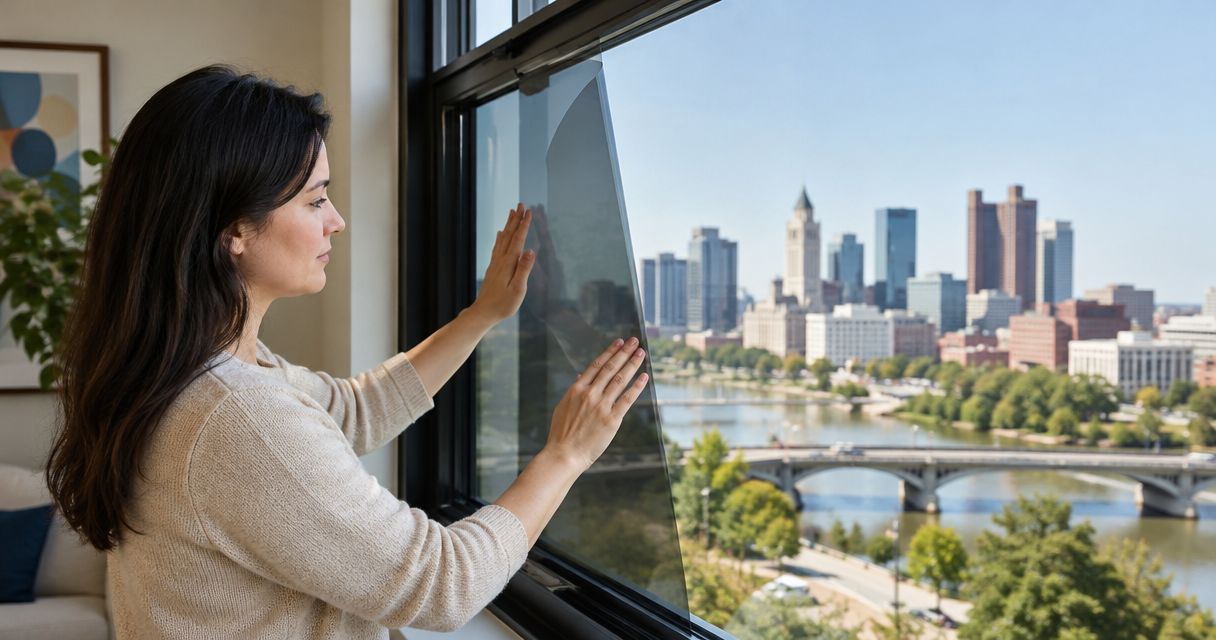
Best overall: a clear security-film system with documented testing and specified frame attachment. Best for glare: a solar-control security film. Best for privacy: a frosted security film. For your 2026 security window film Columbus shortlist, compare the installed system—not just the roll of film.
- For security window film Columbus projects, prioritize documented testing, glass compatibility, and the specified attachment method.
- Clear security film suits homeowners who want to preserve their view while addressing broken-glass retention.
- Solar-control and frosted security films address different needs; ordinary tint and decorative film are not substitutes.
- Olsson Smart Shades provides custom window treatments; discuss blinds, shades, shutters, and drapes separately from security-film installation.
Why this matters
A dark window is not necessarily a more secure window. Security film, solar tint, and decorative privacy film serve different purposes, even when they look similar on a sample board.
Security film helps hold broken glass together. Whether that retained sheet helps resist entry depends on the film, glass, frame, attachment, and installation. No residential film makes a window unbreakable or guarantees that an intruder stays outside.
Olsson Smart Shades provides custom-measured window treatments for Columbus and Central Ohio homeowners. Shades and drapes address privacy and light control; treat security-film selection as a separate technical decision. For the distinction between glass retention and entry resistance, read whether security window film helps prevent break-ins.
What makes the best security window film?
Use these criteria before comparing a 2026 proposal. A product name alone does not answer any of them.
- Glass compatibility: Written confirmation that the proposed film suits your existing glass construction and condition.
- Edge attachment: A clear explanation of how the filmed glass connects to the frame, where the specified system requires it.
- Test evidence: Documentation identifying the tested film, glass, attachment, and purpose—not an unrelated demonstration video.
- Daily use: A sample that shows the effect on daylight, reflections, privacy, and your view.
- Installation scope: A written description of preparation, application, attachment, curing instructions, and inspection.
- Claim limits: Plain language separating fragment retention, forced-entry resistance, solar control, and privacy.
Ask the installer to explain each item using your windows as the example. If the explanation stops at film thickness, keep asking.
Security window film options at a glance
These rankings compare system types, not unverified manufacturers or local installers. The first choice addresses attempted entry; the remaining choices fit narrower priorities.
| Rank and option | Best for | Standout feature | Key limitation |
|---|---|---|---|
| 1. Clear security film with specified attachment | Entry-resistance projects | Treats film, glass, and frame as one assembly | Requires evidence matching the proposed installation |
| 2. Clear safety film | Broken-glass retention | Preserves the view without adding a privacy finish | Safety documentation alone does not establish entry resistance |
| 3. Solar-control security film | Security needs plus troublesome glare | Combines documented security performance with solar control | Tint and glass compatibility need separate review |
| 4. Frosted security film | Privacy where a clear view is unnecessary | Obscures the view through treated glass | Ordinary frosted film is not automatically security film |
| 5. DIY decorative privacy film | Appearance-only projects | Changes the look or visibility of glass | Not a substitute for a documented security system |
1. Clear attached film: best for entry-resistance projects
A clear security-film system is the strongest starting point when your main concern is someone breaking glass to get inside. Specify a documented assembly that addresses the film, glass, frame, and attachment rather than treating the film as an independent barrier.
Edge attachment connects the filmed glass to the frame through the method specified for that system. Do not assume every installation includes it, or that every frame accepts the same method.
Clear attached film pros:
- Preserves a clear view when the selected film is transparent.
- Keeps attention on the complete opening rather than thickness alone.
- Supports a direct comparison between the proposal and relevant test documentation.
Clear attached film cons:
- The existing frame and glass can limit the appropriate installation.
- Attachment details need careful inspection and explanation.
- Testing does not guarantee the outcome of an actual break-in attempt.
Best for: Homeowners prioritizing resistance to attempted entry through accessible glass.
For a 2026 purchase, ask the installer to identify exactly which parts of your proposed assembly match the supporting test. A test on different glass or a different attachment arrangement is not proof of equivalent performance.
Verdict: Buy only with relevant documentation and a written attachment specification.
2. Clear safety film: best for broken-glass retention
Clear safety film focuses on holding fragments together after glass breaks. It fits a different decision from selecting an assembly specifically documented for forced-entry resistance.
That distinction matters around household glass. Holding fragments together and keeping a broken pane attached to its frame are related concerns, but they are not the same performance claim.
Clear safety film pros:
- Retains a transparent appearance with a clear product.
- Addresses fragment retention without requiring a frosted finish.
- Lets you evaluate a defined safety objective separately from privacy.
Clear safety film cons:
- Safety-impact documentation does not automatically establish forced-entry resistance.
- Film does not repair damaged glass or a deteriorated frame.
- Existing glazing requirements still need review for the specific location.
Best for: Homeowners whose stated goal is broken-glass retention, not a promised intrusion barrier.
Ask what safety testing supports the proposed use. Where safety glazing is required, have a qualified professional confirm that the proposed solution meets the applicable requirements; do not assume adding film makes every existing pane compliant.
Verdict: Buy for a documented safety purpose; skip it as an unsupported security upgrade.
3. Solar-control security film: best for glare-prone rooms
Solar-control security film combines solar-control properties with a documented safety or security function. The solar feature does not establish the security feature. Each needs its own supporting information.
Start with the room problem. If afternoon glare makes a living room uncomfortable, review the actual sample and its published optical information alongside the proposed security assembly.
Solar-control security film pros:
- Addresses glare while retaining a view through suitable transparent films.
- Combines two objectives in one glass treatment when properly specified.
- Gives you measurable optical properties to compare between proposals.
Solar-control security film cons:
- Darker or more reflective finishes change how windows look.
- Glass compatibility requires review before installation.
- A solar-control claim does not prove forced-entry performance.
Best for: Homeowners who need glare control and have a separate, clearly defined security objective.
For your 2026 comparison, request visible-light-transmission information and examine samples under real room lighting. Also ask how the proposed film affects the existing window manufacturer's terms. Do not accept a universal compatibility claim for every insulated glass unit.
Verdict: Buy when both the solar-control properties and security documentation fit your windows.
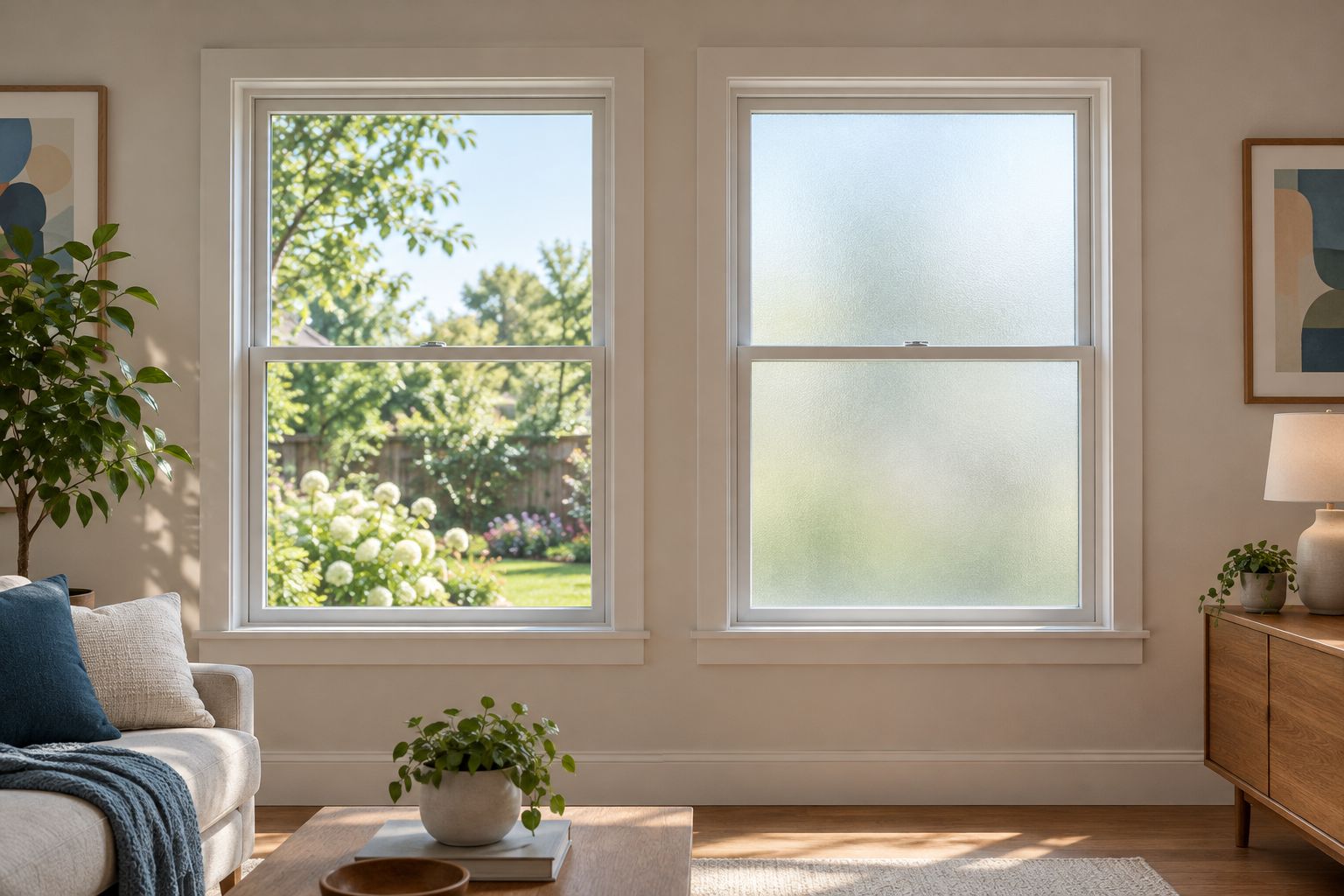
4. Frosted security film: best for privacy without a clear view
Frosted security film suits glass where obscuring the view matters more than seeing outside. The proposal must identify a security-rated construction with a frosted appearance—not merely ordinary decorative frosting.
Privacy also needs a practical check. Frosting obscures detail, but nearby shapes and shadows can remain visible depending on the material, distance, and lighting.
Frosted security film pros:
- Obscures direct views through the treated area.
- Allows daylight through without preserving a clear outside view.
- Separates privacy needs from the look of reflective tint.
Frosted security film cons:
- Removes the clear view through the treated glass.
- Does not guarantee that silhouettes disappear.
- Decorative frosting alone provides no evidence of security performance.
Best for: Privacy-focused glass where retaining the outside view is unnecessary.
Check a physical sample with lights on and off. If you want an unobstructed daytime view and adjustable evening privacy instead, discuss custom shades or drapes with Olsson Smart Shades rather than choosing a permanent frosted appearance.
Verdict: Buy only when the privacy finish and documented security construction both match your needs.
5. DIY decorative film: best for appearance-only projects
DIY decorative film changes the appearance or visibility of glass. It belongs on this list because it is easy to confuse a privacy improvement with a security improvement.
Choose it for decoration only unless the exact product and installed system have relevant documentation. A package photograph of frosted glass does not establish impact or forced-entry performance.
DIY decorative film pros:
- Offers a way to change the appearance of glass.
- Provides decorative patterns or obscured views, depending on the product.
- Lets an appearance-only project remain separate from security work.
DIY decorative film cons:
- Decorative claims do not establish security performance.
- Surface preparation and application affect the finished appearance.
- Glass compatibility and removal instructions still require checking.
Best for: Homeowners seeking decoration rather than a security barrier.
Verdict: Skip for security; consider only for its stated decorative purpose.
How these options rank
The ranking puts the stated job first. An assembly documented for entry resistance ranks above a film selected only for fragment retention when attempted entry is the concern.
Solar-control and frosted security films follow because they add room-specific trade-offs. Decorative film comes last because its appearance does not answer the security question. No manufacturer earns a recommendation here without product-specific evidence.
What to check before signing a proposal
Build your 2026 comparison around the same scope for every installer. Otherwise, similar-looking proposals can describe different work.
Identify the opening
Record the glass location, whether the window opens, and any visible damage. Ask the installer to identify the glass construction rather than guessing from appearance. Include doors and designated emergency escape openings in the discussion.
Read thickness correctly
Film thickness often appears in mils. 1 mil equals 0.001 inch, or 25.4 micrometers. Those are unit conversions, not security ratings.
A thicker-film claim does not replace evidence for the installed assembly. Ask what the thickness specification establishes and what it does not.
Separate the claims
Request separate explanations for fragment retention, entry resistance, glare reduction, and privacy. A film can address more than one concern, but evidence for one does not establish the others.
Get the handover instructions
Ask for written cleaning, curing, and inspection guidance for the selected system. Confirm who handles installation questions and how attachment details will be checked. Keep emergency escape and normal window operation part of the review.
Which security window film should you choose?
Choose a clear, documented security-film assembly with the specified frame attachment when attempted entry is your main concern. Choose solar-control or frosted versions only when their additional features solve a real room problem.
Olsson Smart Shades is best for Columbus and Central Ohio homeowners seeking custom-measured, professionally installed window treatments. For blinds, shades, shutters, drapes, or motorized shades, request an in-home consultation or quote and explain the privacy and light-control problems you want addressed. Confirm any security-film installation scope separately before arranging that work.
Discuss your window treatment needs
Ask about custom blinds, shades, shutters, drapes, or motorized shades for your Columbus-area home.
FAQ
What's the best security window film for a Columbus home?
For an entry-resistance project, start with a clear security-film assembly supported by relevant testing and the specified frame attachment. The right selection depends on your existing glass, frame, and intended purpose—not simply the thickest film.
Can security window film stop a break-in?
Security window film does not guarantee that a break-in will be stopped. A documented installed assembly can help resist entry, but film, glass, frame, attachment, and the attack conditions all matter.
Is thicker security film always better?
Thickness alone does not establish security performance. Compare documentation for the complete installed assembly and ask whether it matches your proposed glass and attachment method.
Does security film give me privacy at night?
Clear security film is not a nighttime privacy covering. Reflective films depend on lighting conditions, while frosted finishes obscure the view; shades or drapes provide a separate adjustable privacy layer.
Can security film go on double-pane windows?
Compatibility must be checked for the specific film and insulated glass unit. Ask for written guidance covering the glass construction and review the window manufacturer's terms before installation.
Is security window film bulletproof?
Ordinary residential security film is not bulletproof. Do not treat safety-impact or forced-entry documentation as evidence of ballistic resistance.
Does Olsson Smart Shades install security window film?
Olsson Smart Shades provides custom-measured blinds, shades, plantation shutters, drapes, and motorized smart shades. Confirm security-film installation directly rather than assuming it is included in those window-treatment services.
One last thing
Before approving a 2026 installation, ask one plain question: What holds the filmed glass in the frame after the glass breaks? The answer reveals more about the proposed security approach than a dramatic demonstration or a thickness claim.