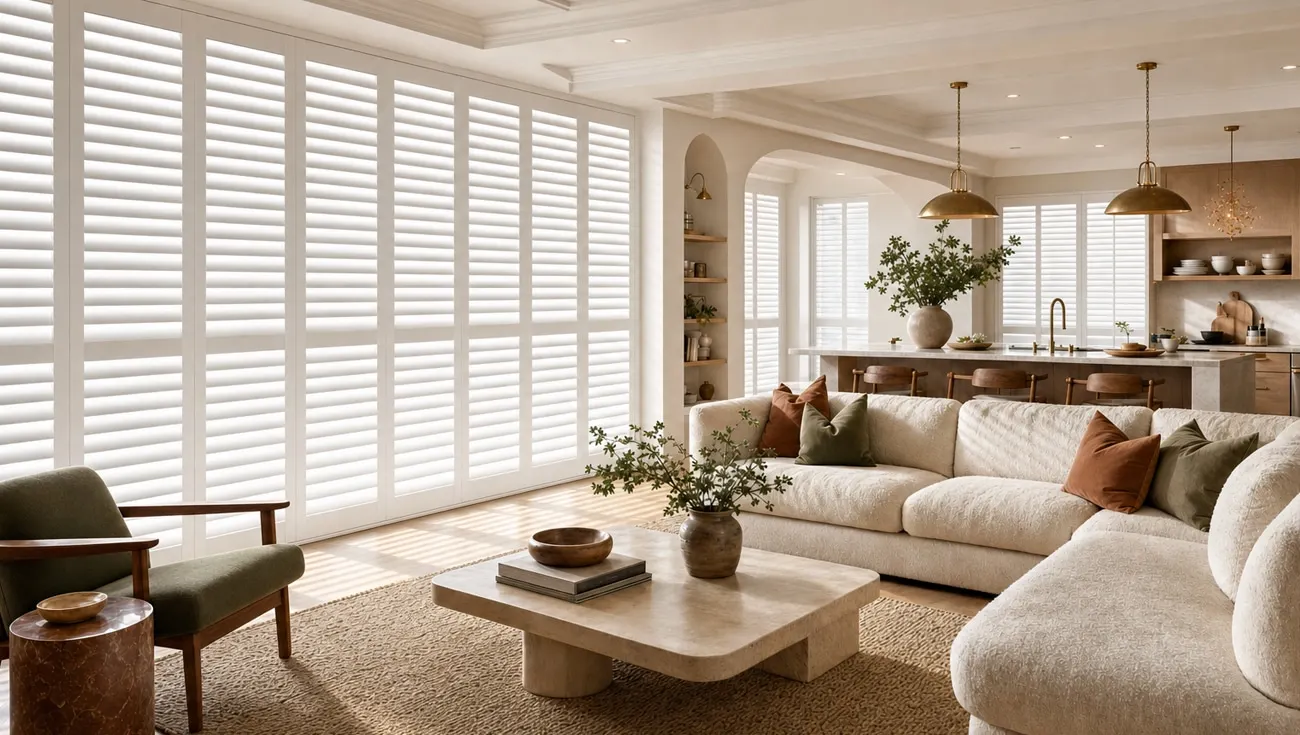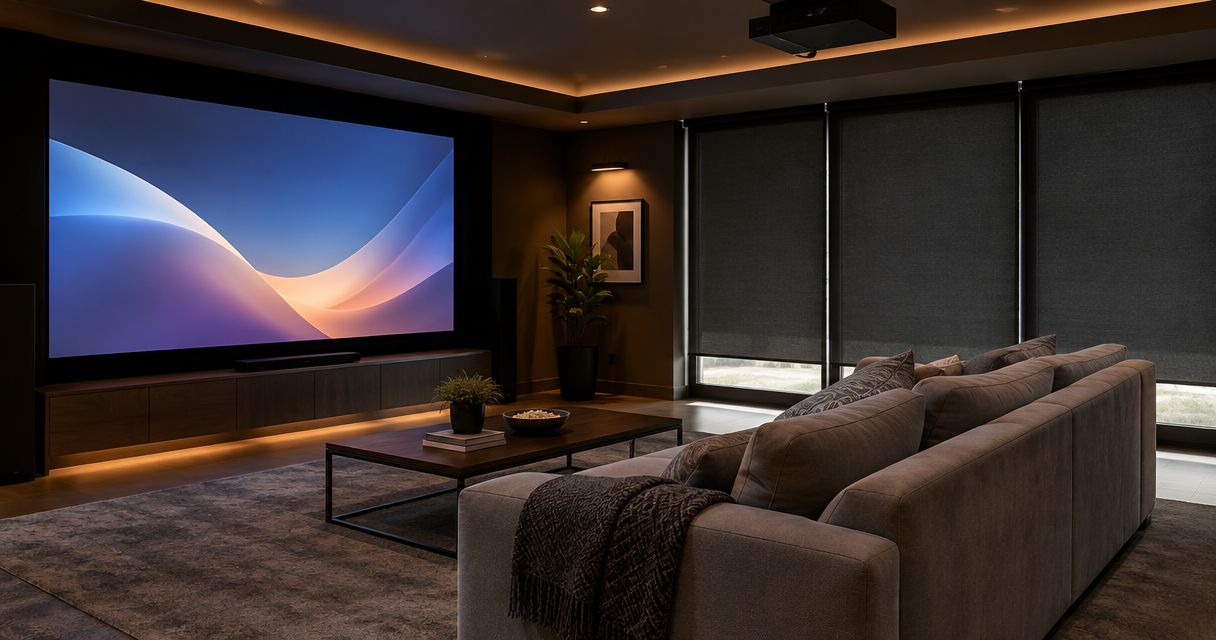
Best overall: blackout roller shades with side channels. Best for a shared living room: dual roller shades. Best simple setup: manual blackout cellular shades. This 2026 guide compares shades for home theaters and explains what to discuss with Olsson Smart Shades when planning custom window treatments in Columbus and Central Ohio.
- Blackout roller shades with side channels are the default shades for home theaters built around daytime projection.
- Dual roller shades suit media rooms that need daylight between movies.
- Blackout fabric does not eliminate light entering around a shade’s edges.
- Olsson Smart Shades provides custom-measured window treatments and motorized smart shade installation in Columbus and Central Ohio.
Why this matters
A shade can block light through its fabric and still leave a bright outline around the window. That distinction matters when you are watching a dark scene during the afternoon. Choose the complete window treatment, not just a fabric labeled blackout.
For your 2026 project, start with how the room works. A dedicated projector room needs tighter light control than a living room used mainly for evening television. Motorization changes how you operate the shade; it does not make the fabric or its edges more light-blocking.
Olsson Smart Shades is a fit for Columbus and Central Ohio homeowners seeking custom-measured shades for home theaters with professional installation. Ask which configurations suit your windows before settling on a style.
What makes the best shades for home theaters
Judge each option against these criteria before choosing fabric or controls:
- Fabric opacity: Blackout material blocks light through the material itself. Light-filtering fabric serves a different purpose.
- Edge control: Side channels, overlap, and layered treatments address light that travels around the fabric.
- Window fit: Recess depth, handles, trim, and mounting surfaces determine what can be installed properly.
- Everyday use: A media room still needs convenient daylight, window access, and straightforward controls.
- Screen conditions: Assess the window from the actual seating position with your television or projector running.
- Installation demands: Power access, charging access, brackets, and drapery clearance belong in the plan before ordering.
A treatment that performs well on one window is not automatically right for every opening. Patio doors, shallow recesses, and closely spaced windows need their own assessment.
Home theater shades at a glance
These are treatment categories, not named product lines. Confirm the proposed construction and mounting details when requesting a quote.
| Rank and treatment | Best for | Standout feature | Key limitation |
|---|---|---|---|
| 1. Blackout roller shades with side channels | Dedicated daytime projector rooms | Channels address side-edge light | Needs suitable mounting and careful fitting |
| 2. Blackout cellular shades | Simple manual operation | Pleated fabric folds into a compact stack | Uncovered perimeter gaps still admit light |
| 3. Dual roller shades | Living rooms that become media rooms | Separate daylight and blackout layers | Two rollers require mounting clearance |
| 4. Blackout-lined Roman shades | Decor-led rooms used mainly for evening viewing | Folded fabric appearance | Lining does not seal the perimeter |
| 5. Blackout roller shades with drapes | Existing roller setups needing another light-control layer | Drapes can overlap exposed side gaps | More hardware and fabric to accommodate |
1. Blackout roller shades with side channels: best for projection
Blackout roller shades use opaque fabric that rolls onto a tube. Side channels guide the fabric edges and help close the paths where daylight otherwise enters beside the shade. The top and bottom still need attention.
Best for: A dedicated home theater where you want to watch a projector during daylight.
Blackout roller shades with side channels pros:
- Address light through the fabric and along the sides.
- Keep the window treatment visually simple when lowered.
- Roll upward when you want daylight and a view.
Blackout roller shades with side channels cons:
- Channels require suitable surfaces and precise alignment.
- Handles, trim, and shallow recesses can complicate the layout.
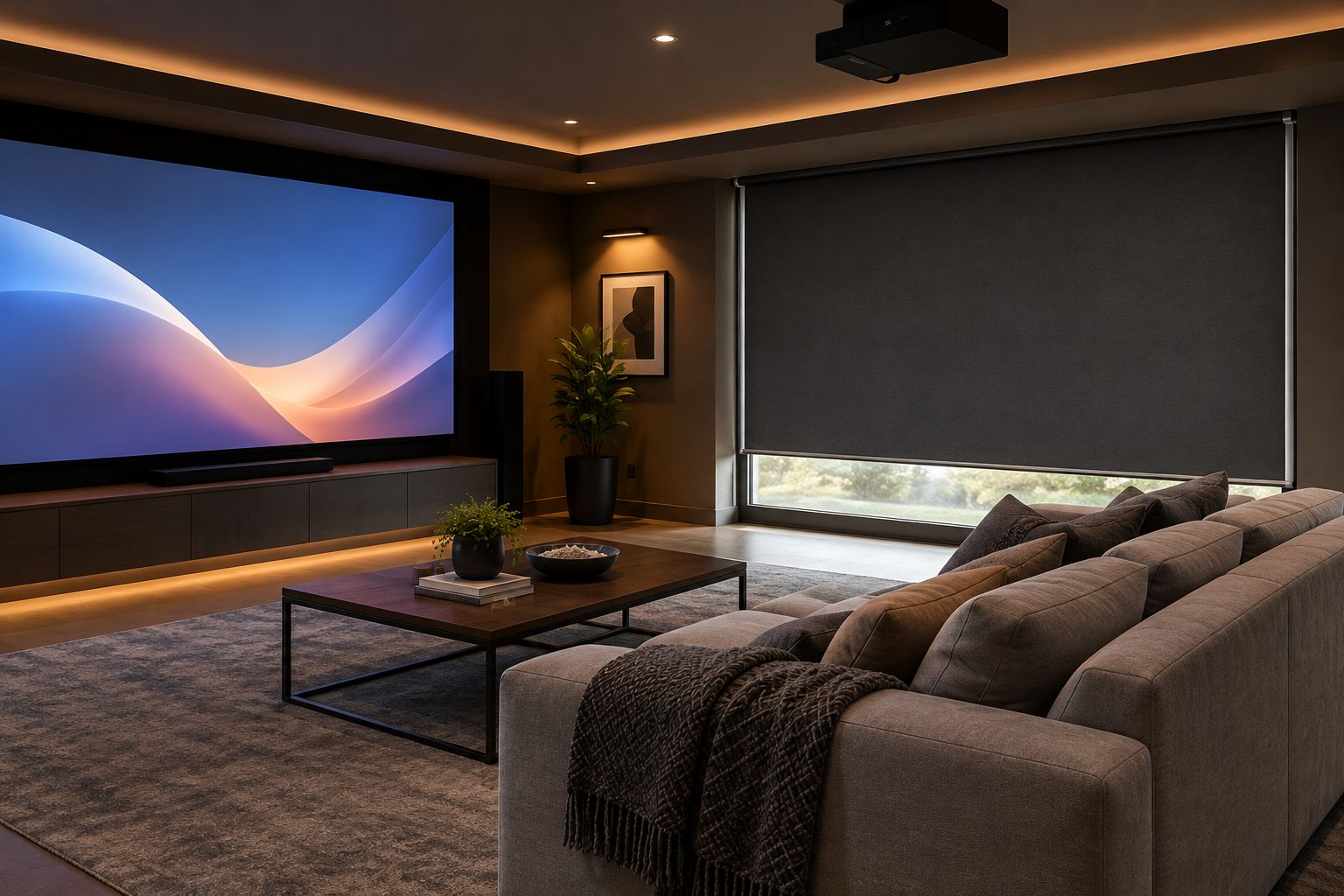
Ask how the proposed treatment handles the roller at the top and the meeting point at the sill. Side channels alone are not proof that the whole opening will be dark.
Verdict: Buy for daytime projection when the proposed installation addresses the full perimeter.
2. Blackout cellular shades: best for simple manual operation
Blackout cellular shades use pleated, pocketed fabric that compresses as the shade rises. They suit homeowners who want a straightforward window covering without adding drapery. Specify blackout fabric rather than assuming every cellular shade darkens the room equally.
Best for: An occasional media room where simple manual operation matters more than tightly controlled projection conditions.
Blackout cellular shades pros:
- Fold into a compact stack above the exposed glass.
- Offer a softer appearance than a flat roller panel.
- Work as a single window-treatment layer.
Blackout cellular shades cons:
- Light can enter around uncovered edges.
- Pleated construction needs cleaning suited to the selected fabric.
For a manual shade, check whether you can comfortably reach the operating point without leaning over furniture. An easy mechanism is not convenient if the sofa blocks it.
Verdict: Buy for straightforward room darkening; skip as an unqualified promise of projector-room blackout.
3. Dual roller shades: best for shared living and media rooms
Dual roller shades combine a daylight fabric and a separate blackout fabric on the same opening. You select the layer that suits the activity. This avoids making the room either fully exposed or dark every time you adjust it.
Best for: A family living room used for daylight activities and movie nights.
Dual roller shades pros:
- Separate daytime light management from movie-time darkening.
- Give you 2 fabric layers with different jobs.
- Keep both functions at the window without floor-length fabric.
Dual roller shades cons:
- Two rollers need enough mounting space.
- The blackout layer still needs its own edge-control plan.
Do not treat the daylight layer as a privacy guarantee. Ask how the selected material behaves when the room is lit after dark, and review it separately from blackout performance.
Verdict: Buy for a multipurpose room where flexible daylight matters every day.
4. Blackout-lined Roman shades: best for decor-led media rooms
Roman shades lift into fabric folds instead of rolling onto a tube. A blackout lining addresses light transmission through the shade body while preserving a softer, furnished appearance. The folds and perimeter still affect the finished result.
Best for: A living room where fabric and decor take priority and most viewing happens after sunset.
Blackout-lined Roman shades pros:
- Bring fabric texture to the window.
- Combine a decorative face fabric with an opaque lining.
- Suit rooms where the television is not the main visual feature.
Blackout-lined Roman shades cons:
- Raised folds occupy space above the exposed window.
- Blackout lining does not close side or top gaps.
Review a sample of the complete construction, not just the decorative fabric. Ask how lining, seams, and mounting will affect visible light before approving the order.
Verdict: Buy for an evening media room; skip as the default for demanding daytime projection.
5. Blackout roller shades with drapes: best for improving an existing setup
A blackout roller shade controls light through the main panel. Drapes add overlapping fabric around the window, helping cover light paths left beside the roller. This approach depends on drapery coverage and placement, not simply adding more fabric.
Best for: A room with a roller shade you want to retain while addressing exposed side gaps.
Blackout roller shades with drapes pros:
- Add another opportunity to cover side-edge light.
- Let you retain an existing roller when it remains suitable.
- Add softness to a room dominated by screens and furniture.
Blackout roller shades with drapes cons:
- Need wall space for hardware and gathered fabric.
- Add another treatment to operate and maintain.
Plan where the drapes sit when open. Fabric that gathers over the glass reduces the daylight opening, while furniture beneath the window can obstruct full closure.
Verdict: Buy when added overlap solves a specific gap problem without crowding the room.
Check the installation before choosing the fabric
For a 2026 installation, settle the mounting approach before approving the treatment. Inside-mounted shades sit within the recess; outside-mounted shades extend beyond the opening. Neither mounting style guarantees darkness by itself.
Look beyond the side gaps
Inspect the top, sides, and bottom from your viewing seat. A blackout fabric sample cannot demonstrate the performance of an installed window treatment. The roller housing, brackets, sill, and nearby trim all affect the result.
The practical work of reducing light gaps around shades starts with distinguishing fabric opacity from perimeter coverage. A wider opaque panel addresses a different problem from a channel beside the fabric; ask which light path each proposed component will close.
Check how the room changes during the day
Test the room in 2 positions: your usual seat and the screen location. A bright window beside your seat is a different viewing problem from sunlight falling directly across the screen. Observe the room during your intended viewing hours, not just when an appointment happens to fall.
Bring photos showing the windows, screen, furniture, and any obstructions to the conversation. Keep doors, vents, and window handles in view. Those details help keep the discussion practical.
Decide whether motorization solves a real problem
Motorization is useful when shades are hard to reach or several windows need regular adjustment. It does not replace blackout fabric, perimeter coverage, or careful measurement. Make the light-control decision first.
For smart shades in 2026, ask about the exact proposed motor, control method, and power arrangement. Do not assume that a familiar voice assistant or home-control system works with every motorized shade.
Before approving motorization, ask:
- Control: How will you operate the shade when you do not have your phone?
- Power: Where will charging, batteries, or wiring be accessed?
- Sound: Can you hear the proposed motor operate before selecting it?
- Integration: Which specific equipment is required for your intended controls?
Olsson Smart Shades offers motorized smart shade installation. Describe what you want to happen when viewing starts, then request confirmation of the equipment needed rather than assuming an automatic movie routine is included.
How these shade types are ranked
The 2026 ranking puts light blocking and perimeter control first, followed by daily usability, window fit, and installation demands. It compares treatment designs rather than claiming measured performance for unnamed products.
Blackout roller shades with side channels take the default position because their design addresses both opaque coverage and side-edge light. The other options win distinct jobs: simple operation, flexible daylight, decorative fabric, or improving an existing roller setup.
Which shades for home theaters should you choose?
Choose blackout roller shades with side channels for a dedicated daytime projector room. Choose dual roller shades when the same room needs comfortable daylight between films. Keep the decision tied to your actual viewing habits.
For your 2026 project, ask Olsson Smart Shades to discuss the windows, mounting constraints, and manual or motorized operation. You can request a quote and ask how to arrange an in-home consultation. Describe the result you want without committing to a treatment type first.
FAQ
What are the best shades for home theaters with projectors?
Blackout roller shades with side channels are the default choice for a dedicated daytime projector room. Confirm how the proposed installation addresses top and bottom gaps as well as the sides.
Do blackout shades make a media room completely dark?
Blackout shades do not automatically make a room completely dark. Opaque fabric blocks light through the material, but light can still enter around its perimeter or through other room openings.
Are motorized shades darker than manual shades?
Motorized shades are not inherently darker than manual shades. Fabric, coverage, and installation determine light control; the motor changes how you operate the treatment.
Are dual roller shades good for a living room with a television?
Dual roller shades suit living rooms that need daylight and movie-time darkening. The separate blackout layer still requires attention to edge gaps.
Can I keep my roller shades and add blackout drapes?
You can consider retaining suitable roller shades and adding blackout drapes to cover exposed light paths. Check wall space, hardware placement, and whether the fabric can close fully around furniture.
Should I choose inside-mount or outside-mount theater shades?
Choose the mounting style after assessing recess depth, trim, obstructions, and required coverage. Inside mounting fits within the opening; outside mounting extends beyond it, but neither guarantees darkness alone.
How do I start planning custom theater shades in Columbus?
Ask Olsson Smart Shades about a quote and arranging an in-home consultation for your Columbus or Central Ohio home. Explain your screen type, viewing hours, window access, and preferred controls.
One last thing
Before replacing a treatment, lower it during daylight and inspect the room with the screen off. Identify whether the unwanted light comes through the fabric, around the edges, or from another opening. Replace the part of the setup that is failing—not automatically the whole setup.