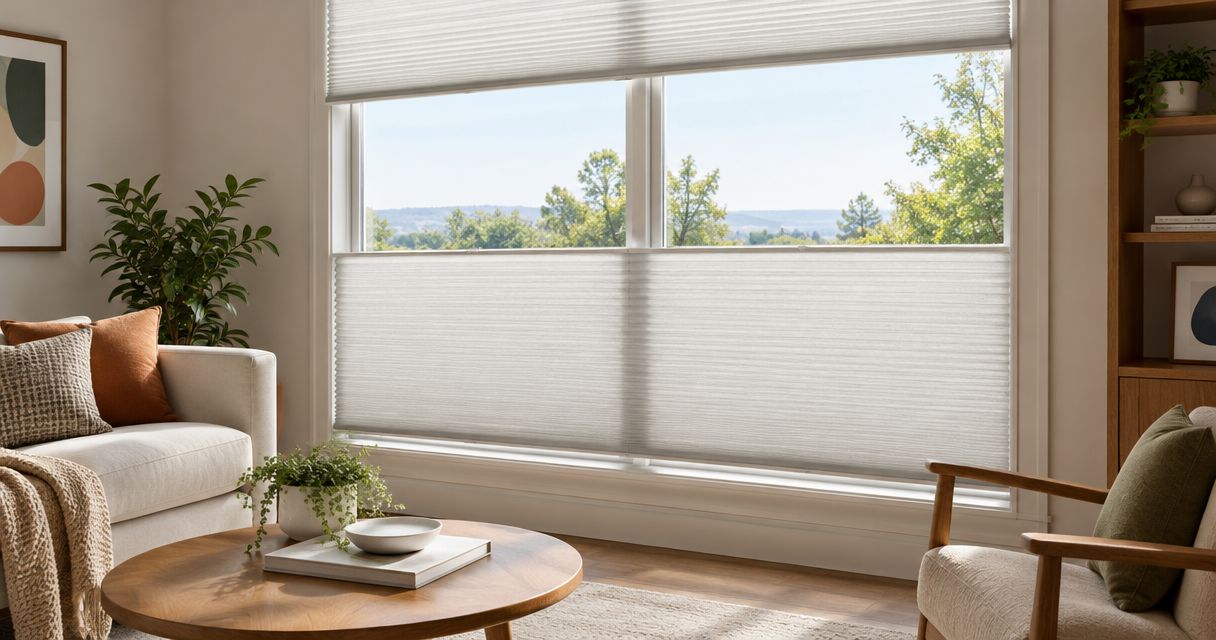
Best overall: cordless, light-filtering top down bottom up cellular shades. Best for bedrooms: room-darkening fabric. Best for insulation-focused rooms: double-cell construction. Best for hard-to-reach windows: motorized operation with confirmed top-down control. This 2026 guide compares configurations, not unverified product models, so you can choose what suits your room.
- Cordless, light-filtering top down bottom up cellular shades are the default choice for daylight with lower-window coverage.
- Choose room-darkening fabric for bedrooms, but address light around the shade’s edges separately.
- Double-cell construction prioritizes insulation; motorization prioritizes access. Confirm both with the exact shade specification.
- Olsson Smart Shades provides custom-measured window treatments for Columbus and Central Ohio homeowners seeking professional installation.
Why this matters
A street-facing window asks you to make a trade-off: enjoy daylight or cover the room. Top-down bottom-up shades give you another position. You lower the upper rail while leaving the lower glass covered.
That helps separate daylight from the view into your home. It does not make an open section private, and it does not turn every cellular fabric into a blackout treatment.
For a locally measured and installed window treatment, Olsson Smart Shades serves homeowners in Columbus and Central Ohio. Olsson Smart Shades is best for local homeowners who want custom-measured window treatments with professional installation. Confirm the exact cellular fabric, operating system, and top-down function during your consultation.
What makes the best top-down bottom-up cellular shades?
The best shade matches how you use the window, not just the fabric sample. Use these criteria for your 2026 shortlist:
- Privacy position: The upper opening should admit daylight without exposing the part of the room you want covered.
- Fabric opacity: Light-filtering fabric softens daylight; room-darkening fabric blocks more light through the material.
- Easy operation: You should be able to position both moving rails comfortably from the floor.
- Window fit: Mounting depth, handles, locks, and trim must work with the finished shade.
- Insulating construction: Cellular pockets hold air, but the complete shade and installation determine performance.
- Cord safety: Prioritize designs without accessible operating cords, especially around children and pets.
These are separate decisions. A double-cell shade is not automatically room-darkening, and a motorized cellular shade is not automatically top-down bottom-up.
Best configurations at a glance
| Rank and configuration | Best for | Standout feature | Key limitation |
|---|---|---|---|
| 1. Cordless light-filtering cellular shade | Everyday living spaces | Daylight through fabric with adjustable upper coverage | Not a room-darkening solution |
| 2. Room-darkening cellular shade | Bedrooms and daytime rest | Greater light blocking through the fabric | Light can still enter around edges |
| 3. Double-cell cellular shade | Insulation-focused rooms | Two layers of cellular air pockets | Cell count alone does not establish performance |
| 4. Motorized top-down bottom-up cellular shade | Windows you cannot comfortably reach | Powered adjustment | Both moving rails need confirmed control |
These configurations describe different priorities, not necessarily mutually exclusive products. Ask which features can be combined in the exact system you are considering.
1. Cordless light-filtering: best for everyday living spaces
A cordless, light-filtering cellular shade is the starting point for living rooms, dining areas, and other spaces where you want daylight without leaving the lower window uncovered. The fabric diffuses incoming light while the top-down position creates an opening above it.
Best for: Homeowners whose main problem is the view through the lower part of a window, rather than darkness for sleep.
Position the upper rail according to the actual sightline outside. A sidewalk, a raised porch, and an upstairs neighboring window do not look into your room from the same angle.
Cordless light-filtering pros:
- Admits softened daylight through the covered area.
- Offers upper-window daylight while covering lower glass.
- Avoids a hanging operating cord when the selected design is cordless.
Cordless light-filtering cons:
- Does not provide room-darkening performance.
- Requires a reachable rail for manual adjustment.
- Fabric privacy varies; check the sample under indoor lighting after dark.
Do not judge privacy by holding a sample against a bright showroom window alone. Ask how the fabric behaves when your room is lit and it is dark outside. Also check whether you like the outward appearance of the fabric.
Verdict: Buy cordless light-filtering shades when everyday daylight and lower-window coverage are your main goals.
2. Room-darkening: best for bedrooms and daytime rest
Room-darkening cellular fabric reduces light passing through the shade more than light-filtering fabric. Top-down adjustment lets you open the upper glass during the day without fully raising the covering.
Best for: Bedrooms where you want covered windows for rest and a separate daylight position while awake.
The key distinction is between the fabric and the finished window. Even opaque fabric leaves a room exposed to light if the installation has gaps around the edges.
Room-darkening pros:
- Blocks more light through the fabric than light-filtering material.
- Provides a daytime opening without raising the entire shade.
- Gives bedrooms a clear covered position for rest.
Room-darkening cons:
- Does not guarantee a completely dark room.
- Reduces daylight through the covered portion more strongly.
- Requires careful attention to edge coverage and mounting.
For your 2026 bedroom plan, explain whether you want softer morning light or darkness for daytime sleep. Those are different requirements. Ask the installer to assess edge gaps and explain whether additional coverage is appropriate.
An outside mount can overlap the opening, but it also covers more trim and wall. Choose the mounting approach with the room-darkening goal in mind, rather than choosing it solely for appearance.
Verdict: Buy room-darkening shades for sleep-focused rooms; hold the order until edge-light expectations are clear.
3. Double-cell: best for insulation-focused rooms
Double-cell cellular shades use 2 layers of cellular air pockets. The construction makes them a useful option to evaluate when insulation is a priority, but it does not establish a fixed energy-saving result.
Best for: Homeowners comparing cellular constructions for rooms where window comfort matters more than a particular operating feature.
Start with the window itself. A shade adds an interior covering; it does not repair damaged seals, failed glazing, or air leaks around a frame.
Double-cell pros:
- Adds a second layer of cellular air pockets.
- Makes insulation part of the fabric-construction decision.
- Keeps the pleated appearance associated with cellular shades.
Double-cell cons:
- Cell count alone does not prove better whole-window performance.
- Does not automatically mean room-darkening fabric.
- Requires confirmation of mounting depth and raised stack size.
Ask for performance information tied to the actual shade, not a claim about cellular shades in general. Check the dimensions, fabric, and mounting conditions behind any published rating. A rating for a different construction is not evidence for your order.
Compare the sample in its raised position, too. The fabric stack occupies space at the top of the window, which affects the view when the shade is open.
Verdict: Buy double-cell construction when insulation is a stated priority and the exact specification supports your choice.
4. Motorized: best for hard-to-reach windows
A motorized shade uses powered operation instead of requiring you to move the rail by hand. For top-down bottom-up use, the important question is whether the specified system controls both moving rails as you expect.
Best for: Windows above furniture or in positions where manual adjustment is awkward.
Motorization and smart-home control are separate features. A powered shade does not establish app support, voice control, scheduling, or compatibility with your existing equipment.
Motorized top-down bottom-up pros:
- Reduces the need to reach the window for adjustment.
- Provides powered positioning with the specified control.
- Lets accessibility guide the operating-system choice.
Motorized top-down bottom-up cons:
- Needs a defined power source and service-access plan.
- Requires confirmation of independent rail control.
- Does not automatically include smart-home integration.
For a 2026 motorized-shade quote, request a demonstration of the exact movement you want: lower the upper rail, keep the bottom covered, then close the upper opening. A demonstration of an ordinary bottom-up motorized shade does not answer that question.
Confirm how you will reach batteries or charging connections if the selected system needs them. Easy daily control should not hide an awkward maintenance task.
Verdict: Hold until powered top-down operation is demonstrated; buy when the control and power plan fit your window.
How to check fit before ordering
Top-down bottom-up shades have 2 moving rails to consider: the upper fabric rail and the bottom rail. Both need usable travel without interference from locks, handles, or the window frame.
For an initial window survey, check width at 3 positions: top, middle, and bottom. Check height at 3 positions: left, center, and right. These observations help identify an uneven opening; they are not a substitute for the selected manufacturer's ordering instructions.
An inside mount sits within the opening. An outside mount overlaps it. Neither is automatically better: available depth, trim, obstructions, and light-control goals decide the fit.
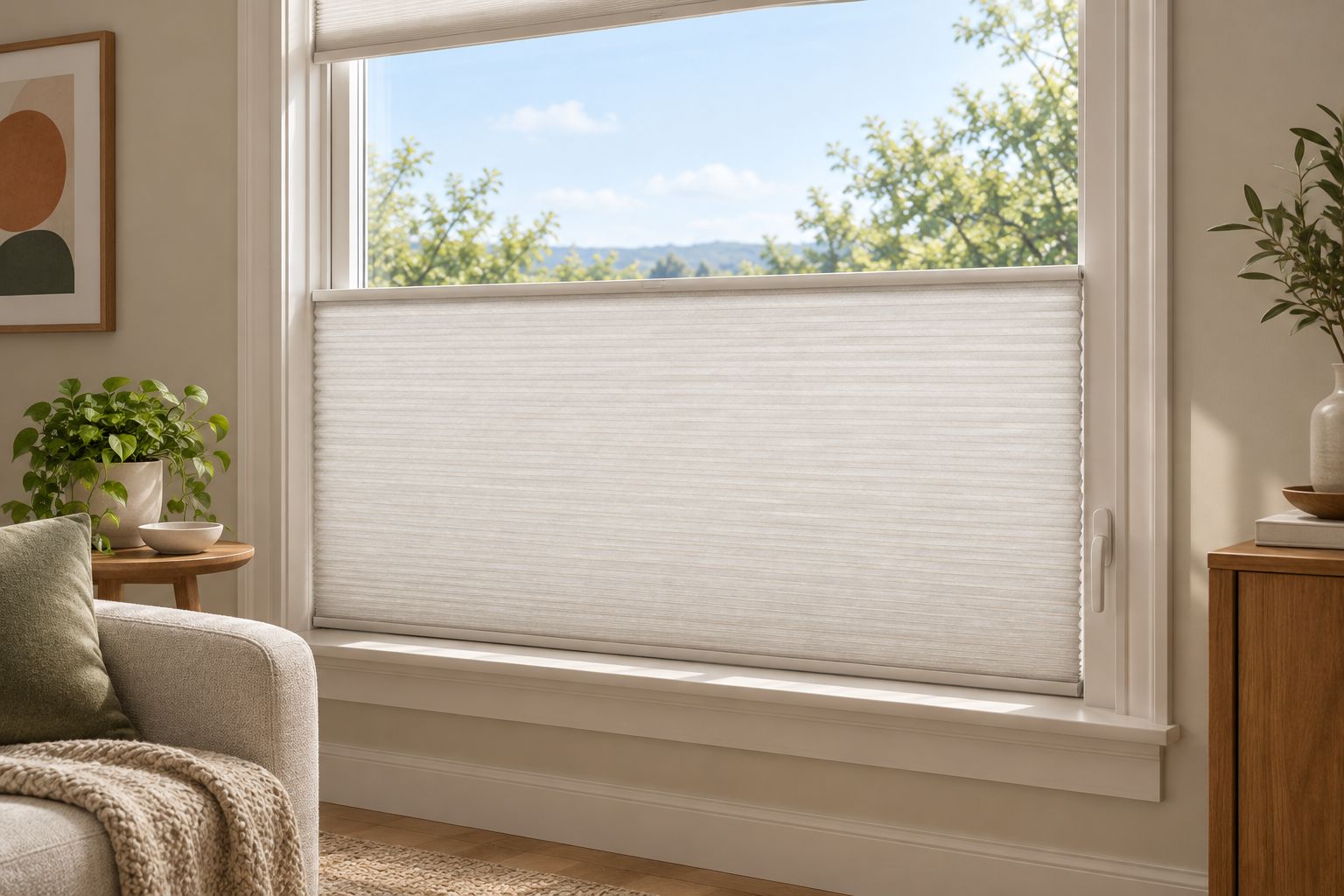
Check the view from your usual seat, not just while standing at the window. Then check the outside sightline. An opening that feels private from the sofa can expose more of the room from higher ground.
Ask the installer to confirm these details before you approve the order:
- Whether the window has enough mounting depth.
- Whether handles and locks remain accessible.
- How much glass the raised fabric stack covers.
- Whether you can comfortably reach manual controls.
- What the finished edge gaps will look like.
How we ranked these configurations
The ranking puts everyday privacy and daylight first, followed by sleep, insulation, and access. It compares operating and fabric choices rather than naming product models without verified specifications.
Cordless light-filtering takes the default position because it directly addresses the central top-down use case: keep lower glass covered while admitting daylight above. The other configurations win only when their distinct purpose matters more to your room.
Which cellular shade should you choose?
Choose cordless light-filtering for an ordinary living space, then change the specification only to solve a clear room-level problem. Choose room-darkening for sleep, assess double-cell construction for insulation, or require powered operation when reaching the window is the obstacle.
Olsson Smart Shades provides custom-measured shades and professional installation in Columbus and Central Ohio. Use the quote request to describe your windows, privacy concerns, and preferred operation, and ask to arrange an in-home consultation.
For your 2026 consultation, ask to compare fabric samples at the window and confirm the exact top-down bottom-up system before ordering. You do not need a finished specification to begin that conversation.
FAQ
What's the best top-down bottom-up cellular shade for most living rooms?
Cordless light-filtering cellular shades are the default choice for living rooms where daylight and lower-window coverage matter most. Choose room-darkening fabric instead if reducing light through the material is the priority.
Can people see through top-down bottom-up shades at night?
Nighttime privacy depends on the fabric and which parts of the window remain open. Check the fabric under indoor lighting after dark, and remember that an uncovered upper section still allows a view through the glass.
Are top-down bottom-up cellular shades blackout?
Top-down bottom-up describes movement, not blackout performance. Room-darkening fabric blocks more light through the material, but light around the edges needs a separate installation plan.
Can motorized cellular shades open from the top?
Only a system specifically designed for powered top-down operation provides that movement. Ask for a demonstration of both moving rails rather than assuming a standard motorized cellular shade does it.
Are double-cell shades always better than single-cell shades?
Double-cell construction is not automatically the better choice for every window. Compare the exact shade's performance information, mounting requirements, fabric opacity, and raised stack before deciding.
Should I choose an inside mount or an outside mount?
Choose the mount that fits your window and light-control goal. An inside mount sits within the opening, while an outside mount overlaps it and covers more surrounding trim or wall.
How do I request custom cellular shades in Columbus?
Contact Olsson Smart Shades to request a quote and ask to arrange an in-home consultation. Describe the rooms, your privacy concerns, and whether you want manual or motorized operation; confirm the exact top-down bottom-up specification before ordering.
One last thing
Test the top opening before choosing the fabric. Temporarily cover the lower glass with an opaque sheet, keeping it away from cords and hardware, and inspect the sightline from outside. That simple check helps you decide whether top-down operation actually solves your privacy problem.