Yes, cellular shades save energy by slowing heat transfer through your windows, especially when they fit closely and stay closed when needed. They can reduce heating and cooling demand, but your bill savings depend on the windows, installation, sunlight, and how you use the shades—not just the honeycomb fabric.
- Do cellular shades save energy? Yes: their air pockets slow heat transfer, but fit and daily use determine results.
- The U.S. Department of Energy reports about 10% heating-energy savings from tightly installed cellular shades under suitable conditions.
- Blackout fabric controls light; it does not establish a shade’s insulating performance.
- Olsson Smart Shades offers custom-measured window treatments for Columbus and Central Ohio homeowners who want professional installation.
Do cellular shades really save on energy bills?
Cellular shades can reduce energy bills, but a published saving is not a promise for your home. The U.S. Department of Energy’s Energy Saver guidance on energy-efficient window coverings says tightly installed cellular shades can reduce heat loss through windows by 40% or more during heating seasons. That translates to about 10% heating-energy savings under the conditions described—not a reduction of that size across your entire utility bill.
For a 2026 purchase, keep those measurements separate. Heat lost through glass, energy used for heating, and the total amount on your bill are different things.
For local help comparing custom window treatments, Olsson Smart Shades serves homeowners in Columbus and Central Ohio. Start with the room that feels uncomfortable, rather than assuming every window needs the same treatment.
| Option | Best for | Main benefit | Main limitation |
|---|---|---|---|
| Single-cell shades | Homeowners comparing simpler honeycomb constructions | Air pockets slow heat transfer | Cell count alone does not establish performance |
| Double-cell shades | Homeowners considering an additional layer of air pockets | Additional cellular construction | Actual performance still depends on the complete shade and fit |
| Blackout cellular shades | Bedrooms where light control matters alongside insulation | Combines cellular construction with stronger light blocking | Blackout labeling does not prove better insulation |
| Motorized cellular shades | Hard-to-reach windows or regular opening and closing | Makes shade operation easier to repeat | The motor itself does not improve insulation |
Why this matters
Windows affect both comfort and energy use. The Department of Energy says heat gain and heat loss through windows account for 25%–30% of residential heating and cooling energy use.
That figure explains why window coverings deserve attention. It does not mean shades can eliminate that entire share: glass, frames, air leakage, weather, and the rest of your home still matter.
For your 2026 buying decision, separate the goals. A bedroom that feels cold at night needs a different operating routine from a living room that overheats in afternoon sun. The right shade should address the problem you actually notice.
How cellular shades slow heat transfer
Cellular shades have pockets formed by folded fabric. Those pockets hold air, creating an insulating layer between the room and the window. That is the practical difference between honeycomb construction and a flat piece of fabric.
In winter, a lowered cellular shade slows heat moving toward cold glass. In summer, a closed shade helps limit heat entering the room through a sunlit window. The shade must be in position to do either job.
A raised cellular shade is not providing its intended insulating barrier across the glass. That sounds obvious, but it matters more than a feature you rarely use.
Insulation and air sealing are also different jobs. A cellular shade does not repair a leaking sash, damaged weatherstripping, or a failed window component. If you feel a distinct draft, investigate the window as well as the covering.
Single-cell shades: compare the whole construction
Single-cell shades use a single layer of honeycomb pockets. They are a sensible option to examine when you want cellular construction without choosing solely by the number of layers.
Ask about the specific shade’s insulating performance, fabric, mounting requirements, and fit. A broad category label cannot answer those questions. Neither can a fabric sample held in your hand.
The trade-off is straightforward: a single-cell shade has less cellular layering than a double-cell design, but that fact alone does not establish the difference in your energy bill. Compare documented performance where available, not an assumed percentage.
Double-cell shades: extra pockets, not a savings guarantee
Double-cell shades add another layer of honeycomb pockets. That additional construction is relevant to insulation, but it does not justify assigning a fixed saving to every double-cell product.
Check how the finished shade will sit against your particular window. Trim, handles, mounting depth, and operating clearance all affect the installation. A promising construction still needs an appropriate fit.
For a 2026 comparison, ask whether the performance information applies to the actual fabric and configuration being quoted. Do not treat a statement about the entire product category as a rating for your chosen shade.
Blackout cellular shades: darkness is a separate benefit
Blackout cellular shades suit bedrooms where blocking light matters as much as comfort. Their cellular structure provides the insulating feature; their light-blocking fabric addresses darkness.
The limitation is that darkening a room does not, by itself, prove a particular level of thermal performance. Edge gaps can also admit visible light even when the fabric blocks it.
If sleep is your main concern, consider light around the edges alongside insulation. The guide to blackout shades for bedrooms covers that related buying decision. Keep the two questions separate during a consultation: how dark will the room become, and how will the treatment manage heat transfer?
Why cellular-shade energy savings vary
The same shade does not produce the same result in every room. These factors determine how much of its potential benefit you actually use:
- Window condition. Cellular shades add an insulating layer, but they do not repair air leaks or damaged window components.
- Installation fit. Gaps around a covering give room air a path around the insulating layer. Mounting details matter.
- Sun exposure. Direct sun can help warm a room in winter and add unwanted heat in summer.
- Shade construction. Fabric and cellular design affect performance; a product-specific rating is more informative than appearance alone.
- Daily operation. Shades need to be lowered when insulation or solar control is useful, then opened when daylight or beneficial warmth is wanted.
- Household energy use. Heating savings affect the heating portion of consumption, not unrelated electricity use or fixed utility charges.
Before comparing products, describe the problem plainly: cold seating beside the window, afternoon overheating, bedroom glare, or coverings that are awkward to operate. That gives the selection a useful starting point.
How should you use cellular shades in winter and summer?
Use a routine based on sunlight and comfort, not a rule that keeps every shade closed all day. Start with the window’s exposure, then adjust the shade as conditions change.
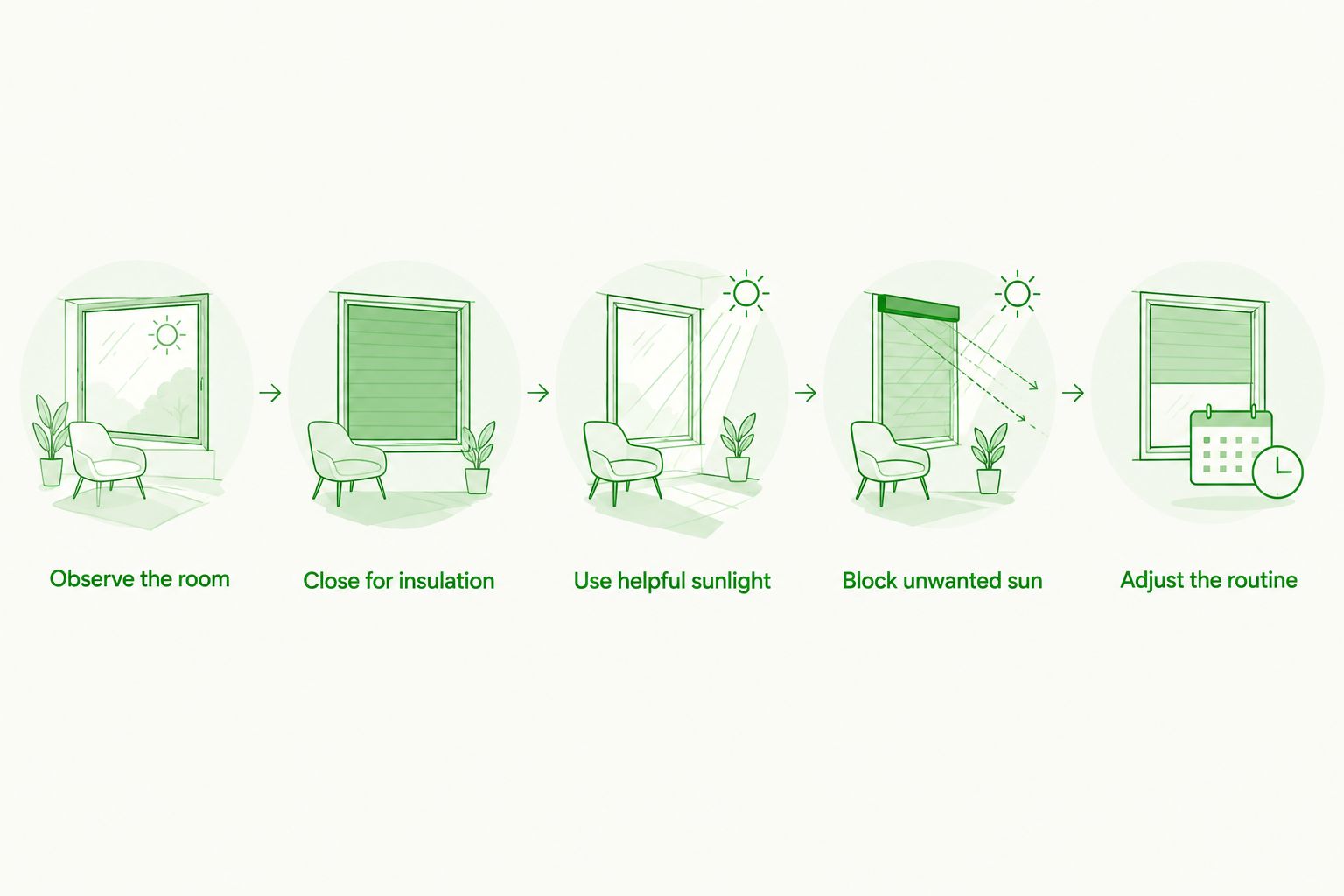
- Observe the room. Notice when it feels cold, when direct sun enters, and when glare becomes uncomfortable.
- Close for insulation. Lower shades during cold periods when you want an insulating layer across the glass.
- Use helpful sunlight. Open shades when winter sun provides welcome warmth, then close them when that benefit ends.
- Block unwanted sun. During cooling weather, close shades before direct sunlight makes the room uncomfortable.
- Adjust the routine. Change the schedule as seasons, weather, and room use change.
A schedule is a starting point, not a substitute for noticing the weather. A sunny winter afternoon and a cloudy one do not give the window the same job. Leave yourself an easy way to change the setting.
Should you fix drafts before buying cellular shades?
Repair an air-leak problem rather than asking a shade to solve it. If cold air enters around a sash or frame, investigate the source. A covering can improve comfort while leaving the underlying defect untouched.
This is the same distinction behind evaluating spray foam insulation for winter: reducing heat flow through a building assembly and stopping air leakage are related, but different, jobs. Neither question is answered simply by adding a decorative layer inside the room.
You do not need to replace every window before considering shades. You do need to distinguish cold glass from an actual draft. Tell the installer where you feel discomfort and whether it changes with wind, sunlight, or time of day.
Also watch for moisture on the glass during cold weather. An insulating covering can leave the glass colder by separating it from warm room air. If condensation appears, address indoor moisture and window conditions rather than leaving the issue hidden behind a closed shade.
Are motorized cellular shades better for energy savings?
Motorization changes how you operate a shade; it does not change the insulating properties of the same fabric and cellular construction. Its practical benefit is making a useful routine easier to follow.
That matters for tall windows, awkward furniture arrangements, or rooms where you repeatedly forget to close the shades before strong sun arrives. The limitation is equally clear: an unsuitable schedule can close a shade when winter sunlight would be welcome.
For a 2026 project, choose the routine before choosing the controls. Decide which windows should move together, which need individual adjustment, and how you want to override an automatic setting. Confirm any requested control-system compatibility for the exact products before ordering.
Do not justify motorization with an invented payback period. Convenience and access are real reasons to consider it. A specific energy saving needs evidence tied to the installation and your use.
How can you tell whether cellular shades are helping?
Look at comfort and energy use separately. A chair beside a window can feel more comfortable even when the change is difficult to isolate on a whole-home bill.
To compare consumption, use energy units on your utility statements rather than the amount charged. Rates and fixed fees can change independently of use. Weather, thermostat settings, occupancy, and other home improvements also affect the comparison.
Keep a simple record of when the shades are closed and which rooms improve. If you compare winter 2026 consumption with another period, account for differences in weather instead of crediting every change to the shades.
A product rating helps compare options under defined conditions. It is not a forecast of your household’s exact bill. Treat both the rating and your own observations as evidence with limits.
What should you ask during an in-home consultation?
Olsson Smart Shades is best for Columbus and Central Ohio homeowners seeking custom-measured window treatments with professional installation. Bring the room’s comfort problem to the conversation, not just a preferred fabric color.
Ask the installer to explain:
- Where the shade will mount and what clearance it needs.
- How the proposed fit handles gaps around the window.
- Whether performance information applies to the quoted configuration.
- How you will operate the shade each day.
- What light control and privacy to expect.
- What work is included in the written quote.
To arrange an in-home consultation or request a quote, contact Olsson Smart Shades through its website and describe the rooms you want to address. Ask to compare the practical differences without committing to a whole-home installation before you understand the choices.
FAQ
Do cellular shades save energy in an older home?
Yes, cellular shades can save energy in an older home by slowing heat transfer through covered windows. They do not repair drafts, damaged frames, or other building defects.
How much heating energy can cellular shades save?
About 10% heating-energy savings is the figure described in the U.S. Department of Energy’s guidance for tightly installed cellular shades under suitable conditions. It is not a guaranteed reduction in your entire utility bill.
Are double-cell shades always better than single-cell shades?
Double-cell construction alone does not establish which finished shade will perform better in your home. Compare the specific product’s performance information, fit, fabric, and mounting requirements.
Do blackout cellular shades insulate better?
Blackout labeling alone does not establish better insulation. It describes light control; thermal performance depends on the shade’s construction and installation.
Should I keep cellular shades closed all winter?
No, keeping cellular shades closed all winter can block useful sunlight. Open them when solar warmth is welcome, then close them when insulation is more useful.
Will motorized cellular shades automatically lower my energy bill?
No, motorization does not guarantee a lower energy bill. It helps you operate shades consistently, but the schedule must suit the room, sunlight, and season.
Can Olsson Smart Shades help me compare custom window treatments?
Olsson Smart Shades offers custom-measured window treatments and professional installation for homeowners in Columbus and Central Ohio. Describe your comfort, privacy, and light-control goals when requesting a consultation or quote.
One last thing
Before choosing a fabric, stand where you actually sit. Look at the window from the sofa, the bed, or your usual reading chair. Explain the discomfort from that position during the consultation.
Buy for the room’s problem, then choose the appearance. Cellular construction matters, but a well-chosen shade also needs to fit the window and a routine you will actually follow.