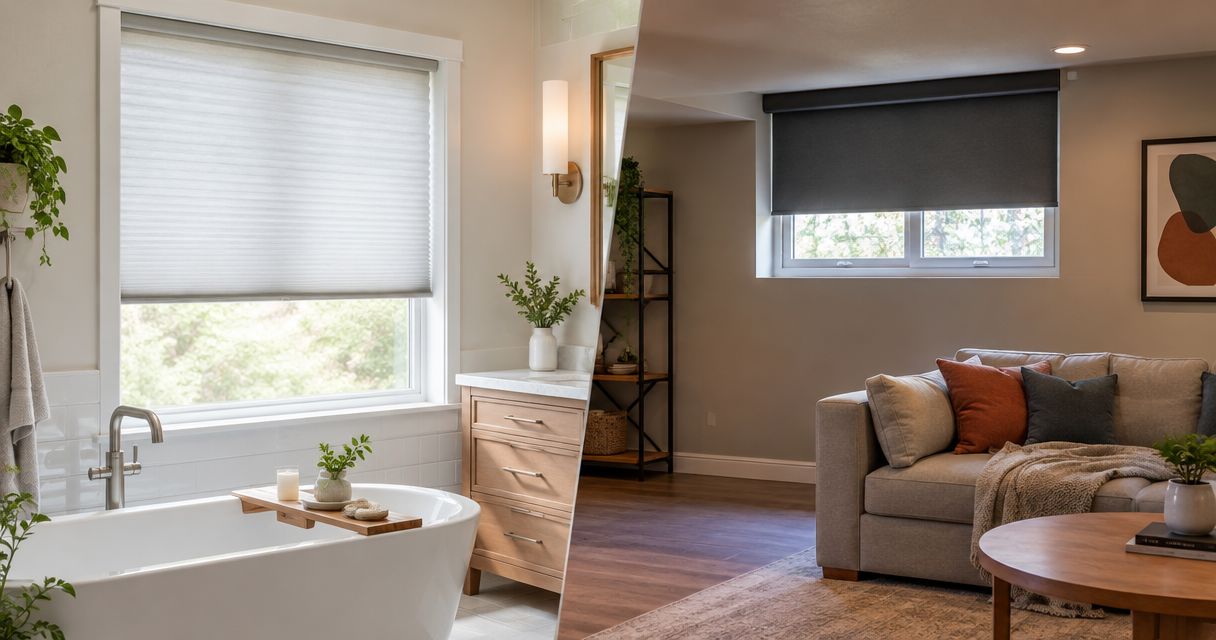
Best overall for damp rooms: moisture-rated PVC (vinyl) blinds; best for bathroom light and privacy control: moisture-rated composite shutters. For 2026, this guide compares the best window treatments for bathrooms and basements, including privacy roller shades, blackout roller shades, and cellular shades for dry finished spaces.
- The best window treatments for bathrooms and basements start with moisture suitability, privacy, and a clear window opening.
- Choose moisture-rated vinyl blinds for damp rooms; check the complete product, not just the slat material.
- Choose blackout roller shades for basement viewing rooms and cellular shades for dry basement offices.
- Olsson Smart Shades provides custom-measured, professionally installed window treatments for Columbus and Central Ohio homeowners.
Why this matters
A bathroom window needs privacy after sunset, not just when daylight makes the glass look reflective. A basement window needs a treatment that suits the room’s moisture conditions without blocking handles or an emergency exit.
Olsson Smart Shades is a fit for Columbus and Central Ohio homeowners who want custom-measured, professionally installed window treatments. Start with the room’s daily problems, then choose the material and operating style.
For a 2026 bathroom or basement project, moisture comes before appearance. The U.S. Environmental Protection Agency’s household mold guidance recommends indoor relative humidity below 60%, ideally between 30% and 50%. A window covering does not fix condensation, a leak, or a damp wall.
You can discuss the room and its windows with Olsson Smart Shades. Treat the options below as buying categories, not a claim that every material or configuration is offered.
What makes the best bathroom and basement window treatments
Use these criteria before comparing colors or decorative details:
- Moisture suitability: Check whether the complete treatment is approved for the room’s humidity and splash exposure. Vinyl slats do not make every bracket, cord, or headrail waterproof.
- Nighttime privacy: Choose an opaque material where you need to block views. Check edges, slat angles, and the view from outside with indoor lights on.
- Cleaning access: Favor surfaces you can reach and clean according to the manufacturer’s instructions. A treatment behind a deep tub is harder to maintain.
- Window access: Keep locks, handles, ventilation, and any required emergency opening usable. Check the treatment in its fully open position.
- Light control: Separate glare reduction from room darkening. A bright bathroom and a basement television room need different results.
- Everyday operation: Choose controls you can reach without leaning over a sink or moving furniture. Ask about cordless or motorized operation where appropriate.
For a 2026 purchase, ask for the care instructions and moisture-use restrictions before approving the order. The material name alone is not enough.
Bathroom and basement window treatments at a glance
| Rank and treatment | Best for | Standout feature | Key limitation |
|---|---|---|---|
| 1. Moisture-rated vinyl blinds | Damp rooms needing simple upkeep | Adjustable slats with wipeable surfaces | Slat and edge gaps need a privacy check |
| 2. Moisture-rated composite shutters | Bathrooms needing adjustable privacy and daylight | Louvers tilt within a framed panel | Panel swing needs clearance |
| 3. Opaque privacy roller shades | Compact powder rooms | A single fabric panel without tilting slats | Fabric and hardware need suitable moisture ratings |
| 4. Blackout roller shades | Basement television and viewing rooms | Opaque fabric blocks light through the material | Light can enter around the edges |
| 5. Cellular shades | Dry, finished basement offices | Cellular construction with light-filtering options | Fabric folds need different care from wipeable slats |
1. Vinyl blinds: best for damp rooms and simple upkeep
Moisture-rated vinyl blinds are the default choice when you want adjustable light and straightforward cleaning. Their slats tilt for privacy and lift to expose the window.
Choose a product explicitly suited to the room’s conditions. A bathroom with occasional steam is different from a window that receives direct shower spray.
Vinyl blinds pros:
- Slats let you adjust daylight without lifting the whole blind.
- Smooth surfaces support routine wiping when the care instructions allow it.
- The blind lifts out of the way for access to the glass.
Vinyl blinds cons:
- Slat openings and perimeter gaps need a nighttime privacy check.
- Individual slats take more cleaning attention than a single flat panel.
Best for: Bathrooms and utility-style basement rooms where moisture suitability and cleaning come first.
Ask how the blind stacks when raised. On a short basement window, the raised stack occupies part of the opening unless the mounting position allows it to sit above the glass.
Verdict: Buy moisture-rated vinyl blinds for the simplest damp-room starting point; skip products without clear moisture-use guidance.
2. Composite shutters: best for adjustable bathroom privacy
Moisture-rated composite shutters use tilting louvers inside framed panels. You can change the louver angle to admit daylight while restricting a direct view into the room.
Composite construction varies. Confirm the specific shutter’s bathroom suitability rather than assuming every product described as composite has the same resistance to moisture.
Composite shutters pros:
- Louvers provide adjustable daylight and sightline control.
- Panels open for access to the window and cleaning.
- Suitable finishes offer a wipeable alternative to fabric.
Composite shutters cons:
- Panels need room to swing past faucets, walls, and nearby objects.
- Frames and louvers remain visible across part of the window opening.
Best for: Bathrooms where you want adjustable privacy without covering the entire window with opaque fabric.
Check the panel movement before approving the layout. A shutter that looks tidy when closed still needs to open without hitting a tap or blocking the window handle.
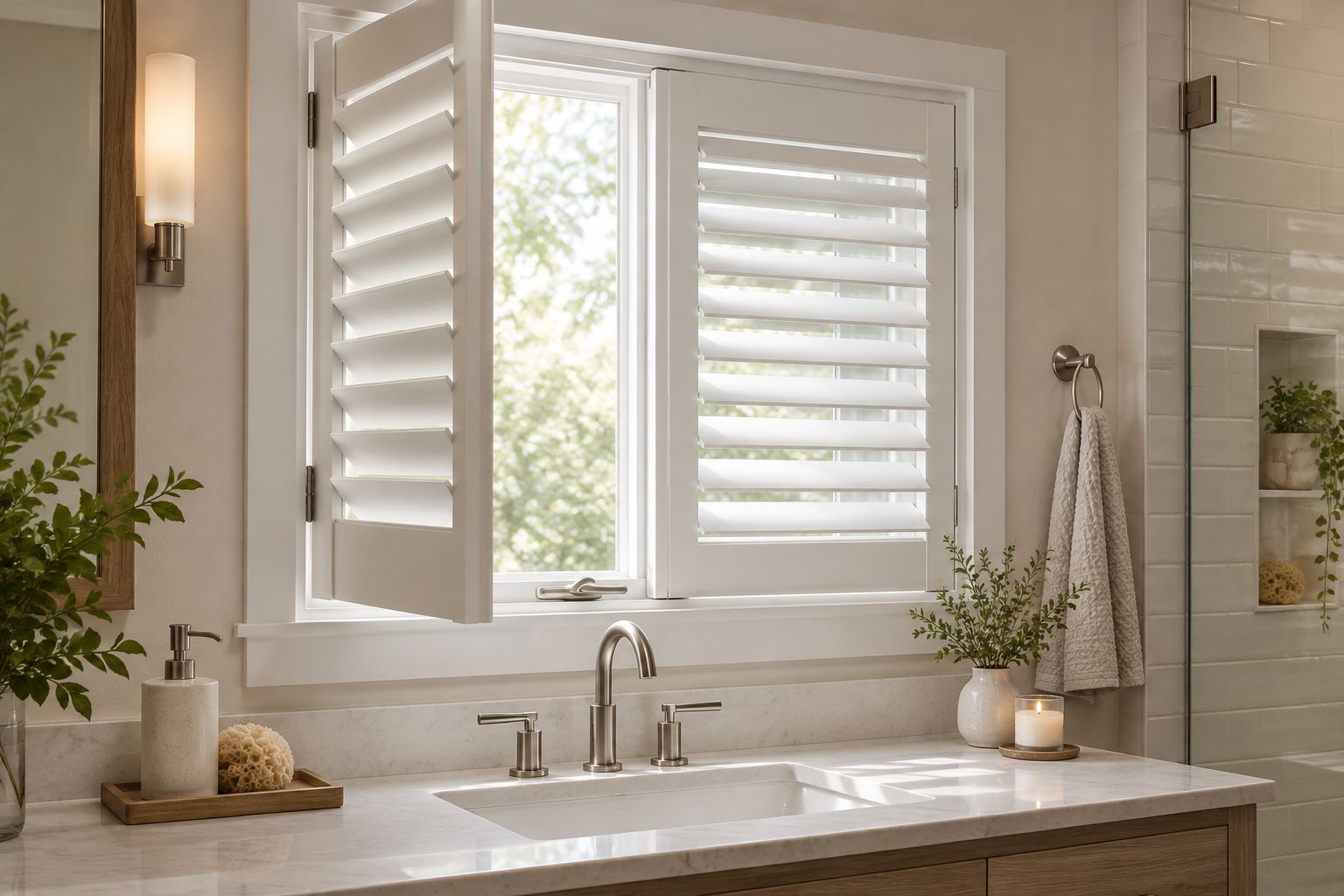
Verdict: Buy moisture-rated composite shutters when adjustable privacy matters and the panels have room to open.
3. Privacy roller shades: best for compact powder rooms
An opaque privacy roller shade lowers a single panel across the glass. It suits a small powder room where you want a simple surface rather than rows of slats.
Specify privacy fabric, not an open-weave solar screen. Solar shades reduce glare, but an open weave does not provide dependable privacy when the room is lit at night.
Privacy roller shades pros:
- A single panel keeps the window treatment visually simple.
- The shade rolls upward when you want the glass exposed.
- Opaque fabric avoids the through-fabric view of an open weave.
Privacy roller shades cons:
- Edge gaps still need checking from outside.
- Fabric cleaning and moisture tolerance depend on the selected material.
Best for: Compact powder rooms without direct water exposure.
Ask to see the fabric held against a light source. Then discuss mounting: an inside mount fits within the opening, while an outside mount can overlap the glass and trim. Neither choice should interfere with the handle.
Verdict: Buy an opaque privacy roller shade for a compact powder room; skip open-weave solar fabric when nighttime privacy is essential.
4. Blackout roller shades: best for basement viewing rooms
Blackout roller shades use opaque material to block light through the fabric. They suit basement television rooms where daylight on the screen is the main problem.
Blackout fabric is not the same as a blackout installation. Light still travels around uncovered edges, so fabric choice and mounting need to be considered together.
Blackout roller shades pros:
- Opaque fabric controls light through the covered area.
- A single panel avoids light paths between individual slats.
- The shade rolls up when you want daylight or window access.
Blackout roller shades cons:
- Perimeter light remains unless the installation addresses it.
- A closed blackout shade also removes useful daylight.
Best for: Basement television and viewing rooms where screen glare matters more than filtered daylight.
Ask where the remaining light will enter. Discuss overlap and any available edge-control options without assuming a standard shade creates complete darkness. Keep required emergency window access clear.
Verdict: Buy blackout roller shades for basement viewing rooms, with a mounting plan that addresses edge light.
5. Cellular shades: best for dry basement offices
Cellular shades fold into a honeycomb-like structure and come in different light-control fabrics. A light-filtering version suits a finished basement office where you want softer daylight rather than a darkened room.
Keep this recommendation to dry spaces. Cellular fabric is not the first choice beside recurring condensation or a window that receives splashes.
Cellular shades pros:
- Light-filtering fabric softens daylight while covering the glass.
- The shade compresses upward to expose the window.
- Cellular construction creates air pockets within the shade.
Cellular shades cons:
- Fabric cells need care that differs from wiping hard slats.
- Moisture restrictions and cleaning methods vary by product.
Best for: Dry, finished basement offices and everyday living spaces.
Check privacy using the actual fabric sample. Light filtering describes how the material handles light; it is not a substitute for checking silhouettes, edge gaps, and nighttime sightlines.
Verdict: Buy cellular shades for a dry basement office; skip them until recurring dampness is resolved.
How this 2026 ranking was decided
This ranking puts moisture suitability first, followed by privacy, cleaning, window access, and light control. Each treatment has a separate job rather than competing for the same room.
Vinyl blinds take the default position for damp-room practicality. Composite shutters serve adjustable bathroom privacy, while privacy rollers suit compact powder rooms. Blackout rollers address basement viewing, and cellular shades belong in dry finished spaces.
The ranking compares treatment types, not tested models. For every category, the final choice depends on the selected product’s instructions and the measured window.
Which treatment should you choose?
Start with moisture-rated vinyl blinds if you are undecided. Change that choice only when another need is more important: shutter-style light adjustment, a simple roller panel, darker viewing conditions, or softer office daylight.
Before requesting a quote, walk through the room and note:
- Where water or condensation reaches the window.
- Who can see through it after dark.
- Which direction the sash and handles move.
- Whether furniture makes the controls difficult to reach.
- Whether the window serves as an emergency exit.
Olsson Smart Shades offers custom-measured window treatments and installation for homeowners in Columbus and Central Ohio. To discuss an in-home consultation, request a quote and describe the room, privacy concern, and moisture conditions. You do not need to settle on a treatment first.
FAQ
What are the best window treatments for bathrooms and basements?
Moisture-rated vinyl blinds are the default starting point for damp rooms. Choose moisture-rated composite shutters for adjustable bathroom privacy, blackout roller shades for basement viewing rooms, and cellular shades only for dry finished spaces.
Are faux-wood or composite shutters suitable for a bathroom?
They are suitable when the specific product is approved for the bathroom’s moisture conditions. Check the complete shutter’s instructions and make sure the panels clear faucets, handles, and nearby walls.
Can I put a window shade inside a shower?
Use a treatment there only if its manufacturer explicitly permits that exposure. A bathroom moisture rating does not automatically cover direct water spray, so discuss the exact window location before ordering.
Do solar shades give bathroom privacy at night?
Open-weave solar shades do not provide dependable nighttime bathroom privacy. Choose an opaque privacy treatment and check its edge gaps with the indoor lights on.
Will blackout shades make my basement completely dark?
Blackout fabric blocks light through the material, but a standard shade can still admit light around its edges. Discuss mounting overlap and available edge-control options when room darkening is the goal.
Are motorized shades useful for hard-to-reach basement windows?
Motorized operation lets you move a shade without reaching its controls at the window. Confirm power, control options, moisture suitability, and access for maintenance before selecting a system.
Can window treatments stop basement condensation?
Window treatments do not fix the cause of condensation. Address excess humidity, leaks, and ventilation problems before choosing a covering for a repeatedly wet window.
One last thing
Before approving your 2026 order, test the privacy plan after dark. Turn on the bathroom or basement lights and have someone check the window from a normal outside viewing position. A daytime sample cannot show every nighttime sightline.
Bring that observation to your conversation with Olsson Smart Shades. The useful question is not just which treatment looks right. It is whether you can use the room comfortably, clean the covering, and still open the window.