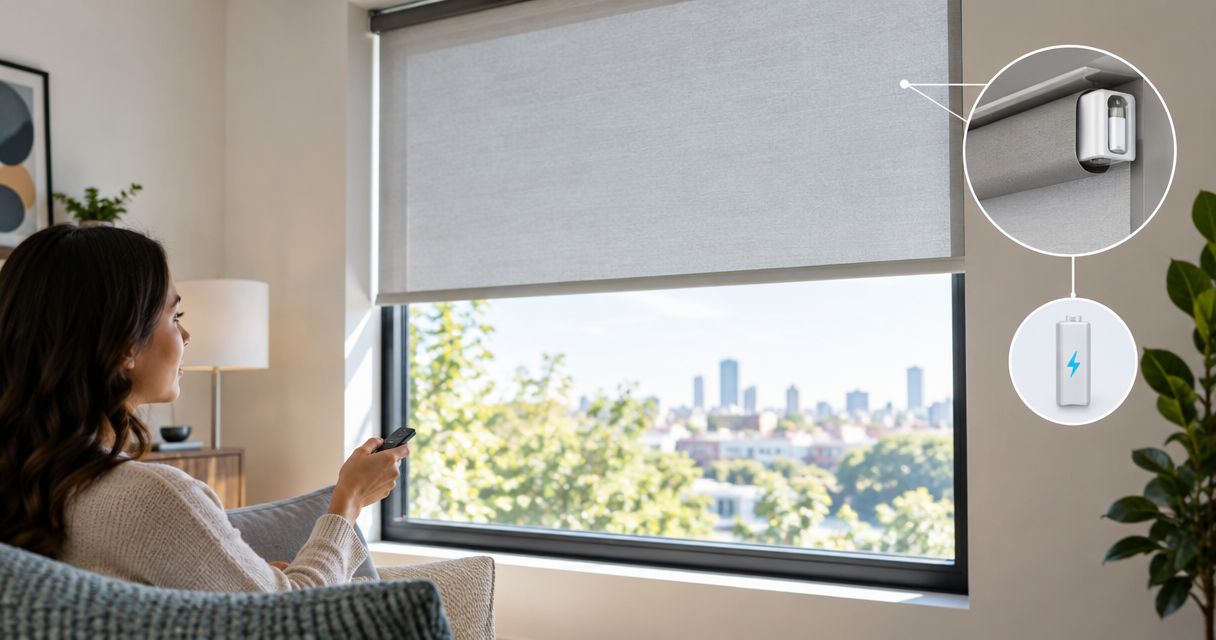
Motorized shades get power without an outlet beside the window through rechargeable batteries, replaceable batteries, or a compatible solar charging accessory. Batteries still need charging or replacement, and solar charging depends on the specific shade system and the light reaching its panel.
- Motorized shades power without outlet: batteries supply the motor; wireless controls do not supply electricity.
- Rechargeable shades suit existing rooms when you can comfortably reach the charging connection.
- Solar charging requires a compatible motor, battery, and panel—not just a sunny window.
- Olsson Smart Shades serves Columbus and Central Ohio homeowners seeking custom-measured, professionally installed motorized shades.
How do motorized shades get power near windows without outlets?
The motor needs electricity, but that electricity does not have to come from an outlet beside the window. A battery can store the energy needed to raise and lower the shade. A compatible solar panel can replenish a rechargeable battery, while a hardwired system brings power through installed wiring.
For a 2026 project, separate the power decision from the control decision. A remote, wall control, or smart-home connection tells the shade what to do. The battery or wiring supplies the energy to do it.
Olsson Smart Shades provides custom-measured, professionally installed motorized shades for homeowners in Columbus and Central Ohio. Use an in-home consultation request to discuss power access alongside fit, fabric, and installation—not after those decisions are settled.
| Power arrangement | Best for | Main advantage | Main limitation |
|---|---|---|---|
| Rechargeable battery | Existing rooms with accessible charging connections | No permanent power cable running to the window | You need a workable charging routine |
| Replaceable batteries | Accessible windows where you prefer changing batteries to charging | No charging cable needed during routine operation | You must reach and replace the batteries |
| Compatible solar charging | Windows with suitable light and panel placement | Can reduce manual charging | Compatibility and actual light exposure govern suitability |
| Hardwired power | Construction or renovation with an accessible wiring route | No battery charging or replacement | Wiring must reach the shade through an appropriate installation |
These are power arrangements, not interchangeable accessories. Confirm the supported arrangement for the exact motor before ordering anything.
Why this matters
A window can be easy to measure and difficult to maintain. Tall furniture, a deep window recess, or a high ceiling can turn a simple charging task into an awkward reach.
Choose the power arrangement you can maintain, not just the one that hides the most hardware. A neat installation should leave you able to charge, change, or service the power source without dismantling the room.
For an existing home in 2026, start with access. For an unfinished room, start with the wiring opportunity. Neither approach requires choosing a smart-home platform first.
Rechargeable batteries: best for accessible existing windows
Rechargeable motorized shades store power in a battery built into the shade assembly or connected to it, depending on the system. During normal operation, the shade does not need a charging cable attached.
The practical question is where charging happens. Some designs charge at an accessible connection; others use a removable battery. Those details belong in the product discussion before you approve the order.
Ask the installer to show you the charging arrangement, rather than simply describe the shade as rechargeable. You need to know what you will reach, what you will connect, and whether anything must come down.
- Best for: Finished rooms where you want to avoid new permanent wiring.
- Advantage: The motor operates from stored power without a nearby outlet.
- Trade-off: Charging remains a household task, and the connection must stay accessible.
Do not assume that a familiar-looking connector accepts any charger. Follow the shade manufacturer's charging instructions and use the specified equipment.
Replaceable batteries: best for easy-to-reach windows
Some motorized shade systems use replaceable batteries in an accessible holder or battery assembly. You replace the batteries when needed instead of connecting a charger.
This arrangement suits a homeowner who prefers a battery change to a charging session. It becomes less convenient when reaching the holder requires moving heavy furniture or working above a stairwell.
Confirm the required battery type and how the compartment opens. Also ask whether the battery holder remains reachable after the shade, trim, and any drapes are installed.
- Best for: Windows with comfortable access to the battery compartment.
- Advantage: Routine operation does not depend on an outlet or charging cable.
- Trade-off: Replacement batteries and physical access remain necessary.
Do not choose this arrangement on a promised replacement interval alone. The useful question is whether you can handle the actual maintenance when the time comes.
Solar charging: best for compatible systems with suitable light
A solar charging accessory converts light into electrical energy for a compatible rechargeable shade system. The battery stores energy so the shade does not depend on sunlight at the instant you press the control.
A solar shade fabric is not a solar power source. The fabric manages incoming light; a charging panel is separate hardware that supplies electrical energy.
Panel placement matters. Window framing, nearby obstructions, curtains, and the panel's position affect the light reaching it. A bright-looking room does not establish that a particular panel location will work.
- Best for: A supported shade system with a suitable place for its charging panel.
- Advantage: Solar charging can reduce the need to connect a charger manually.
- Trade-off: The panel needs appropriate light, and its placement affects the finished appearance.
For a 2026 installation, request confirmation of the exact motor, battery, and panel combination. Do not treat a solar accessory as universal or as a guarantee that charging attention disappears.
Hardwired power: best for planned construction or renovation
Hardwired shades receive power through installed wiring rather than relying on routine battery maintenance. Depending on the system, the power supply can sit away from the window, with suitable wiring carrying power to the motor.
That distinction answers a common concern: no visible outlet beside the window does not necessarily rule out wired power. What matters is whether an appropriate cable route and power supply can be installed.
The advantage is freedom from battery charging or replacement. The limitation is installation work, especially when walls and ceilings are already finished.
Do not assume a shade motor connects directly to household mains electricity. Follow the system's electrical requirements and have electrical work handled by a qualified professional.
How do you choose the right power setup?
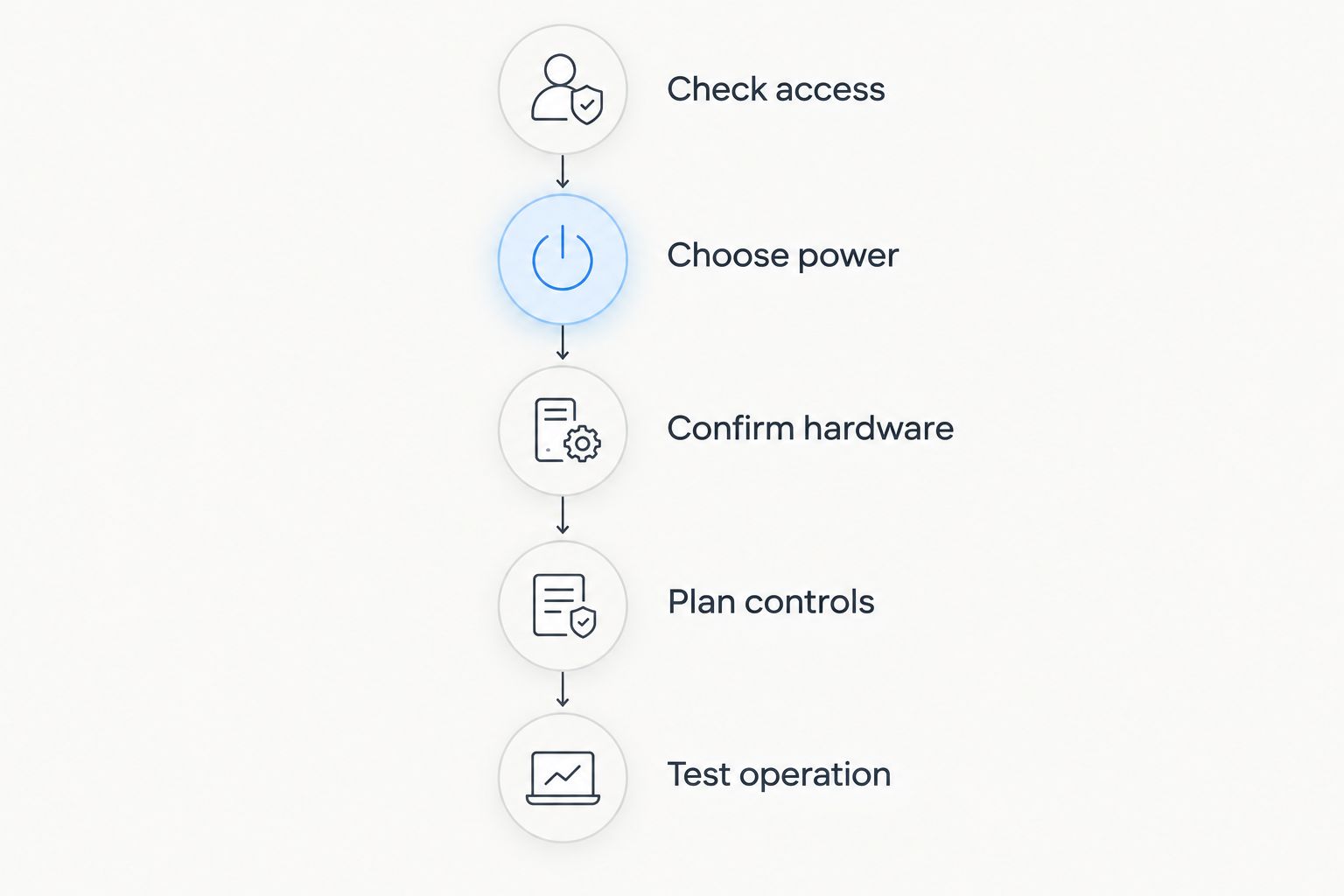
Use this sequence before ordering. It keeps an attractive shade choice from becoming a difficult maintenance job.
- Check access. Stand where you would charge or service the shade. Account for furniture, counters, and the full height of the window.
- Choose power. Compare supported battery, solar-assisted, and wired arrangements for that window.
- Confirm hardware. Identify the battery location, charging connection, charger, panel, or wiring route that the proposed system requires.
- Plan controls. Confirm how you will operate the shade and whether your preferred smart-home connection needs additional equipment.
- Test operation. At handover, have the installer demonstrate both shade movement and the maintenance procedure.
Record 1 power plan per window, even when several windows share the same room. Matching fabric does not mean every opening has the same access or wiring conditions.
Why the right power choice varies by window
The most useful comparison is not battery versus wiring in the abstract. It is the same power choice applied to the actual opening.
- Reach: A charging connection above a stairwell presents a different task from one beside an accessible bedroom window.
- Window depth: The recess and mounting position affect where the motor and battery hardware can sit.
- Shade size and load: The proposed motor and power arrangement must support the specified shade.
- Daily operation: How often you move the shade affects energy use; ask about your intended routine.
- Light exposure: Solar charging depends on the light reaching the panel in its installed position.
- Construction access: Open walls create wiring opportunities that finished surfaces do not.
For your 2026 room plan, mark 2 access points: the normal control location and the maintenance location. A remote can make operation easy without making the battery easy to reach.
Should you add an outlet while renovating?
Consider permanent power while the room is already being worked on, particularly where future battery access would be awkward. First confirm what the selected shade system requires: a nearby receptacle, a separate power supply, or a specified wiring arrangement.
Planning where to add electrical outlets should account for future furniture and charging access as well as current appliances. For shades, that means locating power where the selected system can use it without leaving a cable stretched across the window or walking route.
Keep 3 questions on the renovation plan: Where does power originate? How does it reach the motor? How will you access the equipment later? Have the shade installer and electrician settle those details before walls close.
An extra outlet is not automatically the answer. A compatible battery arrangement can be simpler in a finished room, while planned wiring can remove an awkward maintenance task at a high window.
Does wireless control mean the shade needs no power?
Wireless describes the control connection, not the energy source. A battery-powered shade still needs stored electricity, and a hardwired shade can still respond to a wireless remote.
Smart-home control adds another decision. Confirm the exact motor and any required bridge or controller before assuming that a shade will work with your existing system. Power compatibility and control compatibility are separate checks.
When comparing options in 2026, ask for a plain-language explanation of both. You should be able to say where the motor gets electricity and how your command reaches it.
What should you ask during an in-home consultation?
Tell Olsson Smart Shades which windows concern you and why. Useful details include an absent outlet, a high window, furniture blocking access, or a preference for charging rather than replacing batteries.
For a quote request, ask for the proposed power arrangement to be identified for each opening. Also ask what equipment is included and what preparation, if any, the installation requires. This keeps the discussion practical without committing you to a particular setup before it has been assessed.
Before approving the plan, ask the installer to explain the maintenance task in ordinary language. If the answer depends on a ladder, a removable battery, or a charging lead, you should know that before installation day.
Plan power for your windows
Discuss window access, battery maintenance, and installation with Olsson Smart Shades.
FAQ
Can motorized shades work without an outlet near the window?
Motorized shades can work without a nearby outlet when a supported battery arrangement powers the motor. Rechargeable and replaceable-battery designs still require maintenance access.
Do rechargeable shades have to stay plugged in?
Rechargeable shades operate from stored battery power and do not need a charging cable attached during normal use. Follow the specific system's instructions for charging.
Can a solar panel power any motorized shade?
A solar charging panel must be compatible with the shade's motor and battery system. Its installed position must also receive suitable light.
Will battery-powered shades work when the household power goes out?
A charged battery can supply the shade motor during a household power outage. Controls that depend on powered network equipment can be unavailable, so confirm the supported local controls.
Are battery-powered shades the best choice for high windows?
Battery-powered shades are not automatically the best choice for high windows because charging or replacement still requires access. Compare an accessible maintenance arrangement with suitable solar charging or planned wiring.
Does Olsson Smart Shades install motorized shades in Central Ohio?
Olsson Smart Shades provides custom-measured, professionally installed motorized shades for homeowners in Columbus and Central Ohio. Ask about the power arrangement for your specific windows when requesting a consultation.
One last thing
Ask to see the charging or battery-change procedure before installation is complete. Operate the shade, then have the installer show you exactly how you will maintain its power source.
That small demonstration answers the question a showroom view cannot: whether this setup will be comfortable to live with in your home.