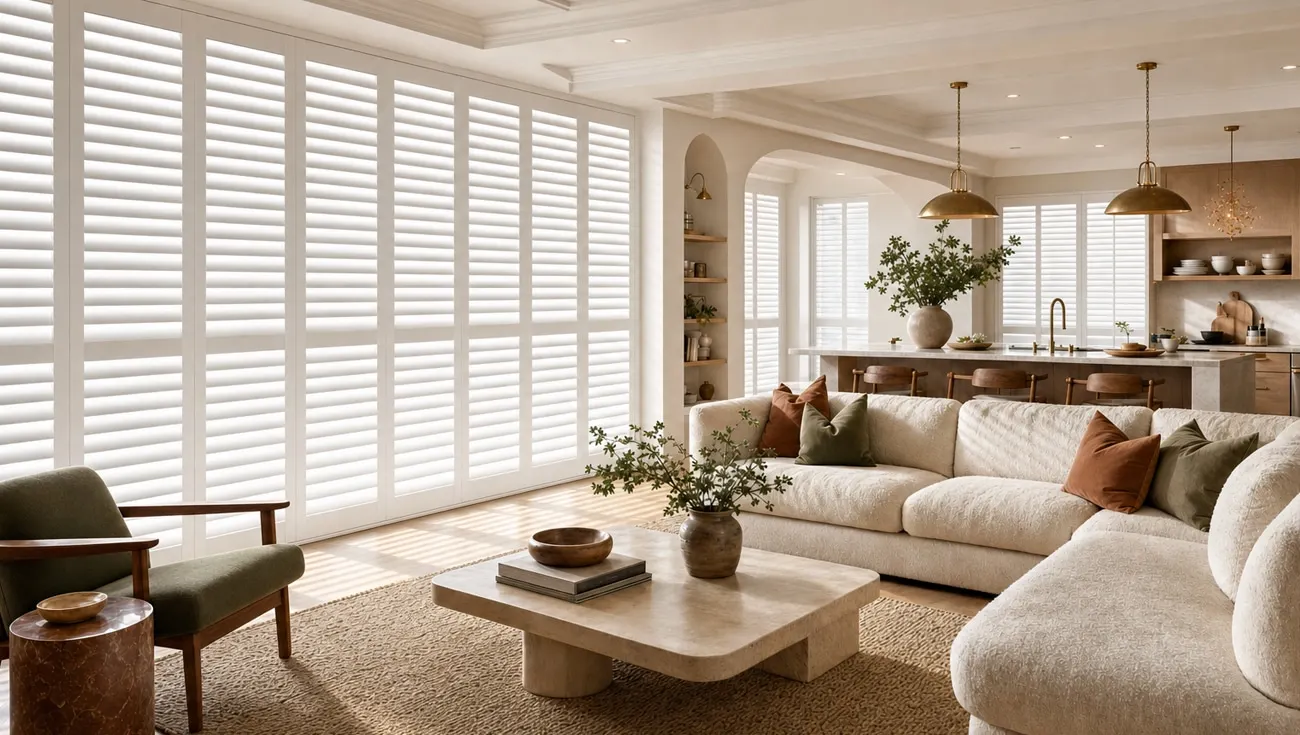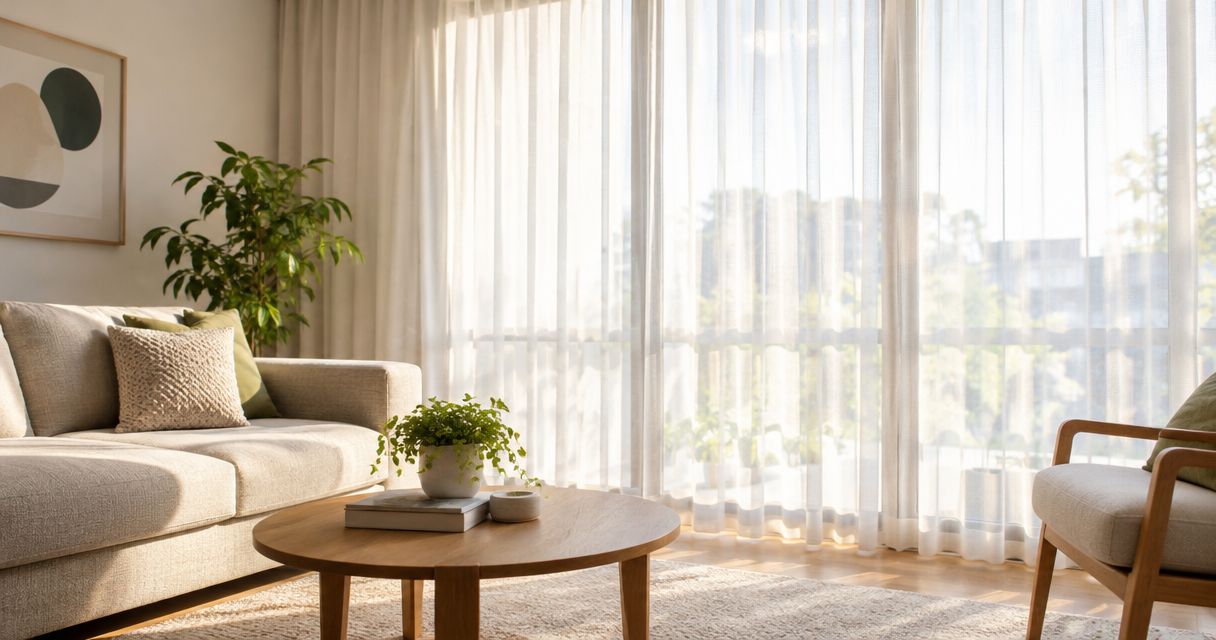
Sheer shades let natural light pass through while softening the view and direct sunlight; they do not create blackout conditions. There is no single light-transmission percentage for all sheer shades, and daytime brightness does not guarantee privacy after dark.
- How much light do sheer shades let in? Filtered daylight, with brightness depending on fabric, construction, and position.
- Sheer shades suit rooms where daylight matters more than darkness; they are not a substitute for blackout window treatments.
- Check sheer fabrics from outside after dark before relying on them for privacy.
- Olsson Smart Shades serves Columbus and Central Ohio homeowners seeking custom-measured, professionally installed window treatments.
Why this matters
A room can feel pleasantly bright and still have an uncomfortable patch of sun across the sofa. A window can look private from inside and reveal silhouettes from the sidewalk at night. Brightness, glare, and privacy are separate decisions.
Choose sheer shades for softened daylight, not guaranteed darkness or nighttime privacy. That distinction matters more than a fabric name when you compare window treatments in 2026.
For local help, Olsson Smart Shades is a fit for Columbus and Central Ohio homeowners who want custom-measured window treatments with professional installation. Start with the room's needs rather than choosing the same fabric for every window.
How much natural light do sheer shades let in?
Sheer shades admit daylight through translucent or open-weave material. The amount reaching your room depends on the exact fabric, the shade's construction, its operating position, and the light outside. A sheer panel and a shade with adjustable fabric vanes do not control light in the same way.
You cannot assign a dependable percentage to the word sheer. Ask for the selected fabric's visible light transmission information when available. That describes light passing through the material under test conditions, not a promise about how bright your entire room will feel.
Use this comparison to separate the main choices. These are general construction differences, not specifications for a particular product.
| Window treatment or setting | What happens to daylight | Best for | Main limitation |
|---|---|---|---|
| Fixed sheer fabric, lowered | Light passes through the fabric and is filtered | Keeping a room connected to daylight | Limited control over changing sun and nighttime visibility |
| Adjustable sheer shade, vanes open | Light passes through the sheer sections | Varying the view and incoming daylight | Performance depends on the particular construction |
| Adjustable sheer shade, vanes closed | Overlapping vanes reduce incoming light | More light control without raising the shade | Closed vanes do not automatically mean blackout |
| Sheer treatment with a separate opaque layer | The sheer filters light; the outer layer adds coverage when closed | Rooms needing different daytime and nighttime settings | More hardware, fabric, and clearance to plan |
Compare the actual material at your window, not just a photograph of a bright room. Photography, exposure settings, and the direction of the sun all affect how sheer fabric appears online.
Fixed sheer fabric: steady daylight filtering
A fixed sheer fabric filters light whenever it covers the window. You can raise or draw the treatment to expose the glass, but the fabric itself does not change from transparent to opaque.
This is a useful starting point for a living room where you want daylight throughout the day. The trade-off is straightforward: if the lowered fabric still leaves too much brightness on a screen, keeping it in the same position will not solve the problem.
Best for: rooms where preserving daylight is the main goal. Before choosing, look through the sample toward the outdoors and then examine how it changes the light falling onto a nearby surface. Those are different tests.
For a 2026 room update, decide whether you want a softened view, reduced glare, or both. A fabric that makes the window look gentler does not necessarily make a television comfortable to watch.
Adjustable sheer shades: more control through vane position
Some sheer shades combine sheer fabric with adjustable vanes. Opening the vanes admits light through the sheer portions; closing them increases coverage. Check the actual operation, because products described as sheer shades do not all share this construction.
The benefit is choice without fully uncovering the window. The limitation is that the closed setting still needs its own privacy and darkness assessment.
Best for: rooms where your preferred light level changes during the day. Ask to see the shade fully lowered with its vanes open and closed. Then ask how much glass remains exposed when the shade is raised.
Watch the light on the floor and furniture rather than looking only at the fabric. That makes the difference between settings easier to judge. Also check whether the view you value remains clear enough in the position you expect to use most.
Sheers with an opaque layer: separate daylight from darkness
A sheer treatment and a separate opaque covering let you handle daytime light and nighttime coverage independently. You use the sheer when you want filtered daylight and close the additional layer when you need more screening.
The benefit is flexibility. The compromise is a more involved installation: both layers need room to operate, and the outer covering must reach far enough to cover the intended opening.
Best for: bedrooms and other rooms that need both daylight and stronger coverage. For sleep, specify the required darkness rather than assuming any opaque fabric delivers a blackout result. Gaps around the edges also admit light.
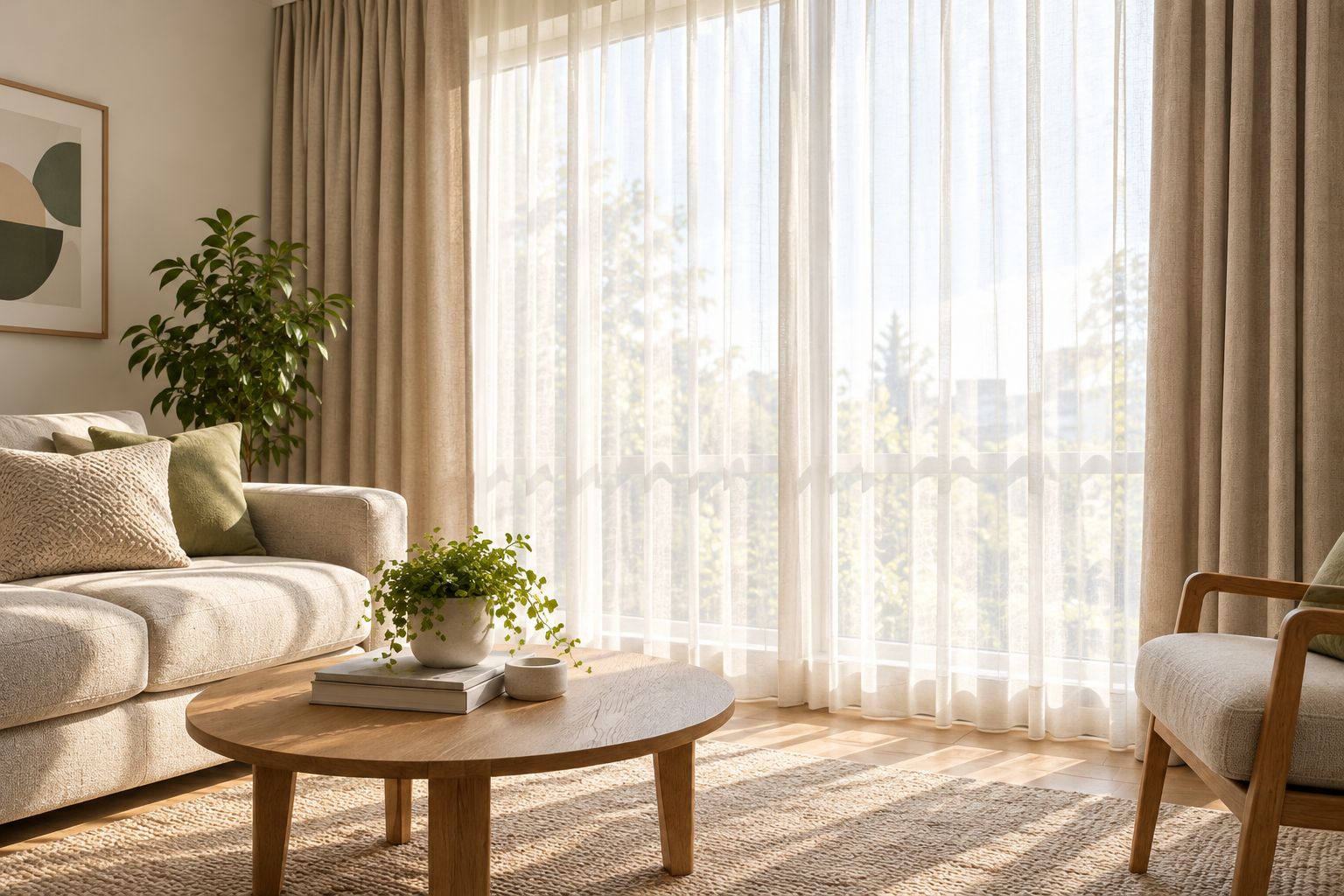
For a layered installation planned in 2026, discuss the complete arrangement before measurements are finalized. A shade that fits neatly on its own can leave insufficient space for another treatment in the same opening.
Why the amount of light varies
The label on a sample tells only part of the story. These factors explain why the same material can feel different from one window to another.
- Fabric construction. Yarn spacing, material, and fabric density affect how light passes through. Compare the exact fabric rather than assuming all sheers behave alike.
- Shade position. Raised, lowered, open-vane, and closed-vane settings expose or cover different parts of the window. Test the setting you will actually use.
- Sun direction and timing. Direct sunlight creates different conditions from indirect daylight. A sample checked away from the troublesome sun does not answer your glare question.
- Window and surroundings. Glass, exterior shade, nearby buildings, and trees affect the light that reaches the treatment before it enters your room.
- The room itself. Wall finishes, furnishings, room depth, and the distance from the window change how bright the space feels. Judge the room, not just the illuminated fabric.
- Additional layers and edge coverage. A separate covering changes the result when closed. Light around the sides remains a separate issue from light passing through the material.
Avoid choosing solely by fabric color. Color affects appearance, but it does not replace information about construction or an at-window comparison.
How can I check sheer shades before choosing?
Bring the decision back to the window where the treatment will be installed. For a 2026 purchase, a useful sample check follows the same practical sequence regardless of the collection name.
- Name the problem. Decide whether you are addressing harsh sun, screen glare, an exposed view, or a room that feels dim. Put the main concern first.
- Check the actual window. Hold the material against the glass or review a demonstration that shows its operating positions. A sample lying on a table cannot show the view through it.
- Use the difficult light. Compare materials when the window normally causes discomfort. Look at the seat, desk, or screen that needs improvement.
- Check privacy separately. With permission and safe access, have someone assess the view from outside while indoor lights are on. Do not rely on your view looking outward.
- Confirm the complete installation. Discuss mounting, handles, trim, additional layers, and access for operation. Then request a quote for the arrangement you have actually chosen.
Write down what worked and what did not. A short note such as comfortable at the desk, too exposed after dark is more useful than remembering that a sample looked attractive.
You can request a quote and ask how to arrange an in-home consultation. Describe the room, your main light concern, and whether you need an additional privacy or blackout layer. You do not need to choose a fabric before asking for help.
Plan your window treatment
Discuss your room's daylight, privacy, and installation needs.
Will sheer shades make my room too dark?
Sheer shades filter daylight rather than aiming to eliminate it, but whether the room feels too dark depends on the window and material. A room with little direct daylight deserves a different sample check from a bright room with afternoon sun.
Best for a dim room: compare materials that preserve the daylight you already have. Stand farther back in the room while someone holds the sample at the window. If only the window looks bright while the seating area feels dull, keep comparing.
Also consider how the treatment looks when raised or drawn aside. Preserving daylight sometimes means leaving more glass uncovered, rather than finding a fabric that solves every condition while fully closed.
Can people see through sheer shades at night?
Sheer shades are not a dependable promise of nighttime privacy. When the interior is brighter than the outdoors, sheer materials can reveal movement, silhouettes, or interior details, depending on the fabric and lighting.
Best for rooms needing reliable privacy: evaluate a more opaque setting or a separate covering. A daytime demonstration does not establish nighttime performance. Test from the relevant viewing angle rather than assuming the view from directly in front represents every sightline.
Bathrooms and bedrooms deserve particular attention. Decide what must be concealed, then evaluate the complete treatment against that need.
Do sheer shades reduce glare on a television or desk?
Sheer shades can soften incoming sunlight, but filtering light does not guarantee enough glare reduction for a screen. Direct sun, the screen's position, and the chosen material all affect the result.
Best for a screen-facing window: test comfort from your usual seat. Turn on the television or monitor and compare the fabric during the problem period. A window that looks pleasantly softened can still produce a distracting reflection.
Do not select solely from how the room looks with the screen off. If the sheer does not control the glare you need to remove, compare a different construction or an additional layer.
FAQ
How much light do sheer shades let in?
Sheer shades let filtered daylight through, but there is no single transmission percentage for the category. The exact fabric, construction, operating position, and window conditions determine the result.
Are sheer shades good for a living room?
Sheer shades suit living rooms where softened daylight matters more than darkness. Check glare from your usual seat and assess nighttime privacy separately.
Can sheer shades give me blackout conditions?
Sheer fabric alone does not provide blackout conditions. For a dark bedroom, evaluate a separate blackout covering and its coverage around the window edges.
Can my neighbors see through sheer shades?
Sheer shades can allow views into a lit room after dark. Assess the actual material from outside before relying on it for privacy.
Are sheer shades the same as solar shades?
Sheer shades and solar shades are not interchangeable labels. Solar shade fabrics are commonly specified by openness, while sheer constructions vary; compare the selected materials' stated light and privacy properties.
Does motorizing a sheer shade change how much light the fabric lets through?
Motorization changes how you operate the shade, not the light transmission of the fabric itself. The resulting light level changes when operation raises, lowers, or adjusts the covering.
Can I arrange help choosing sheer shades in Central Ohio?
Olsson Smart Shades provides custom-measured window treatments for homeowners in Columbus and Central Ohio. Ask about an in-home consultation and describe your daylight, glare, and privacy needs before selecting a fabric.
One last thing
Test the view into your home, not just the view out. Looking through a sheer from a bright room does not tell you what someone outside sees after dark. That simple reversal catches a privacy problem that a daytime fabric comparison misses.
For your 2026 decision, keep daylight and privacy as separate checklist items. A sheer can do its job beautifully during the day and still need another layer at night. Choosing that combination deliberately is better than discovering the gap after installation.