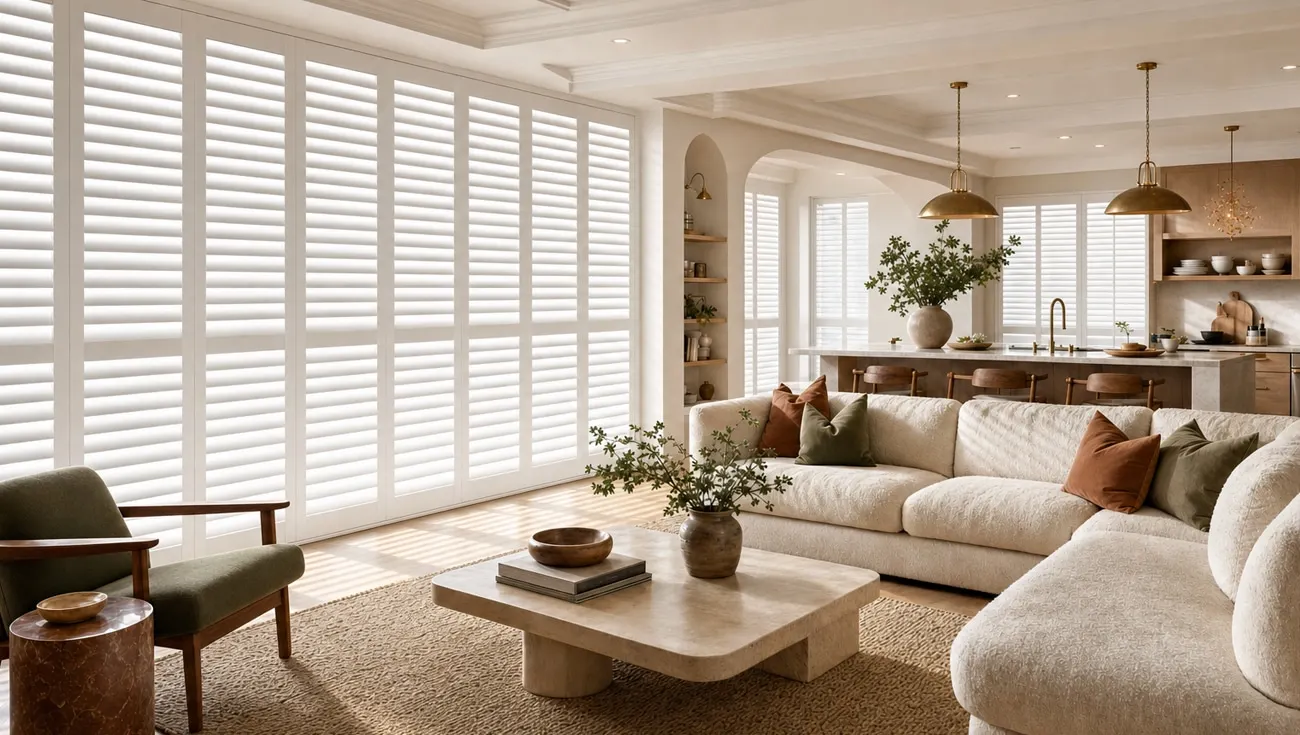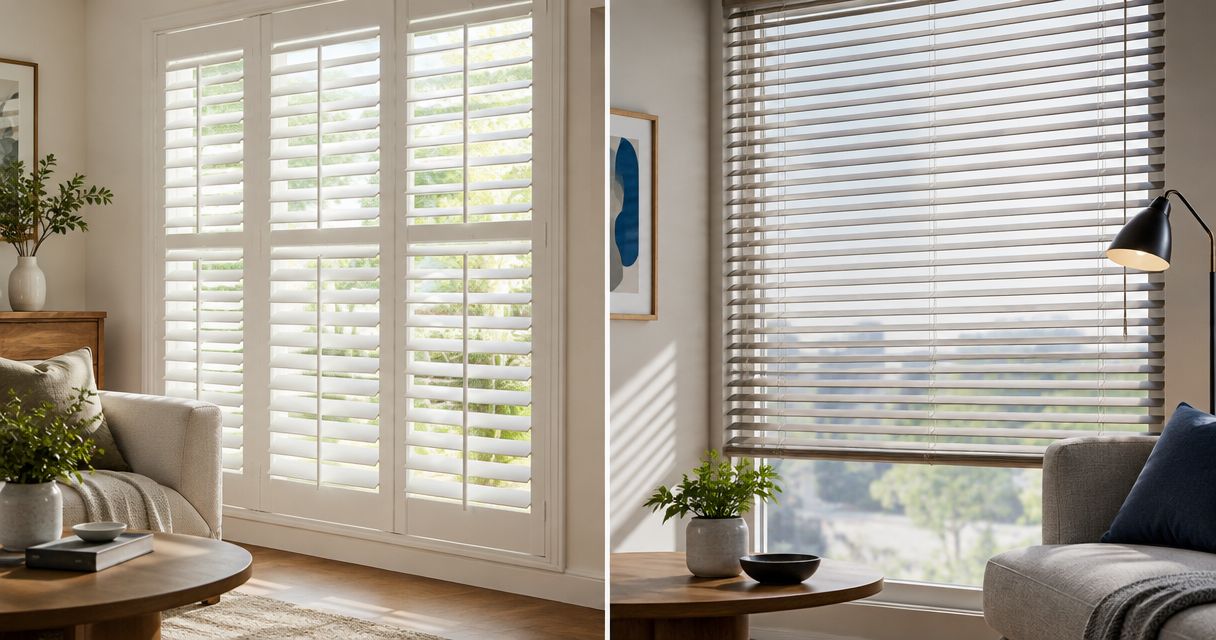
Choose plantation shutters for a framed, built-in look and adjustable louvers; choose blinds when you want slat control and the ability to raise the covering clear of much of the glass. For a 2026 shutters vs blinds decision, compare fitted quotes for the same windows, then check privacy, daylight, opening clearance and everyday operation before choosing.
- Shutters vs blinds: plantation shutters suit a built-in look; blinds suit homeowners who want a covering that raises.
- Compare window treatments by fitted scope, not material alone: measurement, mounting and installation all matter.
- Olsson Smart Shades provides custom-measured plantation shutters and blinds for homeowners in Columbus and Central Ohio.
- Neither slatted option guarantees blackout; test light gaps and privacy before deciding.
Shutters vs blinds: which wins on cost and light control in 2026?
Plantation shutters win for an architectural finish. Blinds win when raising the covering matters more than keeping a fixed frame around the window. Both let you tilt horizontal slats or louvers to redirect daylight, but they behave differently when you want the window fully exposed.
This comparison focuses on interior plantation shutters and horizontal slatted blinds. Fabric shades are a different category, even though people sometimes use the names interchangeably.
| Decision | Plantation shutters | Horizontal blinds |
|---|---|---|
| Best for | A framed, built-in appearance | Adjustable slats with lift-up operation |
| Daylight adjustment | Tilt louvers within a panel | Tilt slats or raise the blind |
| Clearing the glass | Open hinged panels where the design allows | Raise the blind; a stack remains near the top |
| Main clearance concern | Panel swing and access around furniture | Stack height, handles and mounting space |
| Privacy limitation | Open louvers can preserve sightlines | Open slats can preserve sightlines |
| Darkness limitation | Light can enter around louvers and frames | Light can enter around edges and between components |
| Quote check | Frame, panel layout, finish and fitting | Material, operating system, mounting and fitting |
Olsson Smart Shades is best for Columbus and Central Ohio homeowners seeking custom-measured, professionally installed window treatments. You can explore Olsson Smart Shades before narrowing the choice to the rooms that need attention.
Why this matters
A window treatment can look right in a photograph and still interfere with how you use the room. A shutter panel needs somewhere to open. A raised blind leaves a stack that can cover part of the glass.
Choose around your routine, not just the sample finish. If you open a window every morning, sit beside it while working, or need privacy after dark, those habits belong in the decision before you approve the order.
Plantation shutters: best for a built-in finish
Plantation shutters place adjustable louvers inside framed panels. That structure creates a defined border around the window, which suits homeowners who want the treatment to feel like part of the room's trim.
You can tilt the louvers without opening the panels. To expose more of the window, you open the panels, subject to the selected design and surrounding clearance. Those are different movements, and both deserve a demonstration.
The main benefit is controlled light within a structured frame. The main trade-off is the space that frame and opening panels require. A bedside table, faucet or deep window handle can change the workable layout.
For your 2026 selection, ask to see the proposed frame and panel arrangement against your actual window. A small finish sample cannot show how much glass the frame covers or where the panel travels.
Shutters deserve a closer look when:
- You prefer a permanent-looking window surround.
- You mainly adjust daylight by tilting louvers.
- You have room to open the proposed panels.
- You are comfortable cleaning individual louvers and frame edges.
Do not choose shutters solely because they look substantial. If the panels cannot open comfortably around your furniture, that visual benefit comes with a daily compromise.
Horizontal blinds: best for lift-up flexibility
Horizontal blinds give you two distinct adjustments: tilt the slats or raise the blind. That makes them a practical choice when you want filtered daylight at one time and a more exposed window at another.
Their raised position is not invisible. The slats gather into a stack, and the headrail remains in place. Ask where that stack will sit relative to the glass and whether the proposed mounting position preserves the view you want.
The main benefit is lift-up flexibility. The main trade-off is managing the stack and the chosen operating system. A control that feels comfortable on a small sample needs to work on your actual window size and mounting height.
Blinds deserve a closer look when:
- You regularly raise the covering rather than only tilting it.
- You want to avoid hinged panels projecting into the room.
- You prefer a less framed appearance around the window.
- You can comfortably reach and operate the proposed controls.
Ask the installer to explain how you will tilt, lift and lower the selected blind. Do not assume every blind uses the same control or requires the same effort.
How should you compare shutters and blinds quotes in 2026?
Compare complete fitted scopes, not isolated product descriptions. A quote only helps when you know which windows, materials, controls and installation tasks it includes.
Ask for 2 written quotes covering the same openings: one for plantation shutters and one for blinds. This is a comparison method, not a requirement to treat the entire home alike.
Use the same room list for both quotes. Then check these details:
- Window schedule. Match each quoted treatment to a specific opening so nothing disappears inside a whole-home total.
- Product specification. Record the proposed material, finish, frame or mounting arrangement, and operating method.
- Installation scope. Ask whether measurement, fitting, removal of existing treatments and disposal are included.
- Exceptions. Identify unusual shapes, difficult access or trim issues separately.
- Final appearance. Confirm where the treatment sits and what remains visible when it is open.
Do not assume matching color names mean matching materials or construction. Ask to see the actual samples and have the differences explained in plain language.
Why the fitted scope varies
The details below change what must be specified, measured or installed. They are the right questions to resolve before comparing the final proposals.
- Window dimensions: each treatment must fit the opening and mounting arrangement.
- Window shape: arches, angles and grouped windows need a suitable layout.
- Material and finish: the selected construction and surface finish define what you are ordering.
- Frame and mounting: shutters need a frame arrangement; blinds need a suitable mounting position.
- Operation and access: controls, handles and panel movement must work together.
- Existing conditions: trim, old brackets and nearby obstacles affect installation planning.
Which gives you better daylight and nighttime privacy?
Neither category wins every light-control task. Tilting slats or louvers changes the direction of light, while raising blinds or opening shutter panels changes how much of the window is exposed.
Check 3 operating positions during the consultation: fully closed, tilted for daylight and fully open. Describe what you need in each position. A treatment that handles afternoon glare well still needs to provide the privacy you want after dark.
Can people see through tilted slats or louvers?
Tilted openings can leave sightlines through the window. The result depends on the viewing angle, louver or slat position, and lighting on either side of the glass.
For privacy, explain where someone outside would stand and where you sit inside. Ask how the proposed treatment blocks that line of sight without assuming that daylight privacy and nighttime privacy are identical.
Are shutters or blinds better for a dark bedroom?
Neither shutters nor ordinary slatted blinds should be treated as a guaranteed blackout solution. Light can enter around edges and through gaps in the assembly.
If darkness is the priority for your 2026 bedroom project, make it a separate specification. Ask for an explanation of expected light gaps and whether a different covering or layered arrangement better matches your needs.
Will shutters or blinds work around your furniture?
Check the moving parts before choosing the finish. Start with the window you use most, then walk through opening the treatment, reaching the handle and opening the window itself.
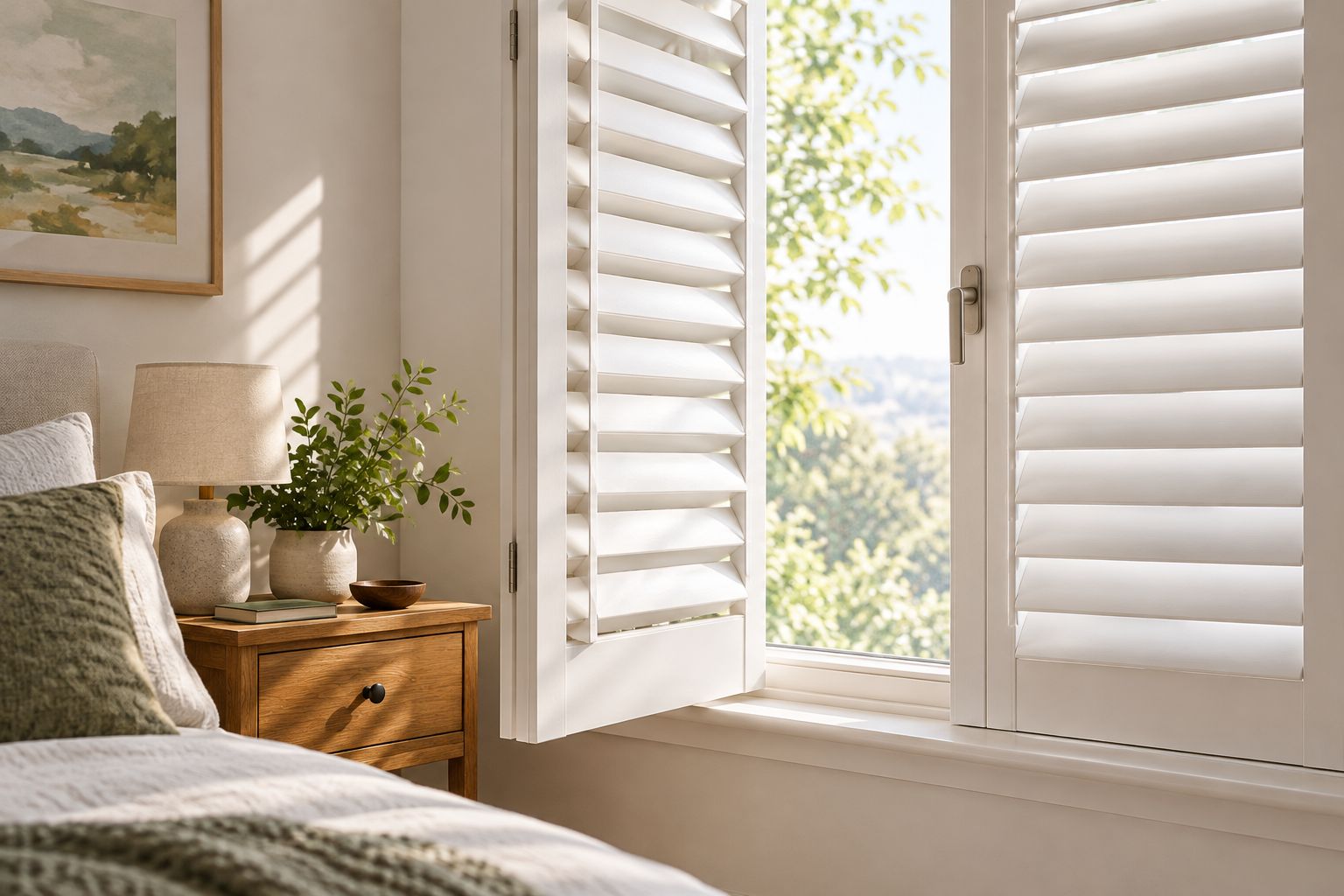
A hinged shutter panel occupies room space as it opens. A blind generally avoids that swing, but its mounting position and raised stack still need checking. Neither choice solves an obstruction simply by being custom-made.
This issue matters in smaller rooms as much as in larger homes. The same clearance question applies to plantation blinds for apartments: a treatment needs to operate around furniture, not just fit the glass.
Ask the installer to demonstrate the proposed movement beside a sofa arm, bedside table or desk. Leave the furniture where you normally use it for that discussion. An empty wall gives a misleading impression of available space.
Also discuss cleaning access. You need to reach the glass, frame and operating parts without making routine upkeep an awkward furniture-moving job.
How should you choose room by room?
You do not need the same treatment at every window. Match the operation to each room, then coordinate finishes where adjoining spaces are visible together.
- Living room: decide whether your priority is a framed appearance, glare adjustment or opening up the view. Shutters suit the framed look; blinds suit frequent lifting.
- Bedroom: start with nighttime privacy and light gaps. Neither slatted option automatically meets a blackout requirement.
- Kitchen: check handles, faucets and the distance between the treatment and nearby work surfaces. Confirm that the selected material suits the location.
- Home office: test the angle of light at your usual seat. A treatment needs to reduce distracting glare without forcing you to keep the room dark.
For a 2026 whole-home plan, choose 1 priority window to explain first. Show what bothers you there, how you currently operate the covering and what you want to change. That gives the consultation a practical starting point.
Then repeat the same questions elsewhere. Avoid copying a solution into another room just because the windows look similar from outside.
What should you ask during an in-home consultation?
Olsson Smart Shades offers custom-measured plantation shutters and blinds with professional installation for Columbus and Central Ohio homeowners. The benefit is having the treatment considered against your actual opening; the limitation is that a made-to-fit order still requires clear decisions about operation, finish and layout.
When you request a quote, describe the rooms and your main concern: privacy, glare, appearance or ease of use. You do not need to settle on a product before asking how the options fit.
During the visit, ask:
- Where will the frame or headrail sit?
- What changes when the treatment is fully open?
- Can I reach every control comfortably?
- Will the window and its handles remain usable?
- What exactly does the written installation scope include?
Approve the layout and operation before treating the color choice as final. A finish is easy to admire on a sample; clearance and access need checking at the window.
FAQ
What's better for my home, plantation shutters or blinds?
Plantation shutters are better for a framed, built-in appearance; blinds are better when you want lift-up operation. Check furniture clearance, window access and privacy before choosing.
How do I compare the cost of shutters vs blinds?
Compare written fitted quotes for the same windows and installation scope. Check materials, mounting, controls, removal and fitting rather than comparing product descriptions alone.
Do plantation shutters make a bedroom completely dark?
Plantation shutters do not guarantee complete darkness. Light can enter around louvers and frames, so discuss light gaps separately if blackout is your goal.
Can I open my windows with plantation shutters installed?
Window access depends on the shutter layout, handles and available clearance. Have the installer demonstrate both panel movement and window operation before you approve the design.
Are blinds easier to move out of the way?
Horizontal blinds raise above much of the glass without hinged panels swinging into the room. A stack remains near the top, so confirm how much of the window it covers.
Can I mix shutters and blinds in the same house?
You can mix shutters and blinds to suit different rooms. Coordinate finishes where rooms connect, but choose operation around each window's daily use.
Who can measure shutters and blinds in Columbus and Central Ohio?
Olsson Smart Shades provides custom-measured plantation shutters and blinds with professional installation for homeowners in Columbus and Central Ohio. Describe your rooms and priorities when requesting a quote.
One last thing
Compare the open position as carefully as the closed position. A shutter's panel swing and a blind's raised stack become most obvious when you want the covering out of the way.
Before ordering, stand at your usual seat and picture the treatment fully open. Then check the handle, nearby furniture and view. That simple check can settle a choice that finish samples cannot.