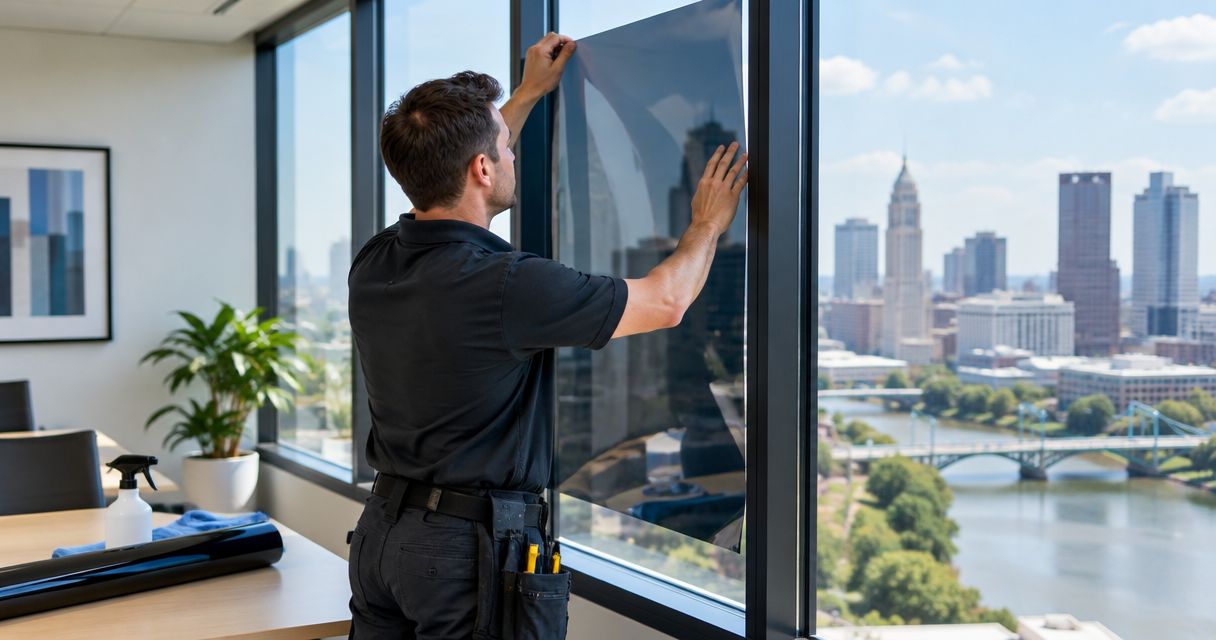
Commercial window film cost in Columbus depends on the measured glass area, the film selected, and the installation scope, so use a written, site-specific quote for your 2026 budget. Check whether the total includes surface preparation, removal of existing film, access equipment, and cleanup—not just the film itself.
- Commercial window film cost Columbus comparisons need matching glass measurements, film specifications, and installation scope.
- Solar-control film, privacy film, and safety film solve different problems; compare the purpose before the total.
- Ask for preparation, removal, access, and cleanup to be addressed in writing.
- Olsson Smart Shades serves Columbus and Central Ohio homeowners seeking custom-measured, professionally installed window treatments.
How much does commercial window film cost in Columbus?
The useful number is the installed total for your actual windows, not a general figure applied to every building. Ask each installer to quote the same glass, the same performance goals, and the same preparation work. Otherwise, the totals describe different jobs.
Start with a room-by-room scope. Identify the windows causing glare, the glass requiring privacy, and any existing film that needs attention. The commercial window treatments guide for office managers provides a broader starting point if you have not yet settled on film.
For a 2026 project, request this breakdown before approving work:
| Quote component | What to have written down | Why it matters |
|---|---|---|
| Glass area | Measured area and individual panes included | Confirms that competing proposals cover the same windows |
| Film specification | Manufacturer, product identification, and intended function | Prevents unlike films from being treated as equivalent |
| Preparation | Cleaning, adhesive removal, and existing-film removal | Makes the starting condition part of the agreement |
| Installation | Application surface, access requirements, and occupied-space arrangements | Defines how the work will happen |
| Completion | Cleanup, inspection, and care instructions | Establishes what happens before handover |
| Exclusions | Work, materials, or repairs not included | Keeps omitted items visible before approval |
A short proposal is not automatically a bad proposal. It still needs enough detail for you to understand what you are accepting.
Why this matters
Film changes the glass for every hour it remains installed. You cannot raise it like a shade when you want a clearer view or more daylight. That makes the product choice just as important as the installation total.
An office with afternoon screen glare has a different brief from a glass meeting room needing visual privacy. A storefront concerned about glass retention has another brief again. Choose the problem first, then compare proposals built to solve it.
For your 2026 budget, separate the required outcome from the preferred appearance. Write down what staff need to do comfortably in the room, then evaluate samples against that task.
Solar-control film: best for persistent sunlight and glare
Solar-control film is designed to change how glazing handles incoming sunlight. Product specifications differ, so compare visible light transmission, solar performance, and appearance rather than choosing by shade alone. Darker-looking glass is not a complete performance specification.
The benefit is a fixed treatment that does not require someone to lower a covering. The trade-off is that its effect on daylight and appearance remains in place when the sun moves or the weather changes.
Ask the installer to identify the proposed product and explain its suitability for your existing glass. Have the glass type checked before installation; film selection is not independent of the glazing beneath it.
Recommendation: choose solar-control film when you want a fixed treatment and the proposed sample preserves enough daylight for the room. Do not select it solely because a sample looks comfortable under showroom lighting.
Privacy film: best for obscuring selected sightlines
Frosted or patterned privacy film can obscure views through interior glass partitions and other suitable glazing. It is useful when the goal is visual separation rather than an adjustable view outside. The trade-off is straightforward: obscuring glass also changes your own view through it.
Reflective film needs a different conversation. Its privacy effect depends on relative lighting conditions, so daytime results do not establish what people can see after dark. Ask to evaluate the proposed approach from both sides of the glass.
For meeting rooms, consider whether full coverage is necessary. A defined privacy band and full-pane treatment create different sightlines and should be specified separately.
Recommendation: use an obscuring finish when dependable visual separation matters more than a clear view through the treated area. Have the intended coverage marked on the proposal.
Safety and security film: best for a defined glass-retention goal
Safety and security films are intended to help hold broken glass together. They do not make ordinary glass unbreakable, and a film-only description does not establish the performance of the complete window assembly.
Ask what the proposed system includes, how it connects to the surrounding frame where required, and what published testing supports the stated purpose. Keep those questions separate from glare and privacy requirements. A solar-control benefit is not proof of security performance.
The benefit is a treatment directed at a specific glass-retention need. The limitation is that results depend on the complete installation and the conditions it was designed to address.
Recommendation: specify the security objective before requesting this category of film. For a formal building requirement, involve the person responsible for that requirement rather than relying on a product label.
How do film and shades compare?
Film and shades are not interchangeable. Film treats the glass; shades provide a movable covering. A room needing a clear view at some times and reduced daylight at others deserves an adjustable option in the comparison.
| Option | Best for | Main advantage | Main limitation |
|---|---|---|---|
| Solar-control film | Fixed sunlight management | Works without daily adjustment | Its daylight effect cannot be raised out of the way |
| Obscuring privacy film | Selected areas needing visual separation | Covers defined sightlines | Reduces the view through the treated area |
| Safety and security film | A specified glass-retention objective | Addresses a different need from ordinary shading | Requires system-specific evaluation |
| Adjustable shades | Rooms with changing light needs | Can be opened or lowered | Require operation and a suitable mounting arrangement |
Do not assume either category solves every problem. For example, a treatment chosen for daytime glare should not be accepted as proof of nighttime privacy or presentation-room darkness.
Why commercial window film quotes vary
Commercial window film proposals vary because both the material and the work change from building to building. For a fair 2026 comparison, ask each installer to address these factors:
- Glass area and layout. Record pane dimensions and locations, not just the number of windows. Different layouts create different cutting and installation work.
- Film specification. Identify whether the proposal addresses solar control, visual privacy, glass retention, or a documented combination of functions.
- Existing conditions. Tell the installer about old film, adhesive, damaged glazing, or other surface concerns. Ask what preparation is included.
- Access. Identify furniture, tall glazing, restricted areas, and any equipment needed to reach the work safely.
- Scheduling. Describe occupied rooms, customer-facing areas, and any restrictions on when work can happen. Have the proposed working arrangements written down.
- Installation details. Confirm coverage boundaries, the application surface, edge details, and any attachment requirements relevant to the selected system.
These are scope questions, not reasons to accept an unexplained total. Ask the installer to connect the proposed work to the conditions in your building.
How do I prepare for an accurate quote?
You do not need to diagnose the glass yourself. You need a clear description of the problem and enough information for an installer to inspect the right windows.
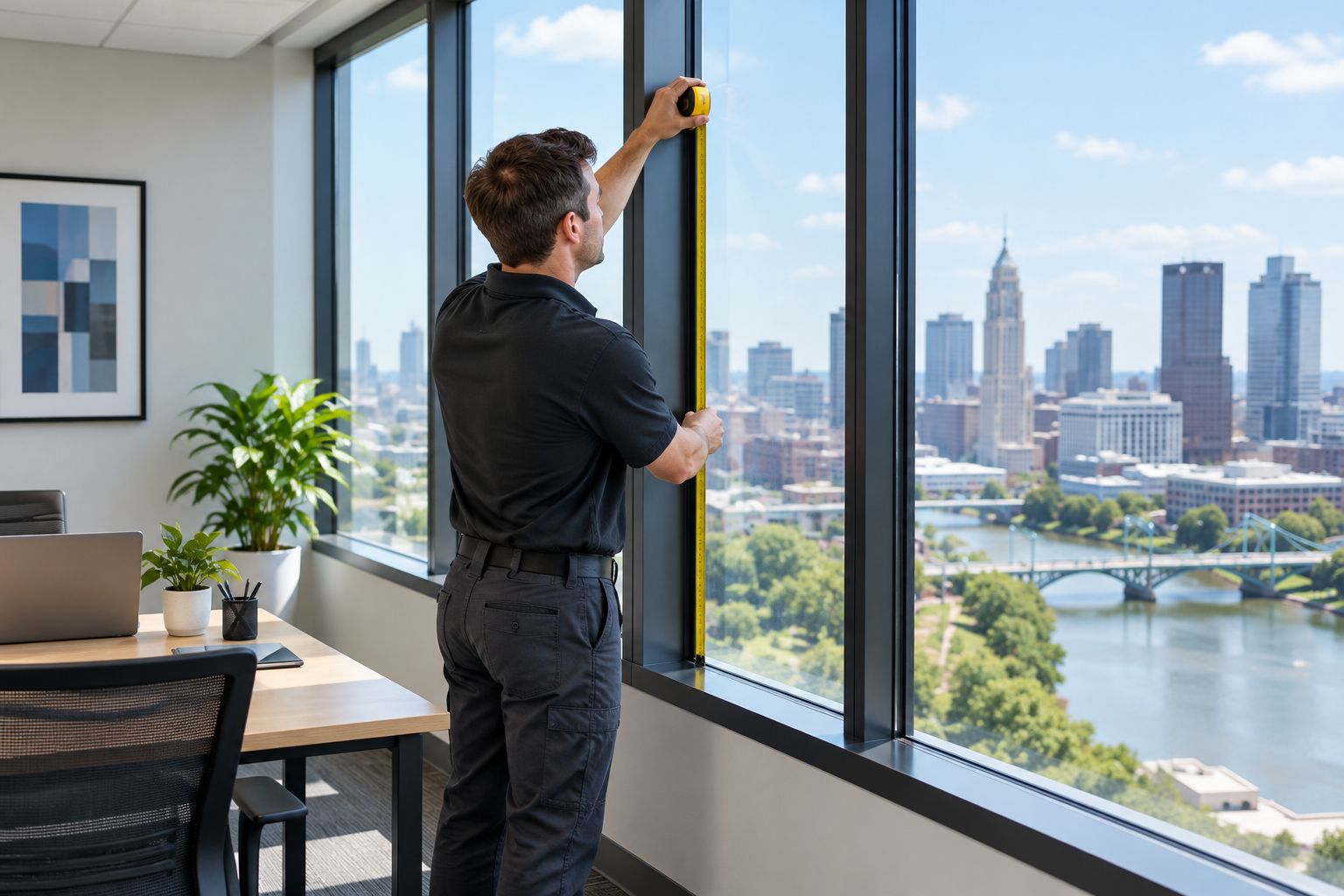
Record 3 measurements for each rectangular pane
Record approximate width, height, and the height of the pane above the floor. Label your units consistently and identify each location. These notes help describe the project; let the installer confirm the final installation measurements.
Photograph the whole window and the surrounding room. A close-up of glass alone does not show desks, doorways, ceiling height, or other access conditions.
Check 2 viewing conditions
Look through the glass during daylight and after dark, with normal interior lighting in use. Note whether the concern is looking in, looking out, reflections, or visibility of screens and work surfaces.
For sunlight complaints, also record when the problem occurs. A description such as afternoon glare on a particular desk gives the installer a more useful brief than asking for the darkest film.
Complete 4 quote checks
- Match the scope. Confirm that every proposal covers the same panes and treated areas.
- Identify the product. Request the exact film identification and relevant technical information.
- Confirm inclusions. Ask about preparation, removal, access, installation, and cleanup.
- Review exclusions. Resolve anything left for you or another contractor before accepting.
Keep your notes with the proposal. If the scope changes, request an updated written version instead of relying on a verbal adjustment.
Where Olsson Smart Shades fits
Olsson Smart Shades is best for Columbus and Central Ohio homeowners seeking custom-measured, professionally installed window treatments. Its stated offering includes blinds, shades, plantation shutters, drapes, and motorized smart shades. A commercial window film inquiry should begin by confirming whether that specific work is offered.
If your real need is adjustable shading at home, you can request a window-treatment quote. Describe the room, the light problem, and whether you want manual or motorized operation. Ask about arranging an in-home consultation rather than trying to choose everything from measurements alone.
An adjustable covering gives you control over when it is open or closed. The trade-off is a visible treatment with mounting and operating requirements. That distinction matters more than choosing film or shades by name alone.
Discuss your home window treatments
Describe your rooms, privacy needs, and interest in manual or motorized shades.
What should I approve before installation starts?
Approve a sample, its placement, and the written scope before work begins. Look at the sample on the intended glass when practical, rather than judging only a loose piece held in your hand. Existing glazing and room lighting affect what you see.
For a 2026 installation, keep the product identification, accepted proposal, and care instructions together. Ask the installer to explain the curing process, temporary visual effects to expect, and when cleaning is permitted for that specific film.
Do not apply a generic cleaning rule to every product. Follow the selected manufacturer's instructions, and ask how installation concerns should be reported after handover.
FAQ
How do I get a useful commercial window film quote in Columbus?
Get a written quote based on the actual glass, selected film, and installation conditions. Ask for preparation, existing-film removal, access requirements, cleanup, and exclusions to be addressed.
Can I compare commercial window film quotes by window count?
Window count alone is not enough to compare commercial window film quotes. Pane dimensions, film specifications, coverage, and installation conditions also need to match.
Is darker window film always better for office glare?
Darker window film is not automatically the better choice for an office. Compare the product specifications and evaluate a sample against glare, daylight, and view requirements.
Will reflective window film give my office privacy at night?
Reflective window film does not provide dependable privacy in every lighting condition. Evaluate visibility after dark with the normal interior lights on before relying on it for privacy.
Does security window film make glass unbreakable?
Security window film does not make ordinary glass unbreakable. Ask how the complete proposed installation addresses your specific glass-retention objective and what testing supports it.
Should I choose film or adjustable shades?
Choose film for a fixed glass treatment and consider adjustable shades when you need to change light or visibility during the day. Compare the limitations as well as the intended benefit.
Can Olsson Smart Shades help with my home's window coverings?
Olsson Smart Shades provides custom-measured blinds, shades, plantation shutters, drapes, and motorized smart shades for homeowners in Columbus and Central Ohio. Describe your rooms and ask about an in-home consultation or quote; confirm commercial film service separately.
One last thing
Ask every installer to quote the same windows—not simply the same building. A marked window schedule makes omissions easier to spot than a longer sales description. Give each pane a simple identifier and carry that identifier through the proposal and final walkthrough.
Before signing, point to each problem window and ask what will change after installation. If the answer does not match your original goal, resolve the product choice first. A clearly defined job is the right starting point for a useful budget.